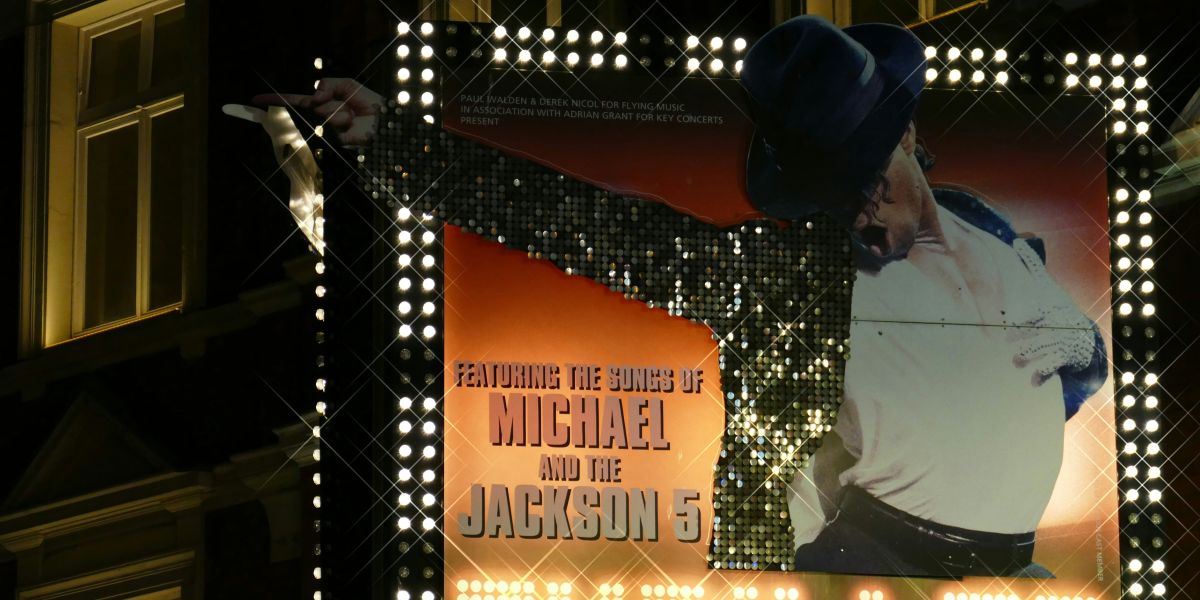

NEW YORK — Before a single ticket was scanned at theaters across the country, the campaign for Michael — Lionsgate’s highly anticipated biographical film about the King of Pop — was already making moves in Manhattan.
In early April, weeks ahead of the film’s April 24 release, Complex transformed its SoHo store at 620 Broadway into an immersive pop-up gallery in partnership with Lionsgate. The curated space showcased props from the film alongside artwork celebrating Michael Jackson’s catalog, with guests enjoying specialty cocktails, DJ sets spinning Jackson’s most iconic tracks, and a surprise appearance from Jaafar Jackson — the King of Pop’s nephew and the film’s lead — in the title role.
At the center of the activation was a technical look at the production design spearheaded by the film’s costume department, including the Crystal Glove — a hand-stitched iteration designed for the film’s performance sequences — along with the iconic Thriller red leather jacket and the 1984 military jacket, a tribute to Jackson’s dominance at that year’s Grammy Awards.
Artist Dimithry Victor debuted a custom piece specifically inspired by Jackson’s biggest hits, utilizing Jackson’s iconic silhouettes as a canvas for abstract textures — reinforcing the film’s positioning as a contemporary cultural event rather than a standard historical retrospective. The gallery ran April 3 through April 5, drawing fans, culture watchers, and press in the days leading up to the worldwide release.
New York, as it often does, served as the proving ground. And the results that followed were historic.
Record-Breaking Numbers at the Box Office
Michael opened to $97 million domestically and $217 million globally in its first weekend of release — setting the record for the largest debut of any biopic in history, surpassing the record previously held by Universal’s Straight Outta Compton, which opened to $60 million in 2015.
The film also notched the second-biggest debut of the year, behind April’s The Super Mario Galaxy Movie, which opened to $131 million.
As of April 28, 2026, Michael has grossed $105 million in the United States and Canada, and $122 million in other territories, for a worldwide total of $227 million.
IMAX rang up $24.4 million worldwide, marking the format’s biggest debut for a musical biopic, with $13.8 million coming from 427 North American screens. The premium large-format push was a deliberate strategy — and it paid off in a city where IMAX screens fill fast and audiences expect spectacle.
Audiences Disagreed With Critics — Loudly
The film’s opening weekend told a complicated story about who critics write for and who actually buys tickets. Michael holds a 38% critics score on Rotten Tomatoes, with the site’s consensus describing the film as a ‘greatest hits album that could’ve benefitted from including liner notes.’ Reviewers pointed to the film’s decision not to address the child sexual abuse allegations made against Jackson during his lifetime — a choice that was, in fact, legally mandated after producers discovered a clause in a settlement agreement that barred depiction of the accuser in film or television.
Audiences, however, told a different story entirely. The film earned a 96% audience score on Rotten Tomatoes — the highest ever recorded for the genre — alongside PostTrak exit scores in the low 90s and a definite recommend rate of 85%, levels that are rarely seen. One source close to the production told Deadline, “Something special is happening. People are dancing in the theaters.”
Streaming Numbers Follow the Momentum
The cultural wave extended well beyond theaters. According to Luminate, an industry data and analytics company, streams of Jackson’s catalog jumped 95% in the U.S. over the opening weekend compared with the same dates the previous weekend. Jackson received 31.7 million streams on April 24 and 25 alone.
The film’s social campaign amplified everything. Flash mob “Don’t Walk, Moonwalk” dance activations transformed city intersections in 20 markets globally into live performance moments, generating 23.4 million domestic views. A first-of-its-kind HBCU marching band initiative reinterpreting Jackson’s music through a cultural lens yielded 8.4 million additional views across social platforms. In total, the Michael social campaign has generated 564 million views to date.
What It Means for Lionsgate — and for New York’s Entertainment Ecosystem
The opening marks Lionsgate’s largest debut since the pandemic and its sixth-biggest ever, behind four Hunger Games installments and the final Twilight film. For a studio that has navigated years of uncertainty in a shifting theatrical landscape, the result is a proof of concept: event films built around genuine cultural icons — marketed with the kind of city-rooted, experiential strategy that Complex and Lionsgate executed in SoHo — can still move the needle in ways that pure digital campaigns cannot.
New York did not just show up for Michael. It helped build the moment. From the NoHo gallery that gave fans their first physical connection to the film weeks before it opened, to the IMAX screens packed across the boroughs opening weekend, the city functioned exactly as it has for decades — as the place where cultural movements get their footing before they go everywhere else.
Lionsgate is expected to greenlight at least one more film about Jackson’s life, and if the Bohemian Rhapsody model holds — that film opened to $51 million before reaching $910 million worldwide — the studio has reason to believe the story is only getting started.