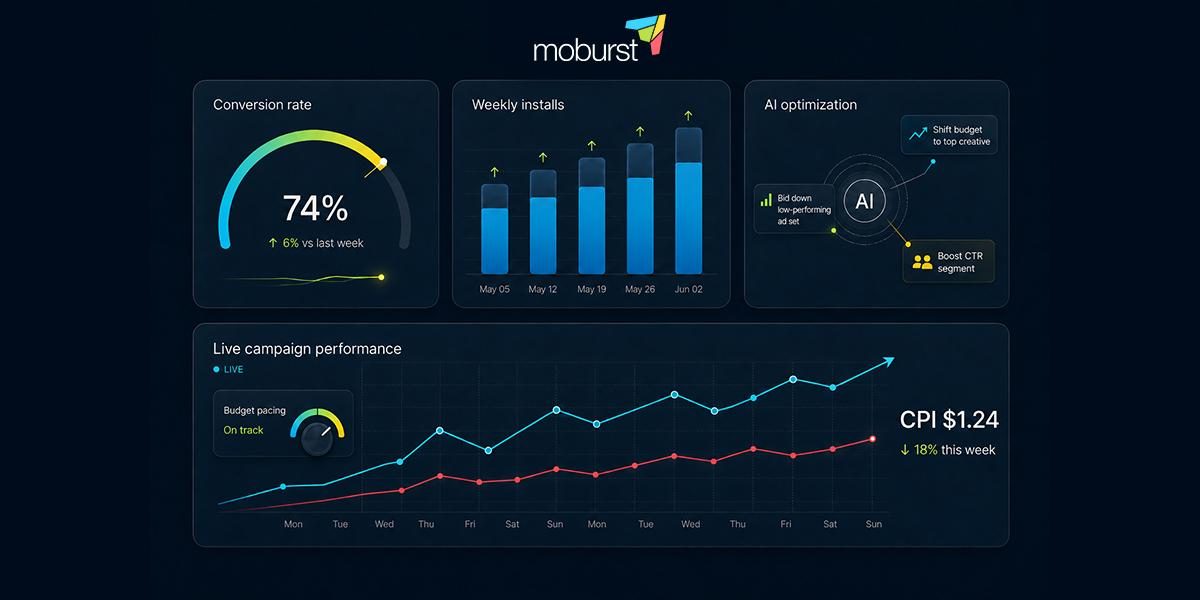

Digital marketing stopped being a single-channel activity years ago. It now runs as a connected system. Search, app stores, social feeds, and video platforms feed into one another. The result is constant measurement pressure. Campaigns are no longer evaluated after launch cycles. They are adjusted while running. Numbers decide direction quickly, sometimes daily.
Budgets move the same way. If a channel underperforms, spend shifts. If conversion improves, it scales. This has made marketing less about planning in isolation and more about continuous correction inside live systems. Agencies now operate inside that pressure loop rather than outside it.
Moburst was founded in 2013 in Israel by Gilad Bechar and Lior Eldan. It started with mobile growth work. App Store optimization. User acquisition. The early focus was narrow because the market was narrow. Apps needed visibility inside stores, where ranking determined traffic. That was the core problem at the time.
In 2014, the company opened a New York office. That shifted operations into the United States and expanded its client base. Over time, more offices followed in San Francisco, Tel Aviv, Denver, Orlando, Miami, and London. The footprint matters less as branding and more as operational distribution. Campaigns run across time zones now. Work never really pauses.
The company’s structure changed as digital systems evolved. Marketing stopped being separate from measurement. Performance analytics became central. Cost-per-install, conversion rates, retention data. These were not reporting metrics sitting on slides. They became steering inputs. Campaigns are adjusted based on live behavior rather than end-of-month summaries.
There is a difference between tracking and acting. Most agencies track. Fewer actually change direction during campaigns. That gap is where performance marketing now sits.
By 2021, Moburst operated across more than twenty marketing disciplines. That included paid media, SEO, influencer marketing, video production, analytics, and development services. The expansion was not cosmetic. It reflected that campaigns had begun to require multiple skill sets simultaneously. One channel rarely works alone anymore.
A user might see an ad on social media, later search the brand, land on a page, and then install an app. Each step is part of the same system. If one step breaks, the entire funnel shifts.
That is where multi-channel execution became standard. App-store campaigns tied to paid social. Paid social tied to landing pages. Landing pages tied to product design. This is where product development was introduced into the structure. Web and mobile builds were no longer external services. They became part of campaign delivery itself.
The separation between marketing and product began to blur. Small product changes affected the acquisition cost. Small marketing changes affected retention. The feedback loop tightened.
Machine learning entered during the early 2020s, not as a replacement for strategy, but as a support layer. Audience targeting became more automated. Media buying systems began adjusting bids based on performance signals. Some optimizations moved faster than human teams could react manually.
Creative testing cycles are also shortened. Variants could be pushed faster. Results came in quicker. Underperforming assets were removed earlier. The goal was not automation for appearance. It was speed inside competitive ad environments.
Artificial intelligence followed a similar path. It was used in campaign optimization and targeting refinement. Large datasets on user behavior were analyzed to identify patterns in acquisition efficiency and engagement. That information fed back into campaign decisions. Some actions became system-recommended. Others stayed manual. Both operated together.
The shift did not remove human input. It compressed the reaction time.
At the same time, analytics became more layered. The data did not come from a single source. It came from app stores, ad platforms, web behavior, and product usage. These streams were combined into unified performance views. That allowed campaigns to be adjusted based on multiple signals at once.
Nothing about this system is stable. App-store algorithms shift. Social platforms change ranking logic. Advertising costs fluctuate without warning. What works in one quarter may not work in the next. The response is continuous adjustment through analytics loops rather than fixed campaign planning.
Moburst’s model sits inside that environment. Marketing execution is linked with product development and performance measurement. A change in onboarding flow can affect acquisition cost. A change in ad creative can shift retention rates. These connections are operational, not theoretical.
That is the core shift. Marketing is no longer isolated communication. It is part of product behavior.
Moburst continues under Gilad Bechar and Lior Eldan. Its trajectory reflects broader changes in digital marketing structures. Agencies no longer function as single-service providers. They operate as systems that combine data, execution, product development, and automated optimization into one workflow.