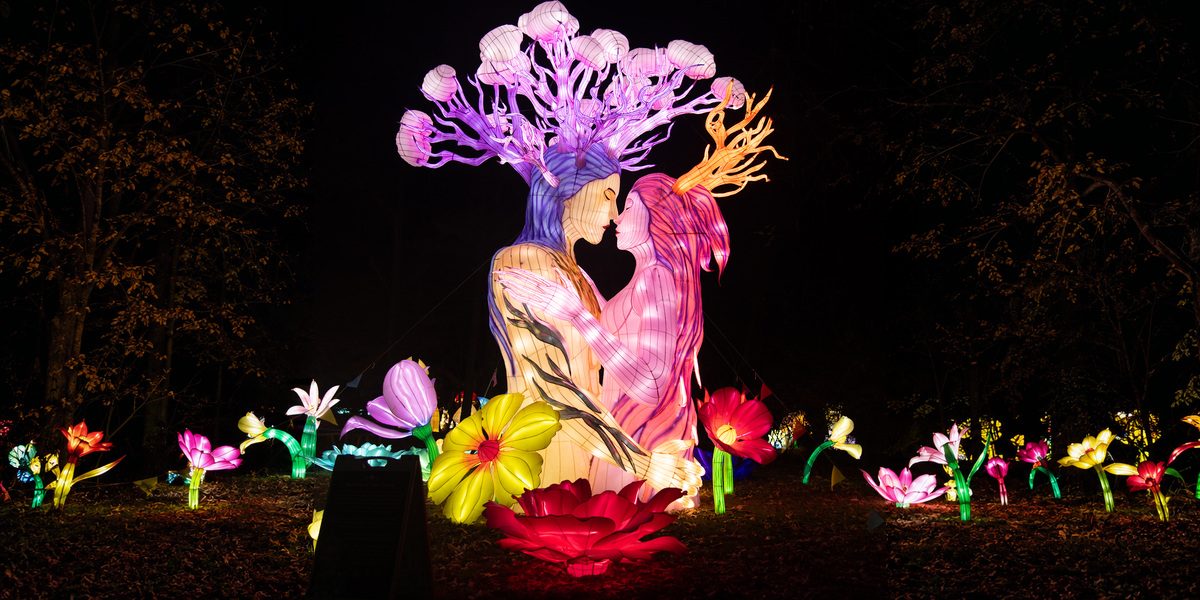

The Chief Artist of Kaleido Arts & Entertainment Group designs every lantern and every festival layout, bringing the craft of his native Sichuan to parks, zoos, and waterfronts across the United States.
In September 2026, the Autumn Glow Festival opened at Glen Island Park in New Rochelle, New York. Chinese lantern sculptures occupied a setting familiar to local families: a waterfront park on Long Island Sound. For Yu Wang, Kaleido’s Chief Artist, the location was part of the appeal. In published remarks about the opening, he pointed to the waterfront, the park’s trails, and its proximity to New York City as reasons the festival belonged there.
The choice of setting says something about the work Wang does. He creates all of Kaleido’s lantern designs and is responsible for the artistic layout of every festival venue. The sculptures and the spaces between them are part of the same assignment. He decides what visitors will see and how the works will sit together in a place that already has a character of its own.
That scope of authorship is easy to overlook once a festival opens. Visitors see the finished lanterns. Behind them is a series of decisions that begins with a drawing and extends across an entire site. Wang’s work gives those decisions a consistent direction, even when the venues are thousands of miles apart.
A craft with roots in Sichuan
Wang comes from Sichuan, home to Zigong’s celebrated lantern tradition. A 2025 newspaper account featuring him recalled his childhood memories of the crowds at Zigong’s festivals. Years later, he was watching American children respond to giant illuminated figures at an exhibition in Louisiana. The setting had changed. The excitement was familiar.
Zigong’s lantern culture has a substantial history behind it. The lantern festival was added to China’s national intangible cultural heritage list in 2008. The traditional craft of making Zigong lanterns received provincial heritage recognition the year before. Large groupings of lanterns, often based on literature, folk customs, or mythology, are among the tradition’s defining features.
The craft involves close attention to how a form behaves when illuminated. A frame establishes the shape, fabric gives it a surface, and light changes the way both are perceived. Color must work after dark. A figure needs to be readable at a distance and convincing when approached. In a group of figures, their proportions and relationships determine whether a scene holds together.
For Wang, carrying this tradition into new work means making those judgments repeatedly, across different subjects and scales. The knowledge remains in use because new designs call for it. His contribution to its continuation is practical. He creates the works through which American audiences encounter the craft, then designs the setting in which they will experience it.
Responsibility for the whole exhibition
Wang’s position at Kaleido gives him responsibility for both the individual object and the complete exhibition. Each lantern design originates with him, as does the artistic arrangement of each venue. That allows the character of the work to carry through from an individual sculpture to the festival around it.
The two tasks place different demands on a designer. A lantern can be studied as a single composition, with its own silhouette, colors, and details. A venue has to accommodate many such works without losing a sense of order. Their placement affects what draws the eye first, which pieces are seen together, and where a change of scale or subject occurs.
At this level, design concerns the visitor’s experience over time. An installation viewed from across an open space makes a different impression from one discovered at a turn in a path. A succession of large pieces can lose its effect without changes in pace. These are the kinds of spatial problems contained in Wang’s responsibility for the entire layout.
The finished lanterns also depend on the skill of the craftspeople who build them. Wang supplies the original designs and the overall artistic direction within which that work takes place. His contribution is identifiable across the project, connecting the production of separate pieces to a complete visual plan.
Giving unfamiliar stories a way in
An American visitor does not need to know a Chinese legend before enjoying a lantern scene. But the design can give that visitor a reason to learn more. This is an important part of the cultural work carried by Wang’s exhibitions.
Coverage of Kaleido’s American tour has described a scene based on the Butterfly Lovers, the Chinese story of Liang Shanbo and Zhu Yingtai. Figures and butterflies offer an immediate visual introduction. The story behind them gives the scene another dimension for visitors who choose to explore it.
Presenting such material calls for judgment about how much an image can communicate on its own. A composition must catch the attention of someone walking past while preserving details that belong to the story. The goal is an encounter that feels welcoming without making the cultural subject indistinct.
This matters in a family setting, where people arrive with different levels of knowledge and interest. One visitor may recognize the narrative. Another may first notice the colors or the construction. The same artwork has to allow room for both responses. Wang’s responsibility for the imagery and its placement gives him a direct role in shaping that introduction to Chinese culture.
Different places require different designs
Kaleido’s 2026 program brought Wang’s work into several kinds of American public space. At Noccalula Falls Park in Gadsden, Alabama, the Spring Lantern Festival was scheduled from February 13 through April 5. Handcrafted displays appeared alongside activities associated with a family visit to the park, including train rides and live performances.
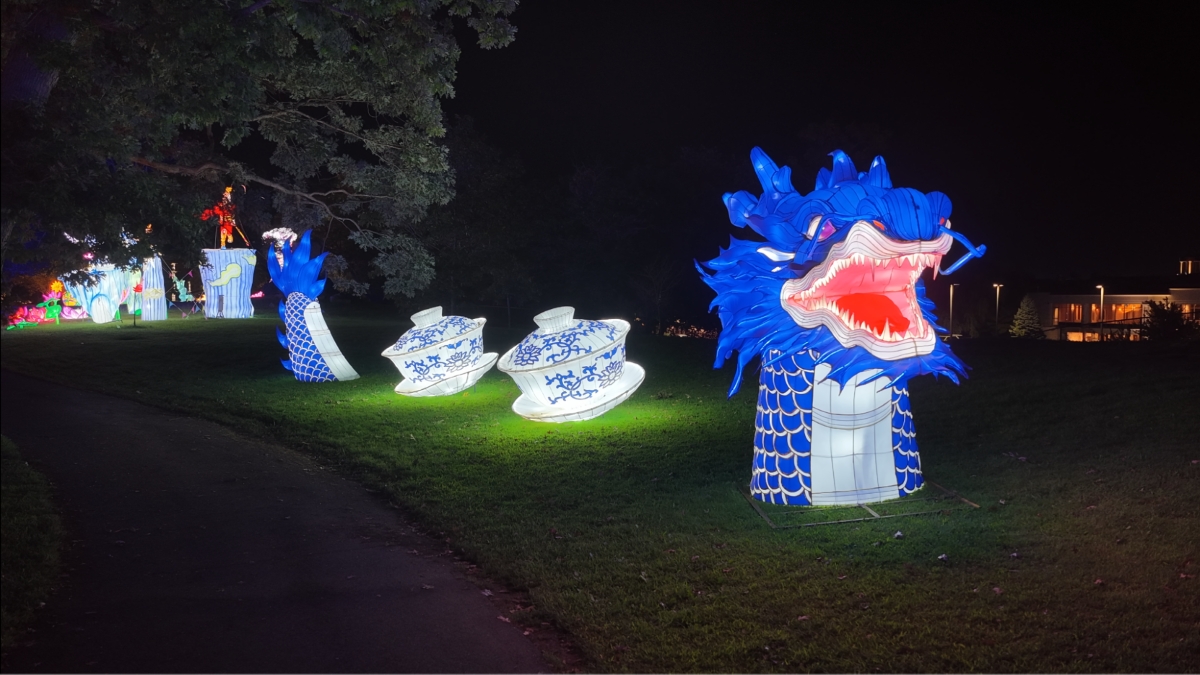
In Illinois, Glow Wild returned to Peoria Zoo during the spring, giving visitors an evening experience on grounds usually associated with a daytime outing. By September, Autumn Glow was welcoming audiences to Glen Island Park in New Rochelle. There, the waterfront supplied a very different backdrop.
As the creator of the lantern designs and the layouts for these venues, Wang has to account for those differences. A zoo, a park, and a waterfront cannot be treated as interchangeable exhibition halls. Each has existing features that influence the way an artwork is seen. The arrangement needs to make sense within the location, as well as within the exhibition’s theme.
This is where localization becomes concrete. It involves the relationship between an artwork and the place around it, including the audience’s familiarity with that place. A visitor who already knows a park can return to find it changed by an exhibition whose artistic origins lie in Sichuan.
For Wang, the opportunity to introduce Chinese culture is embedded in that familiar outing. People come with their families, walk through a place they recognize, and encounter an art form they may never have seen at this scale.
An anniversary year and the question of belonging
America’s 250th anniversary in 2026 gives this work a timely context. Across the country, commemorations have brought renewed attention to the ways history and local identity are presented to the public. Lantern art offers an unusual medium for considering those subjects.
American historical imagery, regional landscapes, and community stories could all be interpreted through Chinese lantern craftsmanship. Such possibilities are relevant to Wang’s practice, which already brings that craft into American settings. An anniversary exhibition would require careful choices about the stories being told and the people represented, as well as close collaboration with the host community.
It would also need an artist able to connect those choices to the design of individual works and an entire site. Wang’s existing responsibility across both areas gives his practice particular relevance to that challenge. The same questions of proportion, sequence, and setting would shape how a historical subject reached its audience.
The anniversary also draws attention to the role of artists working across cultures. They bring methods and traditions that can expand the visual language of a public celebration. In Wang’s case, the medium carries a recognizable Chinese history, while the setting invites an American community to encounter it on familiar ground.
More broadly, his work raises a useful question about cultural belonging: how does a tradition from one country become part of another community’s experience? At Kaleido’s festivals, the answer begins with an actual place and an audience willing to spend an evening there.
Wang’s contribution is specific. He creates the lanterns that the audience encounters and designs the setting that brings them together. Across the different locations, his authorship provides continuity while his layouts respond to the place at hand. The result is a growing body of public-facing work through which Chinese lantern craftsmanship enters American life, one exhibition and one local audience at a time.