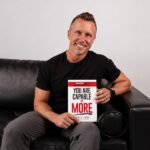

By: Sarah Linden
Daniel Cohen-Dumani built his first company with server racks and an office lease. Twenty-two years later, he started his second with a laptop and a credit card, and a theory about why the best time to found a company might be after 30 years of career.
The first time Daniel Cohen-Dumani started a company, the to-do list read like a construction project. An office lease, signed before the first client. Server racks humming in a closet. A phone system, a hiring plan that ran ahead of revenue, and the quiet arithmetic of receivables that every founder of that era learned to do at 2 a.m. It was 2002, and that was simply what building a business cost.
The second time, in 2024, he needed a laptop and a credit card.
“Everything about building has changed,” Cohen-Dumani wrote recently to the audience that follows his commentary on entrepreneurship and AI. “Except the hard part. That’s still you.”
Cohen-Dumani belongs to a cohort that the mythology of startups keeps overlooking: the second-act founder, deep into a successful career, who walks away from the safest seat they have ever held to start again from nothing. The popular image of a founder remains a twenty-something in a hoodie. The reality he represents is a computer science graduate who began consulting in Switzerland at the firm now known as Accenture, built the technology consultancy Portal Solutions from a team of one to 60 over fifteen years, sold it to a large accounting firm in 2017, and stayed on to lead work inside an organization of 2,000.
The first act taught him lessons the hard way, and the job itself kept changing as it did. Somewhere past ten people, his hands left the product; success stopped meaning the work was excellent and started meaning the team was. Past thirty or forty people, even leading everyone directly stopped working, and the role became designing the systems that ran without him: who the firm hired, how it decided, what it tolerated, what it celebrated. “Nobody promotes you to founder twice,” he says of those transitions. “You relearn it live.” Companies that stall, he has come to believe, are usually not out of market. They have a founder stuck in a job the company outgrew.
It is what happened after the sale that he talks about with unusual candor. “Everyone congratulates you,” he says of the exit. “Nobody warns you.” The morning after signing, the thing that had organized his identity for fifteen years had someone else’s name on it. He describes the feeling not as regret but as something closer to unemployment of purpose: successful by every measure he used to use, and quietly a little lost. The advice he now gives founders approaching their own exits is to know what the next mountain is before coming down from this one.
His next mountain announced itself in November 2022, within days of ChatGPT’s public launch. From his seat inside professional services, Cohen-Dumani concluded that the industry he had spent three decades in was going to be transformed, with or without him. “I’d rather be in the disruption seat than the disrupted one,” he says. He gave notice six months later and founded Experio, which builds what it calls organizational memory for professional services firms: AI designed to help a firm find and use decades of its own expertise quickly.
Leaving looked like the risky choice. He argues the opposite. The executives who see their industry’s disruption coming, he says, are holding the rarest asset in business: deep knowledge of the problem, paired with advance warning. Most spend it worrying. “Watching your industry change without you is the most expensive seat in the house.”
He has watched that dynamic play out across four technology waves in thirty years: the web, the cloud, mobile, and now AI. Each time, he says, the loudest voices drowned first, the overnight rebrands and the end-of-everything predictions rarely surviving their own hype cycle. The winners looked boring while it was happening. They picked one real problem the new technology finally made solvable, went deep instead of wide, and shipped. When the noise died down, they owned the next decade. AI, in his estimation, is the largest of the four waves, which means the noise is the loudest and the pattern is exactly the same.
What surprised him most the second time around is how much of the old founder’s burden has simply evaporated. The infrastructure that once took months and serious capital now takes an afternoon. Distribution can be a single post. AI agents handle the routine work that used to require early hires. This past summer, he stepped away from the business for a stretch of real time off, something that was theoretical in 2002, and nothing stopped. Follow-ups happened. Pipelines moved. “Founders get to have lives now,” he says. “That’s new.”
What has not changed, he insists, is the part that filters out most would-be founders at any age. Conviction when nothing works yet. Picking the right problem and staying with it. Asking someone to join you when all you have is a story. The barriers fell; the hard part remained personal.
Age, in his telling, turns out to be an asset disguised as a liability. Experience compounds: thirty years of hiring, selling, and sitting in client rooms shows up in every decision he makes this week. Energy, he says, is a manageable engineering problem of sleep, health, and saying no. “Curiosity is the only thing you can’t fake,” he adds, and it is the real dividing line between people who should found companies and people who should not, at 25 or at 55.
Asked what he would tell his 2002 self, Cohen-Dumani rattles off the list with the ease of a man who has clearly written it down: charge more, hire slower, write things down, take the vacation. And the fear that comes with the leap itself? It never fully goes away, he says. It just changes what it is pointing at. He has stopped reading it as a signal to stop, and started reading it as confirmation that the thing being built matters.
There is also a vulnerability to the second act that he did not expect to become part of the work. When he began sharing three decades of lessons publicly a few months ago, the polished posts about wins did fine. The ones about the messy parts, the morning after the sale, the jobs he was slow to let go of, are the ones strangers write him paragraphs about. His generation of executives was trained never to show the seams, he says, but nobody connects with a highlight reel. “Your polish gives them a standard. Your struggle gives them company.” He intends to keep sharing the seams.
The window for a second act, he wants his peers to know, does not close on schedule. An unfair advantage that took 30 years to build, he argues, would be a shame to retire right when it matters most.