
By: Aman Jalan
An unexpected meeting in Costa Rica connected finance, business strategy, real estate, and regenerative land expertise. The relationships that followed eventually led to the creation of a natural capital development company.
Ronny Castillo and Kimberly Lacayo did not arrive at natural capital from the same direction. Neither did the people who would eventually become their business partners.
Their paths crossed through circumstances no business plan could have scripted.
A group had set out to visit a Costa Rican forest planted decades earlier by attorney Tatiana “Tati” Salgado. When Castillo’s vehicle broke down on the rugged road, he stayed behind while the others continued to the property in Salgado’s aging manual-transmission 4WD, with forester Javier Esquivel squeezed into the jump seat.
Later, the group reconvened at a local restaurant while Salgado and Alain Romero, co-founder of Forests to Fortune, worked on solving the transportation problem. Romero would later reenter the story in a different capacity, with Forests to Fortune working alongside Forests VC as a regenerative silviculture strategic partner.
Castillo found himself sharing local bar food and conversation with Lacayo, attorney Meli Vega, and Costa Rican businessman Marco Zúñiga.
The broken car eventually got sorted out. The relationships lasted, and in time the broader group came back together in Costa Rica to evaluate a real estate opportunity.
That gathering became consequential.
The property helped crystallize what would become Raíz de Oro, a natural capital development project with Castillo as its president. Within weeks, Castillo and Lacayo had formed Forests VC, with an ambition extending well beyond a single property.
Their different professional paths suddenly made considerable sense together.
Castillo brought conventional and regenerative finance. Lacayo brought communications, business strategy, ESG, and corporate social responsibility. Zúñiga contributed Costa Rican business and real estate experience. Around them was a broader team spanning Javier Esquivel’s forestry and silviculture experience, Adrian Vargas’s agronomy and agricultural systems expertise, engineering, law, and decades of hands-on land stewardship.
What emerged was a shared business proposition: undervalued land can contain considerably more productive and economic potential than its current use reveals.
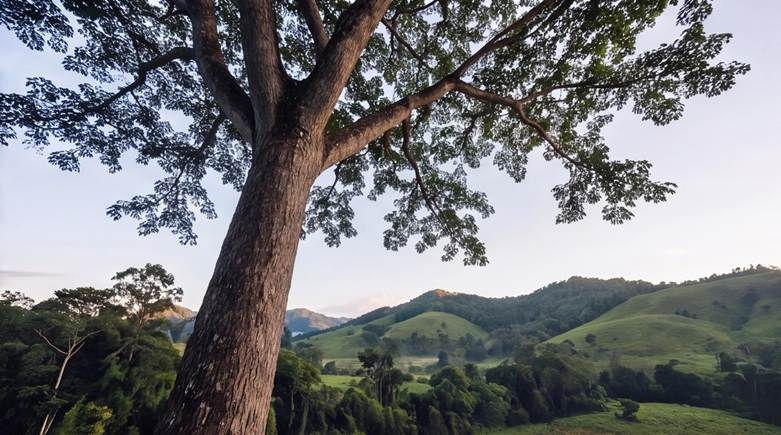
“The question extends beyond what the land is worth today,” Zúñiga says. “It’s what the land could become.”
Forests VC is building an acquisition and development platform around answering that question.
Its FINCA Framework provides a methodology to Acquire, Design, Grow, Measure, Optimize, and Connect natural assets. High-value regenerative forestry can create biological growth with long-duration asset value. Agriculture can provide nearer-term revenue. Processing, circular systems, technology and complementary enterprises can add additional layers of productivity and resilience.
For Lacayo, the opportunity connects stewardship directly with value creation.
“Better stewardship should be one of the reasons the asset becomes more valuable,” she says.
Castillo approaches the same opportunity through capital.
“The challenge isn’t finding capital,” he says. “It’s building natural assets that deserve it.”
The longer-term vision also includes developing creative financial structures that can broaden participation in real-world natural assets, creating new connections between capital, productive land, and the value generated through thoughtful development.
That creates two sides of the Forests VC model: landowners with properties capable of becoming more, and investors seeking differentiated real assets.
The company that emerged from those relationships now intends to make that process repeatable.
Something about the way it began feels fitting.
A failed vehicle interrupted the original journey. The relationships created along the way opened the road to another one.