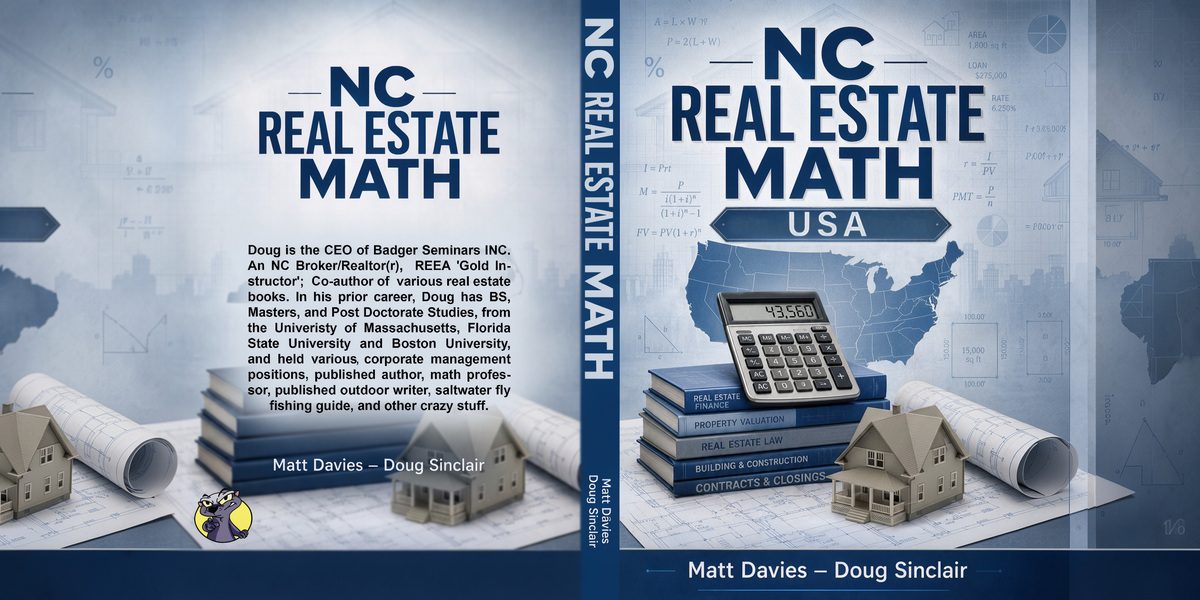

Douglas “Doug” Sinclair, a North Carolina real estate broker, argues in “NC Real Estate Math,” the handbook he co-wrote with fellow instructor Matt Davies, that most of the trouble students have with real estate math begins with how they read a question, not with the arithmetic itself.
For many people preparing for a real estate license, the math section carries an outsized reputation. Sinclair, who taught college mathematics before entering real estate, understands that fear but does not accept it.
“After many years teaching college mathematics, I know how daunting math can be for some people,” Sinclair writes. “It doesn’t need to be.”
The handbook works through 15 sections of examples and practice problems, from lot sizes and excise tax to loan costs, amortization and closing prorations, with step-by-step solutions in the back of the book.
Reading Comes Before Arithmetic
The book’s central lesson is that real estate math has more in common with the word problems students remember from school than with advanced mathematics.
“The key to any mathematics problem is understanding what is being asked,” Sinclair writes. “Real Estate math is not difficult, but it does require following step-by-step what is being asked.”
He advises readers to read each question slowly once, then read it again looking for clues. Does the problem want an answer rounded to the nearest $100? A monthly figure instead of an annual one? A tax rate stated in dollars or in mills? Several examples in the book carry bracketed notes reminding students that the trap was in the wording, not the numbers.
His other recurring advice concerns the calculator. Students are taught to follow the order of operations and enter the whole problem as a single string. “I have found that the biggest error made by students is that they will enter the first part of the problem into the calculator and hit Equals,” he writes.
A Basic Calculator and a 360-Day Year
The handbook is direct about the tools students will have on exam day. Mobile phones and programmable calculators are not allowed, so Sinclair encourages students to practice on a simple calculator that adds, subtracts, multiplies and divides, ideally with a percent key. Badger’s pre-license students receive a calculator with their tuition for that reason.
“Get used to a basic calculator,” he writes.
The book also explains the convention used for pre-license calculations: a “statutory banking calendar” of 30-day months and a 360-day year. That single rule shapes nearly every interest and proration problem that follows.
Numbers Worth Memorizing
Some figures simply have to be known. The most important is the number of square feet in an acre: 43,560.
To make it stick, the book offers two memory aids: four blue-haired ladies driving 35 mph in a 60 mph zone, or Richard Petty’s No. 43 race car tuned to 560 country radio in Daytona Beach. “Find ways to remember this. You must know the number of square feet in an acre,” the authors write.
The Math Behind a Closing
Much of the handbook focuses on calculations brokers see in real transactions. In North Carolina, excise tax, also called revenue stamps, is charged at $1 per $500 of the sales price and rounded up to the next whole dollar. On a $103,250 sale, that comes to $207, and the book reminds students that the seller, not the buyer, normally pays it.
Property tax follows similar logic. North Carolina applies its rate per $100 of assessed value, while many other states use a mill rate per $1,000. A home assessed at $185,500 with a $1.50 rate carries an annual tax of $2,782.50, the same result as a 15-mill rate elsewhere.
The seller net calculation, which brokers use to estimate the minimum price a home must bring, receives careful treatment. A seller who wants to net $25,000, pay off a $121,900 loan and cover $3,500 in costs with a 6% commission must sell for $160,000. The method adds every known expense and divides the total by the percentage left after commission, 94% in that example.
Commission splits are handled the same way, often in a single calculator entry. In one example, a $495,000 sale at a 5% commission, split evenly between two firms and then 80/20 between the broker and her firm, leaves the broker $9,900.
Loans, Points and Prorations
Later sections take on mortgage math. The book explains the 28/36 qualifying ratios used for conventional loans, the rule that one discount point, equal to 1% of the loan amount, lowers the interest rate by one-eighth of a percent, and how to calculate the interim interest a buyer pays at closing.
Prorations come with rules short enough to memorize. For property taxes and HOA dues: “Whoever pays taxes or HOA gets a credit.” For rental property: “Whoever receives rent gets a debit.”
From 200 Copies to a Classroom Staple
The handbook grew out of the classroom. Sinclair and Davies wrote the original workbook together, and many of its examples were later incorporated into the “NC Real Estate Today” textbook. After receiving the NCREEA Program of the Year Award, the two printed 200 copies at Staples and took them to a 2017 conference of real estate educators in Wilmington.
“We didn’t think anyone would buy it, and then they all disappeared,” Sinclair writes. The authors had to buy a copy back because they had not kept one for themselves.
Students kept asking for a separate math publication, which led to the current edition. It was reformatted to be easier to carry, and Badger students worked through it to make sure the explanations made sense and every problem could actually be solved.
The book also puts the exam in perspective. According to Sinclair, the national portion of the license exam includes only seven math questions, and the state portion includes none. The handbook, however, is built around “realistic examples of actual real estate math problems that you will likely encounter as a real estate broker.”
A Teacher’s Path to Real Estate
Sinclair came to real estate after careers in landscape architecture, technology marketing, executive recruiting, and college teaching, including roles as director of marketing for Andersen Consulting and with Prime Computer/Computervision. He began teaching real estate in 2015, launched Badger Real Estate Seminars in 2018, and is a Real Estate Educators Association (REEA) Gold Standard Instructor.
Co-author Matt Davies, who has taught real estate in North Carolina since 2008 and is an active broker, is also a recipient of the Larry Outlaw Award in Real Estate in North Carolina and an author of “NC Real Estate Today.”
“NC Real Estate Math” is available in paperback, hardcover, and e-book editions.
About the author:
Douglas “Doug” Sinclair is a North Carolina real estate broker with Keller Williams and the founder and CEO of Badger Real Estate Seminars in New Bern, North Carolina. A Vietnam veteran and former college mathematics instructor, he teaches all levels of real estate education and has co-authored several real estate books.
Author Name: Douglas Sinclair, Book Title: NC Real Estate Math, Published By: Blue Crown Books