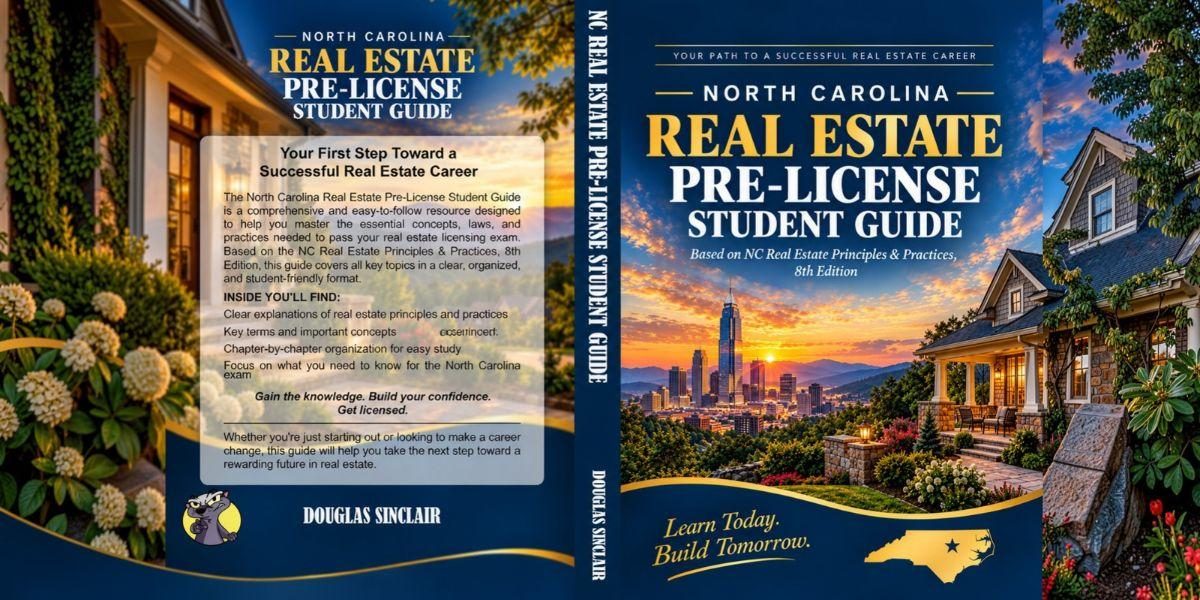

Douglas “Doug” Sinclair, a North Carolina real estate broker, condenses the state’s pre-license course into a focused review in his “Pre-License Student Guide,” written for candidates preparing for both the national and North Carolina portions of the real estate license exam.
The guide follows the 20 chapters of “NC Real Estate Principles & Practices,” 8th Edition, and ends with a section on North Carolina Real Estate License Law and Commission rules. Instead of long explanations, it relies on bold headings, short bullet points and page references back to the textbook, a format built for review rather than first-time reading.
The result reads like the notes a careful student would make after a semester of class: definitions, rules, deadlines and the distinctions most likely to appear on a test.
Knowing Where the Points Are
The guide closes with a breakdown of the exam itself. According to the guide, the national section contains 80 scored questions, with 60 correct answers needed to pass, while the state section contains 60 scored questions, with 40 needed to pass. Each section also includes five unscored pretest items.
The breakdown shows candidates where to spend their study time. Contracts and agency make up 16 national questions, the largest single category, and agency alone accounts for another 16 questions on the state section. On the state side, brokerage practice (12 questions) and other North Carolina laws (11) follow. Real estate math, often the most feared topic, accounts for seven national questions.
Memory Aids for Dense Material
Much of the license course consists of terms and lists that must be recalled precisely. The guide uses short acronyms to make them stick.
A broker’s fiduciary duties become OLDCAR: obedience, loyalty, disclosure, confidentiality, accounting, and reasonable skill and care. The government’s powers over private land become PETE: police power, eminent domain, taxation and escheat. The four unities required for a joint tenancy, possession, interest, title and time, become PITT.
The activities that require a license when performed for others for compensation become LLBEANS: list, lease, buy, exchange, auction, negotiate or sell. To decide whether an item is a fixture, the guide uses IRMA, short for intent, relationship, method of attachment and adaptation, and notes that intent is the most important factor.
The elements of value are summarized as DUST, for desirability, utility, scarcity and transferability. The confidential information an agent must protect becomes PTM: price, terms and motivation.
Where North Carolina Differs
A large share of the guide is devoted to points where North Carolina practice departs from other states, the kind of distinction that can decide a state exam question.
Disclosure is one example. Sellers must provide buyers with the state’s residential property and owners’ association disclosure form, and they may answer “no representation” to its questions. The guide stresses that brokers must still disclose material facts regardless of how the seller answers, even when a property is sold “as is.”
“In NC, all of the burden of disclosure is on the Agent,” the guide states.
It also lists items the North Carolina General Assembly has declared material facts, including polybutylene pipes and synthetic stucco, even if repaired or replaced, as well as meth labs. At the same time, it notes that agents are not required to disclose stigmatizing facts such as a death in the property.
Recording rules receive similar attention. A deed does not have to be recorded to be legal, the guide explains, but under North Carolina’s Conner Act, a later purchaser who records first takes priority. The guide calls it a “pure race” statute.
The Due Diligence Clock
The guide gives close attention to the North Carolina Offer to Purchase and Contract and its due diligence period. During that period, a buyer may terminate “for any reason or no reason,” but only by delivering written notice to the seller before 5 p.m. on the date the period expires. The due diligence fee is paid to the seller and is not refundable except in the case of a seller breach.
Earnest money works differently. The guide notes that it is not required, that it is not a consideration for the contract, and that a broker must deposit it in a trust account within three banking days of an offer’s acceptance.
Life After the Exam
Passing the exam is only the first step, and the guide’s license law section explains what comes next. New licensees begin as provisional brokers and must work under a broker-in-charge. To remove provisional status, the guide explains, they must complete 90 hours of post-licensing education, delivered as three 30-hour courses, within 18 months of licensure.
All licenses expire on June 30 each year, and licensees must complete eight hours of continuing education by June 10 to stay active. The guide also covers trust account rules, advertising requirements and the disciplinary powers of the North Carolina Real Estate Commission, which can reprimand, censure, suspend or revoke a license but cannot fine licensees.
A Guide Shaped by the Classroom
Sinclair has taught real estate since 2015 and founded Badger Real Estate Seminars in 2018. His teaching draws on years of instructing college mathematics students and adult learners, and he is a Real Estate Educators Association (REEA) Gold Standard Instructor.
Before real estate, he worked as a landscape architect, served as director of marketing for Andersen Consulting, held industry marketing leadership roles with Prime Computer/Computervision, and was a principal of an executive recruiting firm. He holds degrees from the University of Massachusetts Amherst, Boston University and Florida State University.
The guide is designed to be used alongside the course textbook rather than in place of it, with many entries pointing students to specific pages for fuller explanations. Sinclair is also co-author, with Matt Davies, of “NC Real Estate Math,” a companion handbook on the calculations covered in the pre-license course.
About the author:
Douglas “Doug” Sinclair is a North Carolina real estate broker with Keller Williams and the founder and CEO of Badger Real Estate Seminars in New Bern, North Carolina. A Vietnam veteran and former college mathematics instructor, he teaches all levels of real estate education and helps license candidates prepare for both the national and state portions of the North Carolina real estate exam.