Cooper Neitzel Explores the Art of Listening Across Faiths in Dharmic Pulse


By: Elowen Gray
A journey through three sacred traditions and their distinct accounts of spiritual freedom
Cooper Neitzel’s Dharmic Pulse invites readers to hear Hinduism, Buddhism, and Sikhism in the vocabularies through which those traditions understand spiritual freedom. Its most compelling question concerns the reader’s own habits: how much can we learn when we allow an unfamiliar faith to challenge the categories we bring to it?
Drawing on sacred texts, explanatory prose, and personal reflection, Neitzel develops an approach that gives his writing a clear place within interfaith spiritual literature. The book’s breadth is matched by a deliberate structure, making a complex comparative inquiry accessible to readers willing to slow down and listen.
When Spiritual Freedom Changes The Question
A familiar religious word can offer comfort. It can also prevent us from hearing something unfamiliar. In the book, Cooper Neitzel asks readers to notice that tension before beginning a journey through Hinduism, Buddhism, and Sikhism. His opening question sets the stakes. “What if the promised land is not first a place to inherit, but a bondage to be released from?”
That question places Volume IV of The Covenant Pulse Series at a turning point. Earlier volumes developed the series through sacred journeys, spiritual practice, and the Abrahamic religious family. Here, the author enters traditions whose accounts of freedom require a different vocabulary. The resulting book follows a demanding but approachable inquiry into what binds human beings, how a life is formed, what liberation means, and how help is received along the way.
The subtitle, Pathways Through Three Traditions, Four Dimensions, One Sacred Field, describes both its scope and its ambition. Neitzel wants readers to encounter each tradition closely enough to recognize its own questions. The shared field is a space for attentive comparison, with room for disagreement and for religious identities that remain distinct.
Four Dimensions That Guide The Reading
Bondage, Discipline, Release, and Gift organize that inquiry. These are the author’s working questions, rather than a claim that the traditions describe themselves through an identical four-part system. The distinction matters because it allows the book to compare without making its framework more authoritative than the people and texts it examines.
Bondage asks what keeps a person entangled. Discipline considers the practices through which spiritual life takes shape. Release examines the freedom sought within a particular tradition. Gift attends to what is received through teaching, compassion, divine favor, or other forms of help that the tradition itself recognizes.
Each dimension becomes more precise as the book proceeds. Hindu avidyā, Buddhist dukkha, and Sikh haumai enter the discussion with different histories and meanings. Likewise, mokṣa, nirvāṇa, and mukti receive attention as particular accounts of liberation. Readers learn why similar English glosses can conceal substantial differences in belief.
Hinduism And The Many Paths Toward Liberation
The Hinduism chapter introduces a religious world with significant internal variety. Neitzel examines ignorance, action and its consequences, the cycle of rebirth, and the different ways Hindu schools understand the relationship between the self and ultimate reality. The reader encounters differences among philosophical and devotional traditions, rather than a single generalized account of Hindu belief.
The Bhagavad Gītā gives the discussion a human point of entry. Arjuna’s paralysis before battle brings questions of duty, action, knowledge, and devotion into a consequential setting. Neitzel uses that encounter to explain paths of spiritual formation, showing how a demanding philosophical question can emerge from a person’s inability to decide what to do next.
Knowledge, devotion, disciplined action, and contemplative practice receive attention as distinct paths. Their variety helps the reader understand why liberation cannot be reduced to a single technique. The chapter also considers how divine favor and received help operate within Hindu devotion, alongside the effort required of the practitioner.
Buddhism And The Habits That Sustain Suffering
The Buddhist discussion changes the terms of the inquiry. Neitzel turns to suffering and unsatisfactoriness, craving, clinging, conditioned existence, and the possibility of release. He examines the Noble Eightfold Path as an ordered cultivation of ethical conduct, attention, and wisdom.
The writing repeatedly brings abstract concepts back to patterns a reader can follow. A moment of craving becomes clinging. Repeated clinging shapes habits, and habits influence the way a life is experienced. Neitzel’s explanations give those relationships movement while keeping them within the Buddhist account he is presenting.
The chapter also attends to differences among Theravāda, Mahāyāna, Vajrayāna, and Pure Land traditions. Compassion, spiritual friendship, the gift of teaching, and other-power broaden the discussion of help along the path. This range allows Buddhist life to appear in its diversity, including forms that an account focused only on individual meditation might overlook.
Sikhism And Freedom Within Ordinary Responsibilities
Sikhism brings remembrance, the Guru’s word, service, and community into focus. Neitzel examines haumai, the self-centered ego, alongside nām simran, remembrance of the divine Name, and sevā, selfless service. Liberation is considered within a life that includes work, family, and responsibility to others.
The community kitchen, or langar, makes that relationship visible. Its openness and shared service connect theological ideas with an institution through which people feed and meet one another. The chapter gives household and communal life substantial spiritual weight, making the Sikh contribution essential to the book’s larger inquiry into how freedom is lived.
A Storytelling Instinct Within Religious Nonfiction
Dharmic Pulse is religious nonfiction, and its narrative strength lies in the way it directs an inquiry. The book begins with a question that the author’s existing framework may be unable to answer. It then gives the reader the conceptual preparation, encounters, and comparisons needed to reconsider that framework. Understanding develops through the sequence.
The reader is asked to discover whether a recognizable pulse can be heard across a change in religious language as substantial as the movement from covenant to liberation. Each chapter makes the next question more specific. The momentum comes from the reader’s changing understanding of the problem.
Neitzel’s recurring images of thresholds, rooms, houses, and journeys make this progression easier to follow. A reader can picture entering a space as a guest, listening long enough to understand what matters there, and returning home with a clearer sense of what has been learned. The metaphors help organize demanding material without replacing it.
The human stakes emerge in the details, from Arjuna confronting the demands of action to a household shaped by remembrance and service. Such examples give the writing a capacity to connect ideas with lived choices.
Research That Remains Visible To The Reader
The book supports that narrative movement with an extensive source apparatus. Its discussions draw on the Bhagavad Gītā, Upaniṣads, Buddhist scriptures, and Guru Granth Sahib, among other texts. Chapter notes identify translations and secondary scholarship, while a glossary and selected references give readers routes for further study.
Neitzel’s note on sources explains why terminology and translation require care. Sanskrit, Pāli, and Punjabi words are introduced with explanations, and meaningful differences between related forms are retained. English helps orient the reader, but the original vocabulary continues to carry weight.
The three-part organization reinforces this approach. Part I develops the listening framework. Part II gives each tradition sustained attention. Part III draws comparisons after that groundwork. The sequence makes the author’s method visible, as a reader first encounters the particular tradition, then considers what comparison can responsibly illuminate.
Why The Book Matters To The Wider Series
Dharmic Pulse extends a project that changes emphasis from volume to volume. Promised Lands begins the Covenant Pulse inquiry through sacred journeys and the relationship between calling, wilderness, and arrival. Living the Pulse turns toward spiritual formation and the practices through which faith enters daily decisions.
Abrahamic Pulse, Volume III, examines Judaism, Christianity, Islam, the Latter-day Saint Restoration, and the Bahá’í Faith through Promise, Lineage, Land, and Unity. Volume IV then asks what the project can learn when those organizing categories no longer provide its starting point.
This development gives the book a consequential role in the series. The author subjects his own comparative idea to a more difficult test. He allows the questions raised by Hinduism, Buddhism, and Sikhism to determine how the volume proceeds, making the series capable of learning from the encounter it proposes.
Readers can approach the book as an introduction to its particular inquiry, while those familiar with the earlier volumes will recognize how much has changed. The guiding rhythm of Listening, Learning, Living continues, but the vocabulary and the expectations carried into that rhythm become more carefully examined.
An Author Who Names His Own Faith
Neitzel openly identifies himself as a member of The Church of Jesus Christ of Latter-day Saints. His perspective is part of the book’s context, and readers are told where he stands. He also distinguishes that standpoint from the authority of the traditions he is describing.
The introduction presents the Restoration as a witness within the conversation. The author’s own tradition becomes more visible during the later comparative work, while the Hindu, Buddhist, and Sikh accounts are first allowed to develop within their own terms. That order gives his personal reflection a basis in the encounters that precede it.
The closing reflection reveals the effect of this method on the writer. “I did not need to pretend sameness to be grateful,” Neitzel writes. It is a concise statement of the book’s central ethical possibility: a person can hold a conviction and still learn from a tradition they have not joined.
A Promising Voice In Interfaith Spiritual Literature
The book gives readers concrete reasons to watch Neitzel’s development as an author in comparative religion and spiritual nonfiction. He can organize a large body of material around a question, sustain that question across distinct religious worlds, and return to it with greater specificity. His voice combines personal investment with a willingness to be corrected by what he studies.
His storytelling ability is especially useful in this niche. A philosophical distinction can become more memorable when a reader understands the situation in which it matters. The book moves between sacred texts, conceptual explanation, practices, and the author’s own response, allowing the subject to remain intellectually demanding while giving the reading an emotional and narrative direction.
Who The Book Is For
Readers interested in world religions will find a focused comparison with enough detail to encourage further study. Latter-day Saints curious about other traditions will find a clearly named point of departure. Readers within Hindu, Buddhist, or Sikh communities can examine how an outside author has tried to hear their texts and practices.
The book also offers material for discussion groups and readers concerned with interfaith relationships. Its central questions can guide conversation without requiring participants to share a theology. What has been misunderstood? Which words need more explanation? What similarities survive close attention, and where do differences remain essential?
The Invitation That Remains After The Final Page
The book closes by returning responsibility to the reader. The traditions it examines continue beyond the book, carried in communities, texts, teachers, and practices..
That gives Neitzel’s project its most persuasive literary purpose. The book makes the reader’s way of listening part of the story. Its final invitation is to approach another sacred world with enough patience to hear its language, and to return to one’s own life with the questions that encounter has made possible.
More information about the author and his books is available on Cooper Neitzel’s official website and his official Facebook page.
About the Book
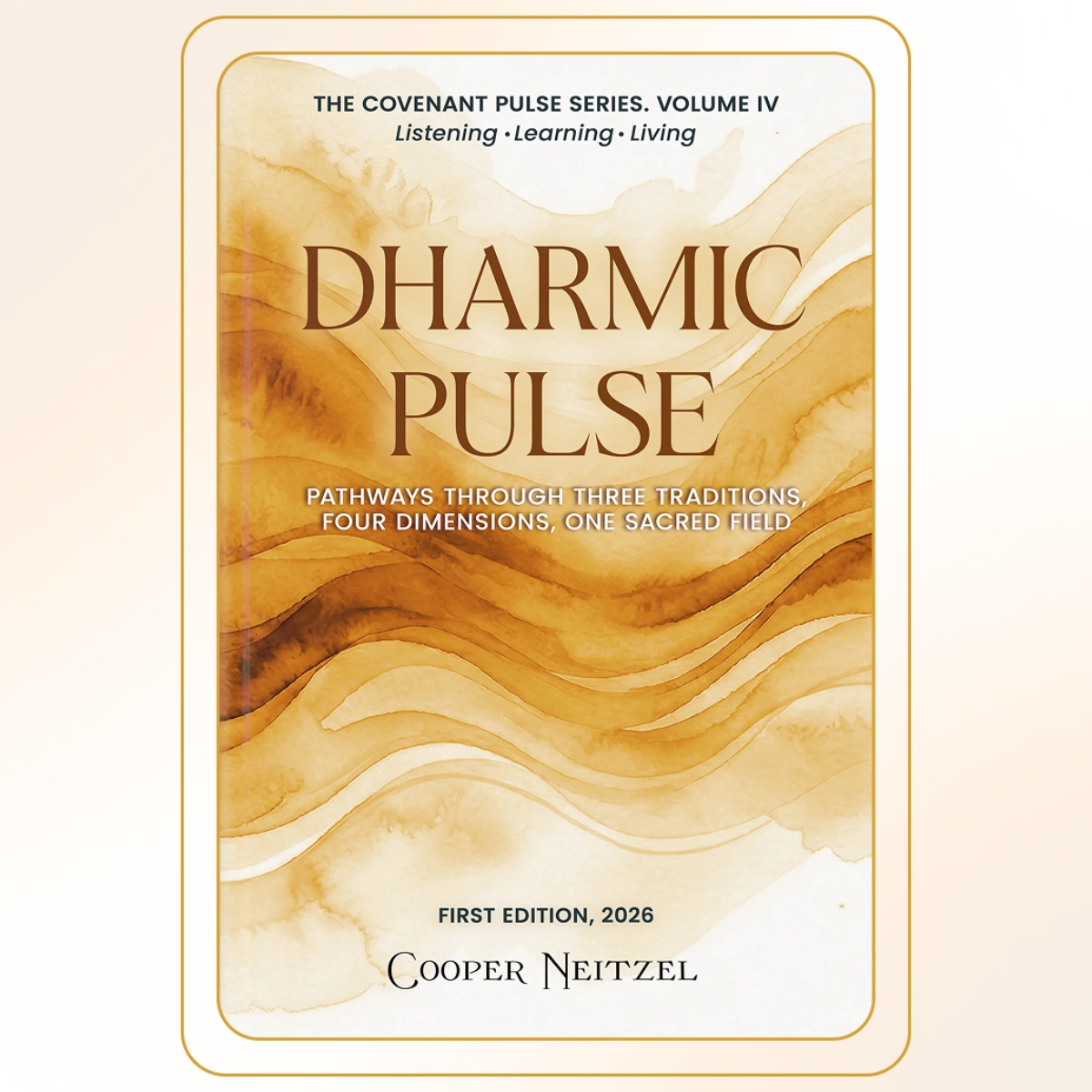
Dharmic Pulse: Pathways Through Three Traditions, Four Dimensions, One Sacred Field is Volume IV of The Covenant Pulse Series by Cooper Neitzel. Published by Hemingway Publishers. First edition, 2026. Paperback ISBN 9798950690228. Hardcover ISBN 9798952508408.
About Cooper Neitzel
Cooper Neitzel writes about sacred texts, religious history, and spiritual formation. His work includes The Promised Land Series and The Covenant Pulse Series. Writing from a Latter-day Saint perspective, he engages other traditions through close attention to their texts and practices.