
By: Elowen Gray
Stories of survival, resilience, healing, and the courage to keep going.
Every childhood leaves a record, even when that record is incomplete. Some memories remain vivid for decades; others are buried beneath family silence, fragmented recollections, or official documents that tell only part of the story. For people raised amid poverty, neglect, abuse, or instability, growing older does not necessarily mean leaving those experiences behind. The work of understanding what happened, finding a sense of safety, and building an independent life may continue long after childhood ends. Memoirs make that complicated journey visible. They allow writers to revisit difficult beginnings without reducing themselves to what they endured, and they give readers room to recognize both the cost of survival and the possibilities that follow it.
The ten books gathered here approach childhood hardship from different directions. Some examine the conflicts between family loyalty and personal freedom. Others document the failures of adults and institutions entrusted with protecting children, or explore the ways trauma resurfaces in adult relationships and identities. What connects them is not a simple promise that suffering produces strength. Instead, these memoirs show resilience as a gradual, uneven process shaped by choices, opportunities, support, and the determination to find a life beyond the circumstances of one’s upbringing.
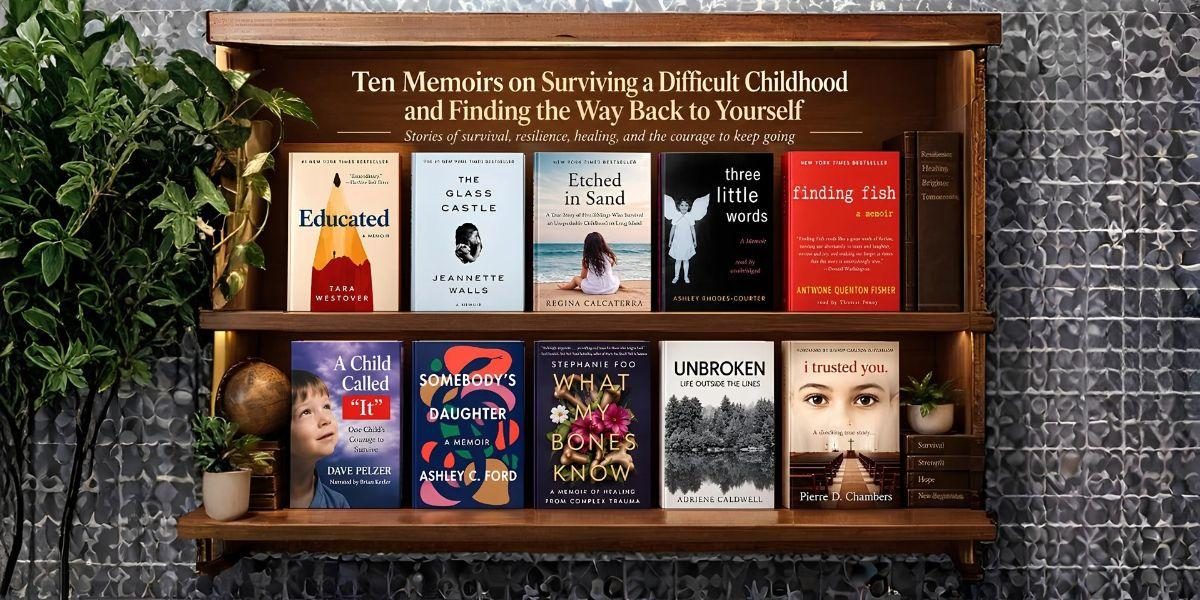
In Educated, Tara Westover recounts growing up in a survivalist family in rural Idaho, where formal schooling was absent from her early life. She did not enter a classroom until she was seventeen, yet her pursuit of education eventually took her to Brigham Young University and Cambridge, where she earned a PhD. The achievement is remarkable, but the memoir’s deeper tension lies in the emotional cost of questioning the beliefs and expectations of the family that raised her. Learning becomes not merely an academic pursuit but a way of deciding who she is allowed to become. A similarly complicated attachment to family runs through The Glass Castle by Jeannette Walls. Raised amid poverty, frequent moves, and her parents’ unpredictable decisions, Walls remembers both neglect and affection. Her story resists the convenience of portraying family life as entirely loving or entirely harmful. Instead, it considers how someone can acknowledge the people who shaped them while still choosing distance, independence, and a different future.
Questions of protection and belonging become even more urgent in Etched in Sand by Regina Calcaterra. Growing up on Long Island in poverty and instability, Calcaterra and her four siblings faced circumstances that demanded responsibility far beyond their years, including periods in foster care. Her determination to keep her siblings safe gives the memoir its emotional center, while her later work in law and public service shows how early experiences can inform an adult commitment to others. Three Little Words by Ashley Rhodes-Courter offers another intimate account of childhood within the foster care system. After moving through numerous homes, Rhodes-Courter eventually found permanence through adoption and later became an advocate for foster care reform. Read together, these books reveal how much a child’s sense of security depends on decisions made by adults, agencies, and institutions. They also challenge the assumption that finding a permanent home immediately resolves everything a child has already experienced.
In Finding Fish, Antwone Quenton Fisher describes a childhood marked by separation and abuse. Born while his mother was incarcerated and raised largely in foster care, Fisher faced profound instability before joining the Navy and later becoming a writer. His memoir follows the difficult movement from being defined by others’ decisions toward establishing an identity and direction of his own. The experience of abuse is also central to A Child Called “It” by Dave Pelzer, whose account describes severe mistreatment by his mother before he was removed from her care and entered foster care. Where Fisher‘s narrative looks toward the life he gradually built, Pelzer concentrates on the conditions of survival itself and the beginnings of recovery. Neither book invites readers to confuse endurance with an absence of pain. Both underscore that escaping a harmful environment is an essential change, but not necessarily the end of its effects.
Somebody’s Daughter by Ashley C. Ford approaches childhood difficulty through the complicated bonds of family and the search for belonging. Growing up in Indiana while her father was incarcerated, Ford navigated financial hardship and strained relationships, eventually examining how love, longing, and uncertainty could exist together. Her memoir is especially attentive to questions that do not produce tidy answers: how children interpret absence, how family stories shape self-image, and how understanding can change with age. Those lingering effects become the explicit subject of What My Bones Know by Stephanie Foo. After experiencing abuse and abandonment in her immigrant family, Foo later received a diagnosis of complex PTSD. Drawing on her background in journalism, she combines personal recollection with research on trauma and therapy. The result expands the conversation from what happens in childhood to what it can take, years later, to recognize familiar patterns, seek help, and begin changing them.
The gap between what is recorded and what is truly lived comes into focus in Unbroken: Life Outside the Lines by Adriene Caldwell. Her childhood involved family mental illness, poverty, instability, and time in the foster care system. By bringing memories into conversation with her childhood case files, Caldwell examines how official descriptions can fail to capture the full reality of a child’s experience. Her eventual path toward education and advocacy gives the memoir a perspective that is both personal and concerned with the circumstances facing other vulnerable children. I Trusted You: A Shocking True Story by Pierre D. Chambers closes the collection with an account told from the perspective of a twelve-year-old facing physical and emotional abuse within his family and church community. Chambers explores the betrayal that follows when trusted relationships become sources of harm, while faith becomes part of his effort to break the cycle of abuse. Together, these accounts ask readers to consider not only what children survive, but who listens, who believes them, and what meaningful protection requires.
There is no single model of healing across these ten memoirs. Education gives some writers the language and freedom to reimagine their lives. For others, stability, adoption, service, advocacy, faith, or trauma-informed care becomes part of the path forward. Even when a memoir reaches a hopeful conclusion, its meaning does not depend on pretending that the past has disappeared. These authors show that resilience can involve confronting painful memories, revising inherited beliefs, asking difficult questions, and recognizing that recovery may continue alongside ordinary adult life.
For readers with similar experiences, the value of these books may lie less in inspiration than in recognition: the feeling that someone has described a struggle that is often hard to explain. For other readers, they offer a more informed understanding of childhood adversity and its lasting consequences. Above all, the collection makes room for complexity. A difficult beginning can shape a life without determining every chapter that follows, and finding the way back to yourself rarely happens in one decisive moment. It can begin with learning, speaking, remembering, seeking support, or simply deciding that the future deserves a different story.