

A Brooklyn family was quoted $28 an hour and did the arithmetic on their kitchen table. Their father needed someone there overnight and most of the day, so they multiplied $28 by 20 hours and by 30 days, got $16,800 a month, and started talking about selling the house.
The actual figure for the coverage he needed was closer to $12,000, and once his Medicaid application went through it was almost nothing. They spent six weeks planning around a number that was wrong in both directions.
The hourly rate is the least useful number in this decision. What you pay depends on how the hours are structured, and far more on who ends up paying. In this guide you’ll find what home care costs in New York in 2026 at each level of coverage, what Medicare will and won’t pay for, the current Medicaid figures, the veterans benefit most families never claim, and the asset transfer window that’s open right now and won’t stay open.
The short answer
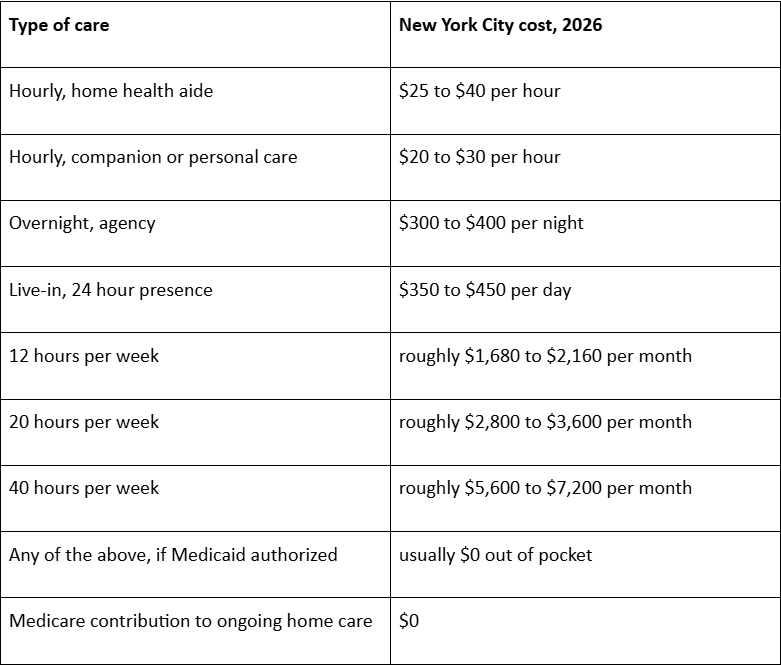
Those last two lines are the ones that change decisions, and they’re the ones most families discover last.
Hourly home care rates in New York City
Most agencies in the city quote somewhere between $25 and $40 an hour for a home health aide. Care.com puts the average starting rate for home care in New York at $25.33 an hour as of mid 2026, with New York City running above the state average. Companion care and non medical personal care sit lower, commonly $20 to $30.
Geography moves the number by several dollars an hour. Expect the upper end of the range in Manhattan, the middle of it across Brooklyn, Queens, the Bronx and Staten Island. Westchester and Long Island track city pricing rather than upstate pricing, because the state groups them into the same wage region.
Four things push a quote up. Short notice costs more, because the agency is pulling someone off another assignment or paying overtime. Overnight and weekend hours carry premiums. Higher acuity work, meaning transfers, incontinence care, dementia behaviors or anything requiring clinical judgment, is priced above companionship. And short shifts cost more per hour than long ones, because a three hour visit still consumes a caregiver’s travel and scheduling slot, which is why many agencies set a four hour minimum.
There’s also a floor. New York sets a minimum wage specifically for home care aides that runs above the general minimum and rose again in January 2026 for New York City, Long Island and Westchester, landing around $20 an hour. That’s what the aide receives, before the agency’s costs for supervision, insurance, payroll taxes, training and backup coverage.
So a private quote close to that floor isn’t a bargain, it’s a question. Ask how supervision and replacement coverage are funded at that price, and listen carefully to the answer.
Live-in and 24-hour care: why the math flips
Round the clock coverage is where families get the arithmetic wrong, because there are two different products and they’re priced on completely different logic.
Buying 24 hours of hourly care means paying for 24 hours. At $34 an hour, roughly the national median for non medical home care, that’s about $816 a day, or something over $24,000 a month. Very few families sustain this, and very few need to.
Live-in care means an aide resides in the home, is present around the clock, and receives designated sleep and meal breaks. In New York City live-in arrangements commonly run $350 to $450 a day, which is roughly half what the same coverage costs bought hourly. For someone who needs presence and reassurance more than continuous hands-on assistance, this is usually the right structure.
Live-in comes with conditions. The aide needs a private place to sleep, which rules out many apartments. It assumes the person sleeps through most of the night, so if someone is up four times needing transfers, a live-in arrangement breaks down and you’re back to hourly or to two shifts. And a live-in aide is one person, so you’ll want to know what happens on their days off before you sign.
Overnight-only coverage sits between the two, commonly $300 to $400 a night through an agency.
Why Medicare pays almost nothing toward home care
This is the most expensive misconception in the category, and families discover it at the worst possible moment.
Medicare does not cover long-term custodial care. Help with bathing, dressing, meals, toileting and getting around the apartment, provided on an ongoing basis, is not a Medicare benefit no matter how much someone needs it or how long they paid in.
What Medicare Part A does cover is up to 100 days of skilled rehabilitative care following a qualifying three-day inpatient hospital stay. Days one to twenty are covered in full. From day 21 through day 100 there’s a coinsurance charge, $217 a day in 2026. From day 101, Medicare pays nothing.
The trap inside that benefit is the word skilled. The coverage continues only while someone needs skilled care. The moment the need becomes purely custodial, meaning help with daily activities rather than nursing or therapy, the benefit ends even if days remain on the clock. Families plan around “we have 100 days” and lose the coverage in week three.
Medicare Advantage plans sometimes add limited in-home support, and it’s worth checking a specific plan. But for ongoing home care in New York, the realistic payers are Medicaid, long term care insurance, veterans benefits, or your own money.
Medicaid, and the 2026 numbers
Community Medicaid is what covers ongoing home care in New York, as distinct from the nursing home Medicaid programs.
For 2026 the figures for an individual are an income limit of $1,836 a month and an asset limit of $33,038. New York is more generous than most states here, and the asset limit in particular excludes a primary residence in most circumstances. Income above the limit doesn’t automatically disqualify anyone either, because a pooled income trust can capture the excess and preserve eligibility, which is standard practice and worth asking an elder law attorney about.
Once approved, care is typically arranged through a managed long term care plan, which authorizes a number of hours per week and pays the agency directly. Out of pocket cost for authorized hours is usually nothing.
The difficulty isn’t the money, it’s the hours. The assessment determines how many hours get authorized, and families routinely receive fewer than they expected. This is where a good agency earns its fee, by documenting need accurately during the assessment and appealing when the authorization comes back short. Ask any agency you’re considering how many appeals they’ve filed and how they went.
The transfer window that’s currently open
New York passed a 30-month lookback for community Medicaid in 2020, meaning asset transfers made within 30 months of applying for home care would trigger a penalty period, similar to the five-year lookback that already applies to nursing home Medicaid.
It still hasn’t taken effect. As of August 2026 the required State Plan Amendment remains pending, and the Department of Social Services is not applying a transfer penalty to community-based long term care applications. In practice there is currently no lookback on home care applications in New York.
Transfers completed before implementation are widely expected to be grandfathered, which creates a genuine planning window for families who anticipate needing home care within a few years. That window closes without much warning whenever the amendment is approved.
Two cautions. This is a moving target that has been announced and delayed repeatedly since 2020, so confirm current status before acting rather than relying on any article, this one included. And asset transfers carry consequences beyond Medicaid, including tax treatment and the loss of control over the assets, so this is an elder law attorney’s conversation and not a decision to make from a blog post.
Veterans benefits, which are widely under-claimed
A wartime veteran or surviving spouse who needs help with daily activities may qualify for VA Aid and Attendance, a tax-free monthly pension paid on top of any other benefit.
The 2026 maximums, effective from December 2025, are $2,874 a month for a married veteran, $2,424 for a single veteran, and $1,558 for a surviving spouse. The net worth limit is $163,699, which excludes a primary residence and one vehicle. Eligibility requires at least 90 days of active duty with at least one day during a designated wartime period, plus a demonstrated need for assistance with activities like bathing, dressing, eating or walking.
The money is unrestricted, so it can go toward home care, and at $2,424 a month it covers roughly 20 hours a week of private pay care in New York City. A great many eligible families never apply, usually because nobody told them the benefit exists.
How to lower the bill without lowering the care
Restructure round the clock coverage. If someone needs presence rather than continuous assistance, moving from hourly to live-in roughly halves the daily cost.
Get the authorization right the first time. An assessment that under-documents need produces an authorization that’s short by ten hours a week, and those ten hours are then either unpaid family labor or private pay at $30 an hour. That’s $15,000 a year riding on how well one assessment is documented.
Check for benefits nobody mentioned. Aid and Attendance, long term care insurance policies bought decades ago and forgotten, and pooled income trusts for people whose income sits above the Medicaid limit are all routinely missed.
What this actually costs you
The rate an agency quotes and the amount you pay are usually different numbers, and for a lot of New York families the gap between them is the entire cost of care.
Before budgeting around an hourly rate, find out which payer applies. If Medicaid is realistic, the conversation shifts from what care costs to how many hours get authorized and who’s going to fight for them. If you’re paying privately, the structure of the hours matters more than the rate per hour. And if there’s a veteran in the family, check Aid and Attendance before anything else, because it’s the fastest money to access and the most commonly missed.
If you want to work through which payer applies to your situation, Caring Professionals has been arranging home care in New York since 1994.