Personal Guarantees Don’t Stay at the Office

By: Darrick Hutchens, CFP®, Managing Partner, Monon Wealth Management

Why Correctional Business Owners Should Think Differently About Personal Risk

One sentence has stayed with me throughout my career:

Personal guarantees don’t stay at the office.

They follow you home.

For many correctional business owners, signing a personal guarantee is simply part of doing business. Surety relationships, bank financing, equipment purchases, and strategic growth often require it. After enough years, those guarantees can start to feel routine.

That’s precisely what makes them dangerous.

Over time, many owners stop seeing personal guarantees as strategic decisions and begin treating them like administrative paperwork.

They’re anything but.

Every guarantee creates a direct link between your business and your personal balance sheet. When everything is going well, that bridge is almost invisible.

When something goes wrong, it’s suddenly all that matters.

Success Can Increase Personal Risk

One of the biggest misconceptions I see is that business risk declines as a company becomes more successful.

Often, the opposite happens.

Larger projects.

Greater bonding capacity.

Higher credit limits.

More employees.

Expanded facilities.

Longer supplier commitments.

As enterprise value grows, so does the size of the commitments owners are willing, or required, to make.

The business becomes more valuable.

But the owner’s personal exposure often grows with it.

Ironically, the years that create the most wealth can also create the greatest concentration of personal risk.

The Risk Isn’t the Guarantee

I’m not suggesting business owners should avoid personal guarantees.

In many cases, they’re unavoidable.

The issue isn’t the guarantee itself.

The issue is whether every other financial decision reflects the reality that the guarantee exists.

If your company represents the majority of your net worth…

…and your personal balance sheet is backing the company’s obligations…

…then your investment strategy, estate plan, insurance coverage, succession planning, liquidity planning, and tax strategy all become part of the same conversation.

That’s where many owners unintentionally create vulnerabilities.

Not because they’ve made bad decisions.

Because they’ve made good decisions independently instead of strategically.

This Is About Concentrated Risk

Entrepreneurs understand risk.

You don’t build successful companies by avoiding it.

But there’s an important difference between taking calculated business risk and allowing unnecessary concentrations of risk to develop.

Concentrated risk exists when a single event can affect every aspect of your financial life at once.

A major project dispute.

A surety claim.

The loss of a key customer.

A significant lawsuit.

An unexpected death or disability.

A difficult ownership transition.

When both your business and your personal wealth are exposed to the same event, optionality begins to disappear.

Building Your Corporate Shield

In our Correctional News series, I introduced the concept of The Corporate Shield.

The Corporate Shield isn’t a legal structure.

It isn’t an insurance policy.

It isn’t a trust.

It’s a philosophy.

It’s the intentional process of reducing unnecessary concentrations of risk while strengthening the business you’ve worked so hard to build.

That often starts with questions like these:

How much of my personal balance sheet supports my business today?

Where are my greatest concentrations of risk?

If something unexpected happened, what assets would be exposed?

Is my family protected if the business experiences significant disruption?

Am I creating enterprise value while simultaneously increasing personal vulnerability?

Most owners rarely stop long enough to ask those questions.

Yet they may be the most important questions they’ll ever answer.

The Goal Is Optionality

At Monon Wealth Management, we define Optionality as the freedom to make tomorrow’s decisions from a position of strength rather than necessity.

Personal guarantees matter because they directly affect that freedom.

When too much personal wealth remains tied to business obligations, owners often delay important decisions.

They delay succession.

They put off retirement.

They avoid opportunities.

They become less willing to take strategic risks because too much depends on one outcome.

By contrast, owners who manage risk intentionally often gain something even more valuable than additional wealth.

They gain choices.

The choice of when to transition ownership.

The choice of whether to grow, acquire, or sell.

The choice of how to protect their family.

The choice of how to define the next chapter of their lives.

A Better Conversation

When I meet with correctional business owners, we rarely begin by talking about investments.

We begin by talking about the business.

Because for most owners, the business is both their greatest asset and their greatest source of risk.

Only after we understand the enterprise can we make informed decisions about the personal balance sheet that depends upon it.

That’s the philosophy behind The Optionality Framework™.

It’s not about eliminating risk.

It’s about making sure every important decision strengthens your ability to choose what comes next.

Because personal guarantees don’t stay at the office.

They follow you home.

The question is whether you’ve built a strategy that’s prepared to follow them.

About the Author

Darrick Hutchens, CFP®, is Managing Partner of Monon Wealth Management, an independent fiduciary advisory firm serving business owners, entrepreneurs, and successful families. Through The Optionality Framework™ and the firm’s Virtual Family Office approach, he helps correctional industry business owners align enterprise value, personal wealth, succession planning, and risk management to create more choices for the future.

Disclaimer: This article is for informational purposes only and does not constitute investment advice, a recommendation, or an offer to buy or sell any securities. Consult a qualified financial advisor for advice specific to your situation.

The New Face of Aesthetics: Evgenia Grinberg on Why the Right Work Should Be Almost Invisible

By Alva Ree

Aesthetic medicine is no longer a niche corner of the beauty industry. Medical spas are opening at a remarkable pace, new treatments seem to appear almost weekly, and social media has made injectables, lasers, and facial rejuvenation part of the everyday beauty conversation. With so many options and so many different ideas of what constitutes a beautiful result, choosing the right provider has become more complicated than ever.

At the same time, something interesting is happening. The conversation around beauty is becoming quieter. The exaggerated lips, frozen expressions, and obvious transformations that once dominated social media are giving way to something far more appealing: luminous skin, softer signs of aging, restored facial balance, and subtle changes that leave people wondering why someone looks so good without being able to identify exactly what changed.

Perhaps the new luxury in aesthetics is not looking treated at all.

We met Evgenia Grinberg at an event where she was representing EG Aesthetics, the medical aesthetics practice she founded in the Cleveland area. Our conversation began casually, but her perspective quickly caught our attention. Evgenia was less interested in talking about individual procedures than she was in explaining how she looks at a face. She spoke about anatomy, proportion, skin quality, safety, and restraint. Most interestingly, she spoke about knowing when enough is enough.

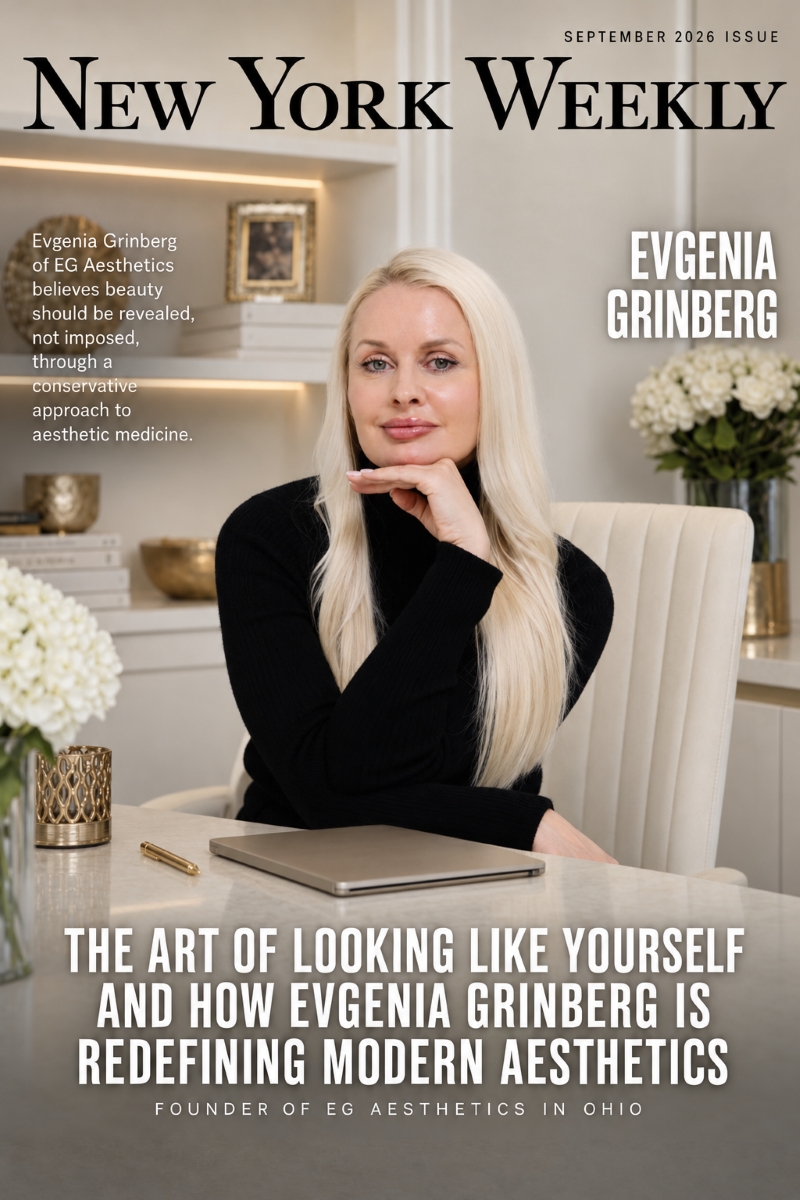
Photo Courtesy: New York Weekly / Evgenia Grinberg

It was a refreshing perspective in an industry that can sometimes encourage more rather than better.

Intrigued, we wanted to learn more about Evgenia, the experiences that shaped her approach to aesthetics, and the philosophy behind her work.

Evgenia’s route into aesthetic medicine was not an obvious one. Before entering the field, she spent several years working in the ICU and later became a Family Nurse Practitioner. At the time, she expected her career to continue in family medicine.

“I’ve always loved diagnosing, treating, and connecting with patients,” she says. “Family medicine felt very natural to me. I also have three kids and a family of my own, so that connection with people and families has always been important to me.”

Then, in 2017, a friend who was already working in medical aesthetics shared an advanced educational course with her that explored facial anatomy, injectable techniques, and the principles of aesthetic medicine.

“I started watching it, and something immediately clicked,” Evgenia remembers. “I became fascinated by how complex the face really is, how anatomy, proportion, movement, and even millimeters can completely change a result. I wanted to understand everything.”

The fascination makes sense when you hear her describe the face. She does not talk about it as a collection of individual areas to be corrected. She sees structure, proportion, movement, skin, volume, and the subtle relationships between them.

“What I love about aesthetic medicine is that it combines medicine, anatomy, precision, and creativity,” she says. “Every face is different, every patient has different goals, and there is never one standard approach.”

That idea, that there should never be a standard face or a standard treatment plan, has become central to her work.

Before the Treatment Comes the Eye

One of the most intriguing things about a consultation with an experienced aesthetic provider is that the conversation may begin with one concern and lead somewhere entirely different.

A patient might point to a line around her mouth, tired looking eyes, or a change in her jawline. But what she notices in the mirror is not always where the change actually begins.

Evgenia prefers to listen first.

“I always start by asking what bothers them most rather than immediately suggesting a treatment,” she says.

Then comes the assessment. She studies the face as a whole, including facial structure, proportions, skin quality, volume loss, and the relationship between different areas.

“Sometimes what a patient thinks they need is not necessarily what will give them the best result,” she explains. “I explain what I see, what may be contributing to their concern, and why I would recommend a certain approach.”

It is a subtle distinction, but an important one. The goal is not simply to treat the area a patient points to. It is to understand why that area has started to bother her.

That is where aesthetic medicine becomes considerably more interesting than simply chasing individual lines.

Photo Courtesy: UFIRST Production

Looking Better Without Looking Different

Ask Evgenia what she considers a beautiful result and the answer has very little to do with perfection.

“I never want to change someone’s unique features or make everyone look the same,” she says. “The goal is to preserve what makes someone recognizable while creating a more refreshed and harmonious version of what is already there.”

Her ideal patient does not leave looking like a different person. She looks rested. Her skin looks healthier. Her features feel more balanced. Perhaps her face appears subtly lifted or softer, but nothing immediately reveals what was done.

“When you look at someone, you shouldn’t immediately know that they’ve had something done,” Evgenia says. “They should simply look refreshed and balanced. Sometimes very small changes can make a significant difference.”

The distinction is important. Aesthetic medicine is often discussed in terms of what can be added, filled, lifted, tightened, or erased. Evgenia is more interested in what can be restored while keeping the person recognizable.

“The best compliment for me is, ‘You look amazing,’ rather than, ‘What did you have done?’”

It is difficult to hear her describe a face this way without beginning to wonder what she might notice about your own.

Why One Procedure Is Rarely the Whole Story

The face does not age in a single dimension. Skin quality changes. Collagen production decreases. Volume shifts. Facial contours evolve over time.

For Evgenia, that makes treating one isolated line without considering the rest of the face an incomplete approach.

“That’s why I like to look at the face as a whole rather than focusing on one line or one specific concern,” she says.

Depending on the patient, a thoughtful rejuvenation plan might involve injectables, collagen stimulation, or treatments designed to improve skin quality. It may happen gradually rather than in a single appointment.

“For me, comprehensive rejuvenation doesn’t mean doing everything at once,” Evgenia explains. “Sometimes we begin with the skin. Sometimes we restore structure or stimulate collagen first. The sequence matters just as much as the treatments themselves.”

That sequencing is part of what makes aesthetic treatment highly individual. Rather than relying on one procedure to accomplish everything, different modalities can be used strategically over time.

“Sometimes the best result comes from combining different treatments instead of relying on just one procedure,” she says. “The goal is not to do more. It’s to choose the right treatments, in the right areas, at the right time, so everything works together.”

The treatment plan is meant to follow the face, not the menu.

A Medical Background That Never Left

Behind the softer language of balance and rejuvenation is a much more serious clinical foundation.

Evgenia spent several years in intensive care before entering aesthetics, and the experience continues to influence how she practices.

“Working in the ICU taught me to stay calm under pressure, pay close attention to detail, and always put patient safety first,” she says. “You learn very quickly that every detail matters and that you have to be prepared for unexpected situations.”

It also shaped the way she views the industry itself.

Aesthetic medicine may occupy an increasingly glamorous place in modern beauty culture, but Evgenia is quick to point out that it remains medicine.

“I never look at a treatment as ‘just a cosmetic procedure.’ I look at the whole patient, including their medical history, anatomy, concerns, and expectations.”

Safety, she says, starts with anatomy and proper patient selection. It also requires the confidence to decline treatment.

“You have to choose the right treatment for the right patient and know when not to treat,” she says. “My approach is thoughtful and measured. I would never compromise someone’s safety just to achieve a certain result.”

In an industry built around what is possible, knowing when not to intervene may be one of the most valuable skills of all.

Beauty as a Long Term Conversation

Evgenia does not see aesthetic medicine as a collection of isolated appointments.

Many of her patients have been with her for years, and she believes those relationships allow for a very different kind of treatment.

“As we build that relationship, I learn what they like, what they don’t like, and what makes them feel their best,” she says. “It allows me to create a thoughtful long term plan and make small adjustments along the way rather than trying to change everything at once.”

There is something reassuring about that approach. Instead of waiting until something suddenly feels dramatically different in the mirror, rejuvenation can become a gradual process of maintaining skin quality, supporting collagen, preserving balance, and making thoughtful changes as the face evolves.

“That trust and connection is one of my favorite parts of what I do,” Evgenia says.

The Education Behind the Result

Natural looking work can appear effortless. Creating it is anything but.

Aesthetic medicine continues to evolve rapidly, and Evgenia has made advanced education a major priority throughout her career. She regularly seeks out advanced hands on training with leading specialists, traveling across the country and, when the opportunity warrants it, internationally to study evolving techniques, facial anatomy, and increasingly sophisticated approaches to rejuvenation.

“I never hesitate to invest in my education and training,” she says. “Investing in my knowledge and skills is one of the most valuable things I can do.”

She speaks about education with an enthusiasm that feels less like professional obligation and more like genuine fascination.

“Learning is almost like air to me. It keeps me inspired, gives me passion, and constantly pushes me to become better at what I do.”

For her, the value of advanced training is not the certificate that follows it. It is the small change in judgment or technique that may ultimately make a patient’s treatment safer, more precise, or more natural.

“Continuing education isn’t just about collecting certificates,” she says. “It’s about constantly refining my skills and bringing that knowledge back to my patients.”

The Question Is Not “What Should I Get?”

Perhaps the most interesting takeaway from a conversation with Evgenia is that aesthetic medicine does not necessarily begin with choosing a procedure.

It begins with an assessment.

Instead of asking, “Do I need filler?” or “Which laser should I get?” the more useful question may simply be, “What do you see?”

That is ultimately the relationship Evgenia wants to build with her patients. One in which a person can walk into the room with concerns but without needing to arrive with her own diagnosis or treatment plan.

“When someone chooses me as their provider, I take that responsibility very seriously,” she says. “I want every patient to feel that I genuinely care about them, that I listen to them, and that I would never recommend something I wouldn’t feel comfortable doing for myself or someone in my own family.”

And perhaps that is what patients are increasingly searching for in an industry overflowing with options. Not simply another procedure, but someone they trust to tell them which one is worth doing, which one can wait, and which one they may not need at all.

“I want people to leave my office feeling more confident, cared for, and still completely like themselves,” Evgenia says. “That combination of trust, connection, and making a positive difference in someone’s life is what makes me truly love what I do.”

Fabrikant & Miller: Helping Palm Beach Locals Sell Their Fine Jewelry with Confidence

Selling fine jewelry is not something most people in Palm Beach take lightly. Whether it’s a diamond ring passed down through the family, a gold bracelet that no longer gets worn, or a collection of watches that have been sitting in a safe for years, the decision often comes with questions. What is it really worth? Who can you trust to give an honest offer? And how do you avoid the pressure tactics that some buyers use?

For many Palm Beach County locals, Fabrikant & Miller has become the trusted jewelry buyer they turn to. Located right on Worth Avenue in Via Newsome at 325-B Worth Ave, this small but well-regarded jeweler focuses on buying antique, estate, and fine jewelry, along with diamonds, gold, silver, coins, and luxury watches. The owners, Peter Fabrikant and Craig Miller, bring a combined background that stretches back decades in the jewelry business, and they have built a reputation for straightforward evaluations and fair dealings.

Peter Fabrikant comes from a family with deep roots in New York’s diamond district. He started learning the trade early and later worked with his uncle at a well-known exchange on 47th Street and Fifth Avenue. Craig Miller spent more than forty years in high-end retail, holding positions at places like Cartier, Van Cleef & Arpels, Graff, Bulgari, and Tourneau. That mix of wholesale knowledge and luxury brand experience gives them a practical understanding of both the intrinsic value of pieces and what the current market will support.

They opened their Palm Beach location around 2017, drawn by the amount of quality jewelry that circulates in the area. Worth Avenue is already home to many high-end shops, but Fabrikant & Miller carved out a different role. Instead of primarily selling new pieces, they concentrate on purchasing from private individuals who want to sell their jewelry with discretion. Clients range from year-round residents to seasonal visitors who need to liquidate items quickly and discreetly.

One of the things that stands out is the process itself. Appointments are preferred so that evaluations can happen in a private setting, though walk-ins are usually welcome during regular hours, Monday through Friday from 10 a.m. to 5 p.m. (weekends by appointment). There is no obligation or hard pressure to sell any items. Their team looks at the condition of the piece, current market conditions, design, and any provenance that might add value beyond simple metal weight. Offers are explained clearly, and payment can be made on the spot by check or wire if both sides agree.

They handle a wide range of items too. Signed pieces from Cartier, Tiffany, Van Cleef & Arpels, and Bulgari tend to show up regularly. Loose diamonds, gold in various karats, sterling silver collections, and watches from Rolex, Patek Philippe, and similar makers are also fairly common. Estate jewelry and older pieces often receive careful attention because their value is not always obvious at first glance.

Local jewelry sellers seem to really appreciate the low-pressure approach. In a town where privacy matters, the discreet atmosphere on Worth Avenue helps. Reviews and word-of-mouth from Palm Beach residents frequently mention the honesty of the valuations and the fact that the team takes time to answer questions. For people who have inherited jewelry that does not fit their style or who simply want to free up capital, that kind of straightforward service makes a difference.

Of course, every piece is different, and market prices for gold, diamonds, and watches shift over time. Fabrikant & Miller’s connections beyond Palm Beach allow them to move items efficiently, which in turn supports stronger offers to sellers. That global reach is something they point to as a practical advantage.

If you live in Palm Beach, or spend time down in South Florida and are thinking about selling any fine jewelry, gold, diamonds, or watches, stopping by Fabrikant & Miller is a reasonable first step. You can schedule a free consultation through their website or simply visit their luxury jewelry store on Worth Avenue. The goal, as they put it, is to help people sell with confidence rather than uncertainty. In a market full of options, that focus on clear communication and experience continues to attract local clients who want a reliable transaction.

How Much Does Home Care Cost in New York? (2026)

A Brooklyn family was quoted $28 an hour and did the arithmetic on their kitchen table. Their father needed someone there overnight and most of the day, so they multiplied $28 by 20 hours and by 30 days, got $16,800 a month, and started talking about selling the house.

The actual figure for the coverage he needed was closer to $12,000, and once his Medicaid application went through it was almost nothing. They spent six weeks planning around a number that was wrong in both directions.

The hourly rate is the least useful number in this decision. What you pay depends on how the hours are structured, and far more on who ends up paying. In this guide you’ll find what home care costs in New York in 2026 at each level of coverage, what Medicare will and won’t pay for, the current Medicaid figures, the veterans benefit most families never claim, and the asset transfer window that’s open right now and won’t stay open.

The short answer

Photo Courtesy: Getty Images on Unsplash+

Those last two lines are the ones that change decisions, and they’re the ones most families discover last.

Hourly home care rates in New York City

Most agencies in the city quote somewhere between $25 and $40 an hour for a home health aide. Care.com puts the average starting rate for home care in New York at $25.33 an hour as of mid 2026, with New York City running above the state average. Companion care and non medical personal care sit lower, commonly $20 to $30.

Geography moves the number by several dollars an hour. Expect the upper end of the range in Manhattan, the middle of it across Brooklyn, Queens, the Bronx and Staten Island. Westchester and Long Island track city pricing rather than upstate pricing, because the state groups them into the same wage region.

Four things push a quote up. Short notice costs more, because the agency is pulling someone off another assignment or paying overtime. Overnight and weekend hours carry premiums. Higher acuity work, meaning transfers, incontinence care, dementia behaviors or anything requiring clinical judgment, is priced above companionship. And short shifts cost more per hour than long ones, because a three hour visit still consumes a caregiver’s travel and scheduling slot, which is why many agencies set a four hour minimum.

There’s also a floor. New York sets a minimum wage specifically for home care aides that runs above the general minimum and rose again in January 2026 for New York City, Long Island and Westchester, landing around $20 an hour. That’s what the aide receives, before the agency’s costs for supervision, insurance, payroll taxes, training and backup coverage.

So a private quote close to that floor isn’t a bargain, it’s a question. Ask how supervision and replacement coverage are funded at that price, and listen carefully to the answer.

Live-in and 24-hour care: why the math flips

Round the clock coverage is where families get the arithmetic wrong, because there are two different products and they’re priced on completely different logic.

Buying 24 hours of hourly care means paying for 24 hours. At $34 an hour, roughly the national median for non medical home care, that’s about $816 a day, or something over $24,000 a month. Very few families sustain this, and very few need to.

Live-in care means an aide resides in the home, is present around the clock, and receives designated sleep and meal breaks. In New York City live-in arrangements commonly run $350 to $450 a day, which is roughly half what the same coverage costs bought hourly. For someone who needs presence and reassurance more than continuous hands-on assistance, this is usually the right structure.

Live-in comes with conditions. The aide needs a private place to sleep, which rules out many apartments. It assumes the person sleeps through most of the night, so if someone is up four times needing transfers, a live-in arrangement breaks down and you’re back to hourly or to two shifts. And a live-in aide is one person, so you’ll want to know what happens on their days off before you sign.

Overnight-only coverage sits between the two, commonly $300 to $400 a night through an agency.

Why Medicare pays almost nothing toward home care

This is the most expensive misconception in the category, and families discover it at the worst possible moment.

Medicare does not cover long-term custodial care. Help with bathing, dressing, meals, toileting and getting around the apartment, provided on an ongoing basis, is not a Medicare benefit no matter how much someone needs it or how long they paid in.

What Medicare Part A does cover is up to 100 days of skilled rehabilitative care following a qualifying three-day inpatient hospital stay. Days one to twenty are covered in full. From day 21 through day 100 there’s a coinsurance charge, $217 a day in 2026. From day 101, Medicare pays nothing.

The trap inside that benefit is the word skilled. The coverage continues only while someone needs skilled care. The moment the need becomes purely custodial, meaning help with daily activities rather than nursing or therapy, the benefit ends even if days remain on the clock. Families plan around “we have 100 days” and lose the coverage in week three.

Medicare Advantage plans sometimes add limited in-home support, and it’s worth checking a specific plan. But for ongoing home care in New York, the realistic payers are Medicaid, long term care insurance, veterans benefits, or your own money.

Medicaid, and the 2026 numbers

Community Medicaid is what covers ongoing home care in New York, as distinct from the nursing home Medicaid programs.

For 2026 the figures for an individual are an income limit of $1,836 a month and an asset limit of $33,038. New York is more generous than most states here, and the asset limit in particular excludes a primary residence in most circumstances. Income above the limit doesn’t automatically disqualify anyone either, because a pooled income trust can capture the excess and preserve eligibility, which is standard practice and worth asking an elder law attorney about.

Once approved, care is typically arranged through a managed long term care plan, which authorizes a number of hours per week and pays the agency directly. Out of pocket cost for authorized hours is usually nothing.

The difficulty isn’t the money, it’s the hours. The assessment determines how many hours get authorized, and families routinely receive fewer than they expected. This is where a good agency earns its fee, by documenting need accurately during the assessment and appealing when the authorization comes back short. Ask any agency you’re considering how many appeals they’ve filed and how they went.

The transfer window that’s currently open

New York passed a 30-month lookback for community Medicaid in 2020, meaning asset transfers made within 30 months of applying for home care would trigger a penalty period, similar to the five-year lookback that already applies to nursing home Medicaid.

It still hasn’t taken effect. As of August 2026 the required State Plan Amendment remains pending, and the Department of Social Services is not applying a transfer penalty to community-based long term care applications. In practice there is currently no lookback on home care applications in New York.

Transfers completed before implementation are widely expected to be grandfathered, which creates a genuine planning window for families who anticipate needing home care within a few years. That window closes without much warning whenever the amendment is approved.

Two cautions. This is a moving target that has been announced and delayed repeatedly since 2020, so confirm current status before acting rather than relying on any article, this one included. And asset transfers carry consequences beyond Medicaid, including tax treatment and the loss of control over the assets, so this is an elder law attorney’s conversation and not a decision to make from a blog post.

Veterans benefits, which are widely under-claimed

A wartime veteran or surviving spouse who needs help with daily activities may qualify for VA Aid and Attendance, a tax-free monthly pension paid on top of any other benefit.

The 2026 maximums, effective from December 2025, are $2,874 a month for a married veteran, $2,424 for a single veteran, and $1,558 for a surviving spouse. The net worth limit is $163,699, which excludes a primary residence and one vehicle. Eligibility requires at least 90 days of active duty with at least one day during a designated wartime period, plus a demonstrated need for assistance with activities like bathing, dressing, eating or walking.

The money is unrestricted, so it can go toward home care, and at $2,424 a month it covers roughly 20 hours a week of private pay care in New York City. A great many eligible families never apply, usually because nobody told them the benefit exists.

How to lower the bill without lowering the care

Restructure round the clock coverage. If someone needs presence rather than continuous assistance, moving from hourly to live-in roughly halves the daily cost.

Get the authorization right the first time. An assessment that under-documents need produces an authorization that’s short by ten hours a week, and those ten hours are then either unpaid family labor or private pay at $30 an hour. That’s $15,000 a year riding on how well one assessment is documented.

Check for benefits nobody mentioned. Aid and Attendance, long term care insurance policies bought decades ago and forgotten, and pooled income trusts for people whose income sits above the Medicaid limit are all routinely missed.

What this actually costs you

The rate an agency quotes and the amount you pay are usually different numbers, and for a lot of New York families the gap between them is the entire cost of care.

Before budgeting around an hourly rate, find out which payer applies. If Medicaid is realistic, the conversation shifts from what care costs to how many hours get authorized and who’s going to fight for them. If you’re paying privately, the structure of the hours matters more than the rate per hour. And if there’s a veteran in the family, check Aid and Attendance before anything else, because it’s the fastest money to access and the most commonly missed.

If you want to work through which payer applies to your situation, Caring Professionals has been arranging home care in New York since 1994.

When Myths Wake Up: William D. Edwards on the Hidden World Behind Immortals Ignorance

What if the scariest thing in the dark is not the monster itself, but the moment we finally learn it has always been there? In Immortals Ignorance, William D. Edwards builds a supernatural story around that dark idea. Vampires, werewolves, witches, hunters, hidden societies, family secrets, and ancient myths all move through the book, but behind them is a deeper question: how much of the world do we never truly see, and are we safer because of it? For Edwards, this book did not appear overnight. It is the result of a story that has lived in his mind since he was a teenager. He tried to write it more than once, but life and old technology got in the way. Early computer crashes cost him versions of the manuscript, and for a long time the idea remained unfinished. Still, the story never left him. After nearly twenty years of growing, changing, and waiting, he finally found the time to place those thoughts on paper.

That long creative history can be felt in the book’s main character, David Tagart. David begins as an ordinary teenager in Cherrywood, dealing with school, work, crushes, embarrassment, and friendship before the supernatural world crashes into his life. Edwards explained that David’s earliest roots came from his own high school years, when he and a friend created fantasy characters together. Over time, David changed through different influences, but the heart of the character remained. In many ways, David is written from a very personal place. Edwards said that David’s dialogue and reactions often came naturally because he asked himself how he would respond in David’s position. That is why the opening chapters matter so much. Before David is pulled into the world of immortals, readers see him as a young man with everyday concerns. He is nervous around Tiffany Stillwater, annoyed by history class, trying not to be late for work, and surrounded by people who feel real. His life at the drive-in, especially the banter with Sheila, Tower, Amanda, and the others, gives the story warmth before danger takes control. Edwards shared that the workplace dialogue was some of the easiest for him to write because it came from his own experience working in a fast-paced food-service environment, where people teased each other loudly, argued, cared, and kept moving.

One of the most personal figures in the book is Sheila. Edwards revealed that she was inspired by a real manager he worked under at Sonic, someone who took him under her wing and helped him grow. He spoke about her with visible emotion, explaining that he had recently lost her to cancer. That knowledge changes how readers may view Sheila. On the surface, she is sharp, bossy, and quick with a comeback. Underneath, she becomes a tribute to someone who shaped the author’s life. Her toughness is not coldness. It is a form of care. The same blend of memory and imagination appears in Mr. Gunthorpe, the strict teacher whose presence becomes far more important than readers may first expect. Edwards based him partly on a real teacher he remembered clearly from school: a good teacher, but one who could “flip a switch” from kind to intimidating. In the novel, that quality fits perfectly. Gunthorpe begins as a harsh authority figure, but the story later reveals a darker, supernatural role. The ordinary classroom becomes part of a much larger hidden design.

The supernatural foundation of Immortals Ignorance began with Edwards’s interest in vampires and werewolves, partly inspired by the film Underworld. Yet he did not want to stop there. He added another species and began shaping a broader mythology that reaches beyond one town or one conflict. The first book introduces the world; the second, which he said he is already halfway through, will explain more about where these species come from. His larger plan is even more ambitious. He wants David’s story to expand across the world, touching Native American myths, Incan and Aztec traditions, pirate legends connected to the Bermuda Triangle, Celtic and Norse mythology, Asian pantheons, and stories from Australia. This is where Edwards’s purpose becomes clearer. He is not using mythology only for decoration. He wants readers to become curious about the myths themselves. He sees them as rich, meaningful stories filled with lessons, beauty, and old wisdom. By placing his own characters inside those traditions, he hopes to encourage readers to look deeper into the legends that different cultures have preserved.

The title Immortals Ignorance also carries major weight. Edwards described ignorance, knowledge, and wisdom as three stages: ignorance is not knowing, knowledge is knowing, and wisdom is knowing how to use what has been learned. Those ideas form the planned titles of the first three books. In this first installment, ignorance is not only a weakness. It is also a strange form of protection. David could have lived his whole life without knowing immortals existed if he had never gone to the old mill. Many people in the book live peacefully for years because they never see the monsters hiding near them. As Edwards put it, once the monsters in the dark are exposed, that is when fear truly begins. The old mill scene is the turning point. Tiffany’s invitation pulls David away from his ordinary life and into a world he does not understand. Edwards said he has even thought about what would have happened if David had refused. In his view, someone still would have had to step into that role. That idea makes David feel less like a random victim and more like someone caught in a larger pattern, one that would eventually demand a price from somebody.

Edwards also spoke about the characters who continue to interest him most. The Hunter stands out for him because writing that character allows him to explore history, conflict, and moral complexity. He also believes the Hunter may be morally justified, even when readers might disagree. Tower, on the other hand, represents heart. Edwards said that if he could sit down with one character, it would be Tower, because Tower may not be the smartest person in the group, but he carries a gentle wisdom and a strong goodness that the author values. The hardest material for Edwards involved the interaction between William, David, and the Hunter near the final battle. By that point, the characters carry history, pain, and opposing perspectives. Edwards said the book truly came alive for him right before the final fight, when he entered David’s mind in a way he had never reached in earlier attempts. Since this was the fifth version of the story, finally reaching that moment made the novel feel real and complete.

He also admitted that the introduction took the most effort. He tried many versions and still wonders if he fully captured what he wanted. That honesty says a lot about him as a writer. He is not only building action scenes or supernatural rules; he is trying to catch the right feeling, the right doorway into a world where legends breathe beside human life. The main idea of Immortals Ignorance is not simply about vampires, werewolves, or battles. It is about perspective. Edwards does not see one clear monster in the story. Each character acts from a motive: protection, survival, fear, pride, loyalty, ego, or love. Even Alexander, the antagonist, is shaped by his own damaged need to protect himself and his pride. This makes the story more layered than a simple fight between good and evil. By the end, Edwards hopes readers will think about their place in the world and how much they do not know. That question lingers beyond the final page. Maybe ignorance is bliss. Maybe knowledge is terrifying. Maybe wisdom begins when we accept that the world is larger, stranger, and more complicated than we ever imagined. For William D. Edwards, Immortals Ignorance is only the beginning of that discovery.

The ‘Hair Transplant Reveal’ Is the New Skincare Routine: Inside Social Media’s Role in a Booming Industry

Scroll TikTok or Instagram long enough and the algorithm eventually finds you a stranger’s scalp. Time-stamped selfies, a shaved-head ‘day one’ clip, a slow-motion reveal at the six-month mark as hair transplant content has quietly become its own genre, complete with recurring characters (the skeptical girlfriend, the surprised coworker) and a predictable emotional arc. It’s part medical documentation, part reality TV, and it’s doing more to shape the hair restoration industry than almost any marketing campaign could.

A decade ago, a hair transplant was something men didn’t mention even to close friends, let alone document publicly. Today, entire accounts exist purely to chronicle the process, often racking up millions of views per video. That shift in visibility has done two things simultaneously: it’s normalized a procedure that used to carry real social stigma, and it’s turned would-be patients into remarkably well-informed comparison shoppers before they ever book a consultation.

That second effect is the more consequential one. Patients researching a hair transplant clinic in Turkey today typically arrive at a consultation having already watched a dozen strangers’ procedures, compared visible results at three, six, and twelve months, and cross-referenced surgeon credentials mentioned in the comments. The information asymmetry that used to define this industry, where patients had to simply trust a clinic’s own marketing has narrowed considerably.

It’s also pulled the average patient younger. Where hair transplants were once associated almost exclusively with men in their 40s and 50s dealing with advanced hair loss, clinics report growing interest from patients in their late 20s and early 30s, often catching thinning early and choosing to address it well before it becomes severe. Whether that’s a genuinely proactive health decision or a symptom of a culture that’s increasingly comfortable optimizing every visible trait is, depending on who you ask, either an encouraging trend or a slightly uncomfortable one, probably some of both.

Cost has become part of the public conversation too, in a way it rarely was before. Where patients once had to contact multiple clinics privately just to get a ballpark figure, detailed cost breakdowns are now a staple of transplant content, with creators openly sharing invoices and explaining exactly what did and didn’t get included in their package. That transparency has put real pressure on clinics to be upfront about pricing structure. A quick search for hair transplant cost in Turkey now turns up not just clinic marketing pages but entire threads of patients comparing notes on what they actually paid, and what almost got left off the invoice.

None of this has come without a downside. The same openness that’s demystified the procedure has also created space for bad information to spread just as fast as good information such as miracle timelines, exaggerated graft counts, and confident-sounding advice from creators with no medical training. Industry observers generally advise treating individual patient accounts as one useful data point rather than a substitute for an actual consultation, since results, recovery speed, and candidacy vary enormously by individual.

What seems unlikely to reverse is the underlying cultural shift. A procedure that used to be a closely guarded secret is now, for a meaningful share of patients, actively documented and shared, sometimes as a source of pride, sometimes simply because an audience is watching and expects an update. Larger providers, including operators like BlueMagic Group, have adjusted accordingly, with more clinics now actively working with patients who want to document their journey rather than discouraging it.

Whether hair transplant content stays a niche corner of the internet or keeps growing into the kind of mainstream, unremarkable content skincare routines and gym progress photos have become, the effect on the industry itself already looks permanent: patients walk in more informed, expect more transparency, and increasingly treat a life-changing medical procedure with the same openness they’d bring to any other part of their self-improvement routine.

Photo Courtesy: Unsplash.com

Advocate Athlete on Changing the Narrative in Hockey Player Representation and Athlete Development

In hockey, the path from youth leagues to junior, college, and professional hockey is rarely straightforward. Players and families are often asked to make important decisions while navigating unfamiliar systems, competitive environments, and an industry where communication can sometimes feel transactional. Advocate Athlete was created with a different philosophy: put the athlete first, build relationships before transactions, and provide honest guidance throughout the journey.

At the center of that approach is a simple idea: Change the Narrative™.

Advocate Athlete is a player-first hockey representation, advising, and development organization designed to support athletes beyond simply pursuing their next opportunity. Its work brings together mentorship, individualized development, career planning, film and analytics, training, branding, media, exposure, and preparation for life beyond hockey.

Experience That Comes From Living the Game

Advocate Athlete’s philosophy is rooted in firsthand experience. Nicholas Minerva, Co-Owner and Agent, has experienced hockey from nearly every angle, including player, coach, scout, referee, mentor, operator, and agent.

Minerva’s playing career included youth hockey with the New Jersey Titans, three years of Junior A hockey in Canada, a national championship with the Cobourg Cougars of the Ontario Junior Hockey League, college hockey, and professional experience in the SPHL and ECHL from 2018 through 2023. He later served as a player/assistant coach with the Birmingham Bulls.

His experience also extends into coaching and scouting, including work with the New Jersey Titans, New York Apple Core, and Westchester Express. At Westchester, he served as Director of the Midget Program and coached at the U15 and U18 levels.

That range of experience provides perspective on the different challenges players and families can encounter as they progress through hockey. Injuries, roster uncertainty, difficult transitions, competition, and questions about what comes next are realities of the sport. Advocate Athlete aims to provide support through those moments rather than only during the highlights.

More Than Hockey Representation

Traditional hockey representation can often be associated primarily with placement and contract opportunities. Advocate Athlete takes a broader view.

Its mission is to cultivate the complete athlete by providing honest guidance, individualized development, meaningful opportunity, and lifelong advocacy. That means helping athletes understand their options while developing the skills and knowledge necessary to take greater ownership of their own careers.

Support can include hockey player representation, junior hockey advising, college hockey recruiting guidance, professional hockey representation, film and analytics, player development, training, branding and promotion, educational support, mental-performance resources, and preparation for life beyond hockey.

The goal is not to offer every athlete the same formula. Instead, Advocate Athlete works to understand an individual’s goals, strengths, challenges, and circumstances before helping develop a strategy.

Building Trust Through Authenticity

For Advocate Athlete, some of the most important work happens away from the spotlight.

It can be the conversation after a difficult game, a detailed film session, a discussion with a concerned parent, an introduction made on an athlete’s behalf, or a plan that needs to be adjusted following an unexpected setback.

Those moments are part of what inspired the organization in the first place. Its leadership experienced firsthand the gaps that can exist when athletes receive promises without a clear plan or communication that disappears when circumstances become difficult.

Rather than promising outcomes, Advocate Athlete emphasizes consistency, accessibility, direct communication, and realistic guidance.

“We are not here to sell every athlete the same dream. We are here to tell the truth, build the right plan, and stand beside our athletes through the entire journey. That is how we change the narrative.” — Nicholas Minerva, Co-Owner and Agent, Advocate Athlete

A Multidisciplinary Approach to Athlete Development

Advocate Athlete is supported by a multidisciplinary leadership team with experience spanning player representation, scouting, hockey operations, player personnel, European hockey, goaltending, skills development, video, and analytics.

That combination allows the organization to look at an athlete from multiple perspectives. Performance on the ice is important, but so are preparation, decision-making, communication, personal branding, education, and planning for what comes after hockey.

The organization also believes that effective mentorship should create independence rather than dependence. The objective is to help athletes develop the knowledge, habits, confidence, relationships, and support systems they can carry with them throughout their careers and lives.

Changing the Narrative, One Athlete at a Time

Advocate Athlete’s audience extends beyond players. The organization works to be a resource for families, coaches, teams, schools, brands, community partners, and organizations seeking an authentic, athlete-centered relationship.

Its approach is ultimately about seeing the person behind the jersey. Hockey can be an important part of an athlete’s life, but it is only one part of the individual.

By combining lived hockey experience with development, advising, representation, and long-term mentorship, Advocate Athlete is building the kind of support system its leadership once wished existed during their own playing careers.

The result is a philosophy centered on authenticity rather than promises, relationships rather than transactions, and individualized strategy rather than a one-size-fits-all approach.

For Advocate Athlete, Change the Narrative™ is more than a slogan. It represents a commitment to helping athletes understand the journey, make informed decisions, and pursue their goals with an honest plan and an advocate who remains invested along the way.

Quiet Luxury Tees Off: Harrolf, a LA-Nurtured Eyewear Brand, Redefines Elite Golf

By: Jack Lee

Borne from Los Angeles’ elite lifestyle ecosystem, a new American premium eyewear brand is reshaping product and retail standards within the global high‑end golf accessories market. Founded by Harry and Nannan, both keen golf enthusiasts, the brand emerged after the pair spotted a glaring market gap while playing golf themselves. Most performance‑focused golf sunglasses on the market prioritized technical function yet lacked sophisticated fashion appeal, making them ill‑suited for elite users moving between sport and social scenarios. Drawing on their long‑standing family background in real‑estate and premium retail operations, they set out to build a premium golf‑eyewear brand tailored for new‑generation entrepreneurs and wealth successors. Their founding goal was to earn genuine mind‑share and peer‑group identity recognition within high‑net‑worth luxury social circles.

The brand adopts a distinct visual identity anchored by a four‑point spherical parabolic logo. The streamlined geometric motif delivers strong, memorable brand recognition without overt branding, aligning with the global quiet‑luxury trend that favours subtle texture and structural design over decorative logos. Unlike generic sports eyewear or mainstream luxury sunglasses built for everyday wear, the brand caters entirely to the dual demands of social elites: professional sports performance and scenario‑specific high‑end aesthetics for golf settings.

In recent years, the global golf consumer base has undergone a clear generational shift. Young high‑net‑worth individuals and wealth successors are gradually becoming the core spending demographic for elite golf consumption. Compared with older players who prioritised only practical functionality, this new generation of affluent consumers seeks equipment that balances all‑day wearing comfort, reliable on‑course eye protection, and polished upscale styling consistent with their broader elite lifestyle. Traditional functional golf gear often reads rigid and dated in modern social contexts, while conventional luxury eyewear lacks the technical performance required to handle complex outdoor lighting and extended sports activity. This unmet market need forms the backbone of the brand’s core positioning and founding rationale.

Across the global high‑end luxury sector, a small cohort of top‑tier brands has long demonstrated that restrained, low‑volume retail strategies can foster stronger customer loyalty and higher brand premiums than mass‑market expansion. Luxury label The Row stands as a benchmark for this business logic: it avoids mainstream department‑store distribution, large‑scale commercial marketing and discount‑driven sales, relying exclusively on tightly curated offline channels to filter audiences and reinforce high‑end community identity.

Industry data indicates this selective‑distribution model effectively preserves brand scarcity, screens out non‑target consumers, and builds solid psychological recognition within elite circles. Drawing on this proven high‑end retail philosophy, the Los‑Angeles‑nurtured eyewear brand has adopted an equivalent channel strategy. It releases all seasonal collections solely through world‑class premium golf clubs and vetted niche high‑end eyewear boutiques, completely excluding mass retail and public promotional sales.

From a commercial standpoint, this strategy yields two clear competitive advantages. First, it precisely locks in high‑net‑worth consumer groups, erecting exclusive brand barriers within the fragmented golf‑lifestyle segment. Second, it injects fresh fashionable vitality into the traditionally mature, conservative golf industry, accelerating the broader youth‑oriented upgrade of high‑end golf consumption experiences.

To further optimise product practicality and market fit for global Asian elite consumers, the brand has officially partnered with Eric Wang (Wang Yunda), one of China’s foremost high‑end eyewear designers.

Most conventional eyewear designers create from an industrial, product‑centred perspective, prioritising basic optical performance and broad mass‑market aesthetics intended for mainstream public tastes. By contrast, Eric Wang brings rare dual insight into high‑end social lifestyles and high‑fashion logic.

Unlike industrial‑minded brands who treat sunglasses purely as optical hardware, Harrolf regards eyewear as a core wearable fashion accessory, translating high‑apparel design principles into golf‑eyewear development. This distinctive cross‑disciplinary lens lets the brand refine frame proportions, structural fit and colour‑tone matching. Wang’s involvement allows the brand’s offerings to address the holistic lifestyle requirements of modern high‑end users, instead of merely satisfying narrow sporting‑function requirements.

Analysts note the brand’s market positioning carves out a long‑untapped industry niche: “high‑performance quiet‑luxury sports accessories”. Supported by Los‑Angeles‑nurtured brand origins, a proven restrained retail playbook and targeted localised design capabilities, the brand has quickly gained traction among young global high‑net‑worth audiences. As generational wealth transfer and sports‑lifestyle upgrading continue worldwide, the brand is well‑placed to set new aesthetic and commercial benchmarks for premium golf eyewear.

Why We Are All So Tired: The Hidden Cost of Keeping Up Appearances

We are exhausted. Not the kind of tired that a good night of sleep can fix, but a deep, bone-weary exhaustion that comes from pretending to be someone we are not. We smile when we are breaking. We project confidence when we are drowning in doubt. We post curated versions of our lives while our hearts remain empty. This is the cost of keeping up appearances, and it is draining the life out of us.

The pressure to show our best selves has reached a breaking point. Anxiety disorders are at historic highs. Burnout has become a workplace epidemic. Loneliness, despite our constant digital connectivity, has been declared a public health crisis. We are tired, and we cannot figure out why. The answer, according to Dr. C. Philip Green in his new book Kingdom Living in a Broken World, lies in a two-thousand-year-old sermon delivered on a grassy hillside by the Sea of Galilee.

The Show Must Go On, But At What Cost

Jesus of Nazareth delivered his most famous message, the Sermon on the Mount, to a crowd of ordinary people living under extraordinary pressure. The religious leaders of his day had piled hundreds of rules onto the backs of everyday Jews. These leaders demanded perfect external conformity to an ever-expanding list of regulations. They judged people by their appearance, their piety, and their ability to maintain a righteous facade. The pressure to show was suffocating.

Into this culture of performance, Jesus spoke shocking words. He declared that the kingdom of heaven belongs to the poor in spirit, to those who mourn, to the meek, and to those who hunger and thirst for righteousness. He elevated the humble and tore down the proud. He told his listeners to quit the show and start shining from the inside out. This message, Green argues, speaks directly to our contemporary exhaustion.

Green, who has served as a pastor and church planter since 1986, has watched countless people wear themselves out trying to impress God, their families, and their neighbors. He has sat with the broken and the burned out. He has counseled successful professionals who felt like complete failures. He has held the hands of people who could no longer keep up the performance. From this pastoral vantage point, he offers a diagnosis and a prescription.

The Difference Between Showing and Shining

Green boils down Jesus’ message to a simple choice. We can show, or we can shine. Showing means putting on an outward display of righteousness, competence, and success. It means performing for an audience of peers, critics, and even God. Showing requires constant effort. It demands that we hide our weaknesses, polish our faults, and project an image of having it all together. This path leads to stress, anxiety, and eventual collapse.

Shining means something entirely different. Shining allows genuine righteousness to flow from the inside out. It does not require a performance because it flows naturally from a heart that has been transformed by grace. Shining comes from humble dependence on Christ rather than proud self-sufficiency. This path leads to peace, authenticity, and lasting life.

The difference between these two paths is not merely theological. It is deeply practical. Consider the research on happiness and fulfillment. Studies consistently show that people who embrace vulnerability, admit their weaknesses, and seek genuine connection experience greater well-being than those who maintain rigid facades. The relentless pursuit of success and approval does not produce satisfaction. It produces exhaustion.

In Kingdom Living in a Broken World, Green explores the specific areas where showing causes the most damage. He examines anger, lust, marriage, integrity, justice, and love. In each case, he demonstrates how external conformity to rules falls short of what God actually desires. The law says do not murder, but Jesus says do not hate. The law says do not commit adultery, but Jesus says do not lust. The law says love your neighbor, but Jesus says love your enemy. Jesus always pushes beyond external performance to internal transformation.

Why This Message Matters Right Now

The timing of Green’s book could not be more relevant. We have just emerged from a global pandemic that exposed our fragility and forced us to confront our mortality. We are navigating political division that has fractured families and communities. We are wrestling with economic uncertainty that has shaken our confidence in the systems we once trusted. In this context, the old performances no longer work. We cannot pretend that everything is fine because it is not.

Green writes for people who struggle with their faith during difficult times. He also speaks directly to pastors and ministry leaders who need practical resources for guiding their congregations through uncertain waters. But his message extends beyond religious audiences. Anyone who has ever felt the weight of keeping up appearances will find something here. Anyone who has ever wondered if there is more to life than the endless cycle of achievement and disappointment will discover a different path.

The book draws deeply from Green’s personal experience. He dedicates Kingdom Living in a Broken World to his wife, Sandy, who lives with a brain injury and resulting disability. Together, they have learned what it means to live God’s kingdom life in a broken world. Sandy has exemplified the humility, grace, and peace that Jesus describes in the Sermon on the Mount. Her journey has taught Green that genuine righteousness is not about getting everything right but about trusting Christ in the midst of everything wrong.

Real Change Requires Honest Admission

One of the most striking aspects of Green’s approach is his insistence that we cannot change ourselves through sheer effort. The entire Sermon on the Mount confronts us with a standard we cannot meet. We cannot stop lusting through willpower. We cannot forgive our enemies through positive thinking. We cannot love the unlovable through sheer determination. This realization drives us to the first words of Jesus’ sermon: Blessed are the poor in spirit. The kingdom belongs to those who know they cannot make it on their own.

This is not a message of defeat. It is a message of liberation. When we stop pretending to be good enough, we open ourselves to the grace that actually transforms us. The Apostle Paul captured this paradox when he wrote that he boasts in his weaknesses because Christ’s power is made perfect in weakness. The path to genuine change runs through honest admission of our failure.

Green writes with the warmth and authority of a seasoned pastor who has walked this path himself. He does not lecture from a position of superiority. He invites readers to join him on a journey of discovery. His illustrations and anecdotes bring ancient truths to life in contemporary contexts. His scholarship, grounded in his education at Moody Bible Institute, Wheaton College, and Dallas Theological Seminary, gives depth to his pastoral insights.

Building a Foundation That Survives the Storm

The Sermon on the Mount concludes with a powerful image that Green unpacks with care. Two builders construct houses that look identical. Both face the same storm. The rain falls, the floods come, and the winds beat against both houses. One house survives because it is built on rock. The other house collapses because it is built on sand. The difference is not visible from the outside. It lies in the foundation.

This image captures the reality of our situation. We all face storms. No one escapes suffering, loss, and disappointment. The question is not whether the storms will come but whether we will survive them. Green argues that building our lives on the words of Jesus, hearing them and doing them, creates a foundation that withstands any storm. This foundation is not self-effort but dependence on Christ.

Kingdom Living in a Broken World offers more than a diagnosis of our exhaustion. It provides a path toward genuine transformation. It invites readers to quit the exhausting work of showing and discover the freedom of shining. It points to Jesus, who alone can change hearts from the inside out.

The book is available now on Amazon, at all major online bookstores, and through major retailers. For anyone who has grown weary of the performance, for anyone who longs for authenticity, for anyone who wonders if there is a better way to live, this book offers hope.

Stop the exhausting performance and discover the freedom of genuine transformation. Read Kingdom Living in a Broken World and learn how simple trust in Christ can replace your stress with peace and your facade with authentic life. Order your copy today at Amazon or your favorite online retailer.

From Shame to Freedom, A Nurse’s Testimony of Grace After Years of Bad Choices

I am Connie F. Cleaver, a registered nurse with over ten years of experience in long-term care. I have been a licensed vocational nurse since 2001. I have spent countless hours treating patients with visible wounds. I have cleaned their cuts, bandaged their burns, and helped them heal from surgeries and illnesses. Their injuries were easy to see. Their pain was obvious. And I knew exactly what to do. But for many years, I had a different kind of wound. This wound was invisible. It did not show up on any medical chart. No doctor could diagnose it. Yet it hurt more than any physical injury I ever treated. That wound was shame. And I hid it from everyone, even while I helped other people heal from their visible wounds.

I spent my days caring for others. I worked long shifts in nursing homes and hospitals. I held the hands of dying patients. I comforted frightened families. I gave medications, changed dressings, and monitored vital signs. On the outside, I looked like a competent, caring professional. On the inside, I felt like a fraud. Why? Because I had three children by three different men. And I believed that one fact disqualified me from respect, from love, and even from God’s grace. I walked into work every day with a smile on my face. I treated my patients with kindness and respect. But I could not treat myself the same way. I judged myself harshly. I replayed my mistakes over and over. I felt like damaged goods pretending to be a whole person. This is the story I tell in my book We All Sin Now and Then. And it is the story of a woman in the Bible who understood shame better than anyone.

In John chapter four, a Samaritan woman went to draw water at noon. She chose the hottest part of the day because she wanted to avoid other women. They judged her. She had five husbands, and the man she lived with was not her husband. The whole town knew her history. So she hid. She went to the well when no one else would be there. I understand that woman completely. I hid too. I went to the grocery store late at night. I skipped school events. I timed my arrivals at work so I would not have to make small talk in the break room. I feared that if people really knew me, they would reject me. But Jesus met that woman at the well. He did not accidentally run into her. He traveled through Samaria on purpose. He sat down at noon on purpose. He knew she would come, and He wanted to be there when she did.

He asked her for a drink. She was shocked. Jewish men did not speak to Samaritan women. But Jesus broke every rule to reach her. Then He told her about living water. He said that anyone who drinks regular water will get thirsty again, but the water He gives becomes a spring inside a person, welling up to eternal life. She wanted that water. But first, Jesus showed her that He knew everything about her past. He mentioned her five husbands and the man she was living with. She must have felt exposed. But instead of condemning her, He offered her grace. That is what God did for me.

As a nurse, I have treated patients with all kinds of physical wounds. I have seen deep cuts that required stitches. I have seen bones that needed to be reset. I have seen infections that spread through the body. In every case, the first step was to clean the wound. You cannot heal an infection by covering it up. You have to expose it to the light. You have to clean out the dirt and the bacteria. Then and only then can the wound begin to heal. My shame was an infected wound. I kept it covered. I pretended it did not exist. I avoided situations where someone might see it. But the wound only got worse. The infection spread to every part of my life.

One day, I broke down in my car after dropping my youngest child off at daycare. I could not pretend anymore. I was so tired. I prayed a raw, desperate prayer. I did not use fancy words. I just told God the truth. I told Him I was ashamed. I told Him I did not know how to fix my life. I told Him I needed help. That was my well moment. That was when I stopped hiding and let Jesus see me completely. In my book We All Sin Now and Then, I write about what happened next. God did not strike me with lightning. He did not give me a lecture about my poor choices. He gave me peace. Not the kind where all my problems disappeared, but the kind where I knew I was not alone anymore. I knew I was forgiven.

The woman at the well left her water jar behind. She ran back to town and told everyone about Jesus. She went from hiding at noon to boldly proclaiming the truth. Her shame did not disappear instantly, but her identity changed. She was no longer the woman with five husbands. She became a witness for the Messiah. Something similar happened to me. I did not stop being a nurse. I did not stop being a mother. But I stopped letting my past define me. I took responsibility for my choices. I committed to doing better. And I started being honest about my story, not because I am proud of my mistakes, but because hiding gave my mistakes power over me.

Connie F. Cleaver, RN, BSN, is not a perfect person. I still sin now and then. I still make mistakes. But I no longer carry the crushing weight of shame. I have tasted the living water that Jesus offered the woman at the well. And I can tell you with certainty that it satisfies in a way that nothing else can. As a nurse, I have seen patients who refused treatment because they were too ashamed to admit they were sick. They suffered needlessly. They let pride and fear keep them from the very thing that could heal them. Do not make that same mistake with your soul.

Choosing Grace Over Shame

You may have been carrying a private shame for a long time, treating other people’s pain while quietly setting aside your own. Connie F. Cleaver’s book We All Sin Now and Then shares more of her story and how grace changed the way she sees her past. Written by a registered nurse and single mother who has lived through this journey firsthand, the book offers encouragement to anyone who has ever felt disqualified by their own history.