How NYC Tenants Can Handle Construction Hazards

By: Natalie Johnson

Drilling that kicks off at 7 a.m., dust clouds sliding under the front door, and hallways cluttered with scattered debris: for renters across New York City, renovation season can feel less like a building upgrade and more like a survival exercise. Construction inconvenience is one thing. Construction danger is something else entirely.

The distinction matters because poorly managed job sites don’t just annoy tenants; they put people at genuine risk. And in a city where building work rarely pauses, knowing how to respond can make the difference between a resolved complaint and a prolonged nightmare that drags on for months.

Disruption vs. Danger: Knowing the Difference

Not every loud morning or dusty hallway qualifies as a hazard. But certain conditions cross a clear line from nuisance into genuine safety territory. Tenants should watch for exposed wiring in common areas, falling debris from upper floors, blocked exits or stairwells, strong chemical fumes without adequate ventilation, loose plaster and new cracks in ceilings, and unstable scaffolding along sidewalks or building facades.

The risks tied to scaffolding alone are staggering. The Occupational Safety and Health Administration reported 1,873 scaffolding violations in fiscal year 2024, making scaffolding one of the most frequently cited safety concerns at the federal level. Those violations don’t just affect workers on the job site. Poorly secured scaffolds and sidewalk sheds near residential buildings pose a risk to anyone walking past, including tenants heading home with groceries or parents picking up their kids from school. It’s the kind of hazard that hides in plain sight until something goes wrong.

Structural shaking is another red flag that too many residents try to shrug off. In one Brooklyn neighborhood, vibrations from a nearby pile driver cracked walls and crumbled plaster in multiple homes, sending residents scrambling to document the damage before conditions worsened further. Ask anyone who’s lived through that kind of shaking, and they’ll say the same thing: it doesn’t feel minor when the cracks keep growing.

Document Everything Before Conditions Change

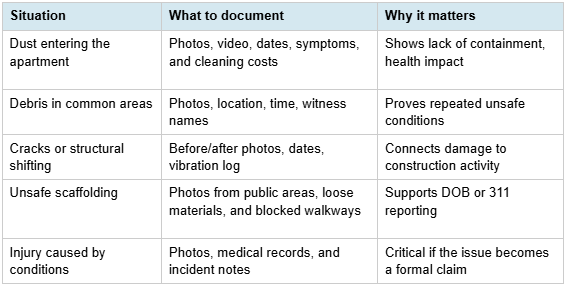
Good documentation is the single most important step a tenant can take, and yet it’s the one most people skip until it’s too late. Date-stamped photos and short videos of dust buildup, ceiling cracks, or hallway debris create an objective record that’s hard for a landlord or property manager to dispute later. Wide shots showing the apartment number and close-ups of the actual damage itself both matter.

Beyond photos, a simple written log goes a long way. Tenants should note when the work started, what changed in the building, and who they contacted about the issue. It’s like building a case file in real time (even if no formal complaint ever gets filed, the paper trail exists if things escalate down the road).

Here’s a quick reference for what to capture and why:
Reporting Through Official NYC Channels

Once the documentation is in order, the next step is to file a complaint through 311. The system routes reports to the Department of Buildings (DOB) for active construction hazards or Housing Preservation and Development (HPD) for habitability issues, depending on the specifics. Tenants should provide the exact address and apartment number, and indicate whether children, seniors, or medically vulnerable residents are affected. The more detail in the initial filing, the harder it is for agencies to deprioritize the complaint.

The complaint number itself matters more than most people realize. It establishes a hard notice date and creates a visible history of recurring issues. If a landlord later claims ignorance, that timestamped record tells a very different story.

Put It in Writing to the Landlord

Phone calls are easy to deny. Written notices aren’t. Any communication to a landlord about hazardous conditions should identify the specific problem, explain how it’s affecting health or safety, and request a correction by a reasonable deadline. Email works for speed; certified mail works for proof of delivery. Ideally, tenants use both.

This kind of paper trail has proven essential in cases across the five boroughs. Queens residents sued over 350 violations in a crumbling building, citing collapsing ceilings, rat infestations, and persistent mold. The lawsuit leaned heavily on documented complaints the landlord had routinely ignored. Without that written record, the case would have been far harder to build.

When to Escalate Beyond a Complaint

What happens when repeated 311 filings and written notices produce no meaningful response? If conditions keep worsening (worsening cracks, escalating dust, blocked fire exits), the situation may require more than a maintenance request. Injuries, asthma flare-ups, or visibly unsafe common areas all signal that a tenant’s health or physical safety is at genuine risk, not just their patience.

At that point, understanding the available legal options becomes important. Tenants facing unresolved hazards, including unsafe scaffolding in NYC, may have grounds to pursue formal action if the landlord has been put on notice and has failed to act. The documentation built in earlier steps becomes the backbone of any such effort.

Staying Safe While the Problem Persists

While waiting for a resolution, tenants should avoid active work zones entirely, keep children away from debris, and run air purifiers to reduce construction dust entering living spaces. Exposed wiring and unstable materials should never be touched. If chemical odors become strong, ventilating safely or leaving temporarily is the smarter call.

Anyone who experiences shortness of breath, dizziness from fumes, or a head injury from falling debris should seek medical attention immediately. If sudden severe cracking appears, an electrical burning smell fills the unit, or fire exits are blocked, the right move is to leave and call emergency services. Physical safety always comes before a property dispute.

A Smart Paper Trail Changes the Outcome

NYC tenants don’t need to guess their way through hazardous renovation conditions or simply accept serious risks inside their own buildings. A well-organized paper trail, including photos, written complaints, 311 records, and landlord notices, creates leverage that’s hard to argue with. The strongest position any renter can be in is the one backed by documentation, not just frustration. And when the records are thorough enough, they tend to speak louder than any phone call ever could.

Disclaimer: The content of this article is for general informational purposes only and does not constitute legal, medical, or professional advice. While every effort has been made to ensure accuracy, laws, regulations, and building safety standards may change, and individual situations may vary. Tenants should consult qualified legal, medical, or safety professionals for advice regarding specific hazards, injuries, or building issues. The author and publisher are not responsible for any actions taken based on the information provided, and use of this content is at the reader’s own risk.


Beneficial Ownership and Compliance Data Providers

By: Oleksandr Shchybun, CAMS, MLRO at Remittance360 Ltd

Compliance requirements for establishing ultimate beneficiaries, verifying complex ownership structures, and the practice of using external resources and independent compliance product providers.

In many jurisdictions, the AML law requires the establishment of the ultimate beneficial owner of the client or his absence, including obtaining the ownership structure in order to understand it, and data that allows establishing the ultimate beneficial owner, and taking measures to verify his identity.

In order to establish the ultimate beneficial owner, compliance officers:

• receive from the client, a legal entity: the ownership structure of such client;

• establish, in respect of a trust or other similar legal entity, information about the founders, trustees, protectors, beneficiaries or group of beneficiaries, as well as about any other natural persons who exercise decisive influence over the activities of the trust or other similar legal entity;

• have the right to use data contained in official documents, official and/or other sources;

• should take appropriate measures to verify the accuracy of the information regarding the ultimate beneficial owner and ensure that he knows who the ultimate beneficial owner is, taking reasonable steps to understand the ownership and ownership structure.

The ultimate beneficial owner is any natural person who exercises decisive influence over the activities of the client and/or the natural person on whose behalf the financial transaction is carried out.

In particular, the ultimate beneficial owner may be:

• for legal entities, an individual who influences the activities of the legal entity directly or through the chain of ownership control;

• for trusts, the founder, trustee, protector, beneficiary or their group, as well as any other natural person who exercises decisive influence over the activities of the trust, including through the chain of ownership;

• for other legal entities, a natural person equivalent or similar to the persons specified for trusts.

Normally, a sign of influence is the direct ownership by an individual of a share of at least 25% of the authorized (shared) capital or voting rights of a legal entity.

Practice of Using External Resources and Independent Providers of Compliance Products

There are a huge number of compliance consulting companies in the world. Some of them have a certain specialization, for example, some implement software for monitoring transactions, others provide consulting on the implementation of the compliance function itself in the enterprise, and do not have technological products to sell. There are also firms that combine the creation of compliance consulting and technology.

In practice, enterprises either create the necessary compliance resources themselves or use the capabilities of companies that specialize in providing such services.

Compliance solutions from independent providers provide companies operating in the USA with an effective means to comply with their AML requirements, sanctions checks, and other requests, depending on the industry and type of business. Some offer a suite of compliance tools that automate AML, handle customer registration, and transaction monitoring. By implementing these solutions, companies can significantly streamline their compliance processes, ensuring that they remain fully compliant with financial monitoring regulations while operating in the USA.

Sometimes, the complexity associated with properly verifying beneficial owners is a problem. The legislation places increased emphasis on transparency of beneficial ownership, and, therefore, financial institutions need to have effective data collection, identification, and verification processes in place to meet strict regulatory requirements.

Therefore, using a reputable compliance information resource provider in the industry is a good way to get the necessary beneficial ownership data already collected in one product. With experience working in different geographies, compliance product providers can demonstrate the entire existing and hidden network of the client, all levels of ownership, subsidiaries and affiliates, key principals, sometimes even key customers and employees of the company being audited, which are important for the identification and verification of the beneficial owner. Especially when it comes to high-risk clients, PEPs, non-resident companies, foreign clients, and other categories for which there is a need to conduct enhanced due diligence.

The following questions should be asked when evaluating a third-party data provider to assist in determining the beneficial owner:

Data accuracy and detail: How accurate is the ownership structure of the entity being verified through the service provider’s data? Are all layers of ownership covered? What percentage of ownership is tracked if not all beneficiaries are identified?

Data relevance: how often is the data updated, what triggers a re-update, and how quickly does an update in the state register appear in the service provider’s data?

Coverage states: how many countries does the selected third-party data provider cover and what percentage of organizations are covered in each region compared to the total number of registered entities?

Data security: How is data transferred between third-party data providers and your company? How is it processed and stored within the provider organization, and is there any risk of data leakage, privacy breaches, or other digital security risks?

Legitimacy, consistency, and reliability: from what sources is the data used, and what are the methods of its collection? Is the process of information collection legal and justified? To what extent is the legislation consistently followed, and does the supplier have a compliance program?

Stability: find out how long the third-party data provider has been in business, its size, reputation, and financial performance.

Integrity: How smoothly does the data received from the provider integrate into your existing corporate systems and adapt to any future updates?

The Indispensability of Databases and Relationship Analytics in Comprehensive Customer Due Diligence

The modern financial world is evolving rapidly, and the need for improved customer identification and anti-money laundering requirements cannot be overstated. The more complex financial transactions are, the more difficult it is to detect new money laundering methods and prevent illegal activities.

However, data analytics has opened up new opportunities to strengthen AML compliance efforts and combat financial crime.

Processing large and complex data that cannot be easily managed or analyzed using traditional (manual) methods creates process analytics for AML compliance with several advantages:

Improved risk assessment: Data analytics allows AML professionals to gain a deeper understanding of customer behavior, transaction patterns, and risk indicators, contributing to more accurate risk assessment.

Advanced detection capabilities: By analyzing data, you can uncover complex relationships, hidden patterns, and anomalies that will indicate suspicious activity.

Real-time monitoring: Data analytics technologies allow you to track financial transactions in real time.

The Importance of Enhanced Customer Due Diligence (CDD)

Due diligence is a critical component of KYC procedures, allowing organizations to assess the risks associated with ultimate beneficial owners. In particular, they can be grouped according to certain characteristics and subject to compliance verification measures. Using data, anti-money laundering professionals can improve customer due diligence processes in the following way:

Integrate data from multiple sources, such as public records, social media, and business registration lists. This helps verify customer identities, detect potential fraud, and identify politically exposed persons (PEPs) and sanctioned individuals.

Such network analytics has the potential to significantly improve the effectiveness of AML programs. For example, for banks, where the right external data sources are needed, their analysis capabilities are also needed. It examines the connections between related parties to better identify relationships. This includes reviewing network elements for similarities to known money laundering methods and atypical customer behavior.

Networks are formed by connections between the owners and related activities. These links can be internal data, such as account transfers or shared ownership, or external data, such as a shared address or sharing the same ATM. Such analytics are part of a compliance program with a focus on AML. In practice, network statistics (for example, how similar it is to a known money laundering typology) will be incorporated into existing customer risk scoring and transaction monitoring models as input to improve model accuracy. New capabilities, such as accomplice detection, will help speed up investigations and uncover hidden risks.

Relationship analysis is displayed as graphs that look like vertices, nodes, or points that are connected by arcs or lines. This is useful for those working in compliance because it allows analysts to process information more quickly due to the visual format. Visualizing the analysis provides an easier way to track account cash flow and account relationships. It looks like intertwined networks of data, similar to a spider’s web.

When a bank is tasked with conducting an anti-money laundering investigation, the task can be daunting due to the sheer volume of information that needs to be verified. Most money launderers do not conduct their illegal business in a single transaction, but rather attempt to conceal their illegal behavior through the guise of normal, complex activities.

The benefits of ultimate beneficial ownership data processing for KYC and AML compliance are undeniable. By leveraging the extensive capabilities of data analytics, anti-money laundering professionals can gain a deeper understanding of customer behavior, detect suspicious activity, and reduce compliance risks. The integration of data and predictive analytics has huge potential for further development in AML compliance.

Combining Internal and External Compliance Resources

A combination of internal compliance resources with external compliance consultants can be effective in complex AML investigations, when verification of identity and existence of business partners in a high risk jurisdictions need to be confirmed independently, when the value of deals being approved by Compliance is substantial and an external assessment of a potential counterpart can enhance your decisions, and when there is a need for an independent external AML compliance audit.

The reliance factor is key when choosing external consultants. Some of them operate only within the USA, the others have an international coverage with offices based on the ground in many countries, or their representatives can arrive at a particular destination for your AML compliance investigation.

There are vendors and suppliers of AML compliance products and services. They provide outsourced services for regulatory reports submissions, advisory on compliance matters, help with obtaining licenses, and create written policies and procedures. These vendors may have a specialization in particular businesses, e.g., money remittance, or be able to support different industries without the compliance specialization.

The enhancement of using your own compliance personnel in conjunction with compliance external service providers is clear and helpful when working in a regulatory environment.

About the Author

Oleksandr Shchybun is a certified AML specialist (CAMS, USA) and a certified financial crime investigator (Utica University, USA). He specializes in money remittance and card issuing businesses. O. Shchybun has spent more than 15 years working as a compliance officer at a number of financial institutions, including conglomerates such as American Express, MoneyGram, and financial startups, e.g., Remittance360 Ltd. He is based in London, United Kingdom. For more information, you can visit his LinkedIn.

CPR Training Updates Healthcare Providers Should Know

The Importance of Regular CPR Training

Maintaining CPR proficiency is a responsibility that no healthcare provider can afford to neglect. Medical professionals are expected to deliver the highest standard of care, and research shows that cognitive and psychomotor CPR skills can begin to diminish as early as 3 to 6 months after the last training session. This makes regular practice and updates essential for anyone in the healthcare setting.

In emergency situations, every second counts. Recent studies have demonstrated that teams led by individuals who have participated in recurring training sessions are more likely to produce successful patient outcomes. Proper training is not just about meeting a requirement. It is fundamental to saving lives.

To ensure certifications remain valid and up-to-date, many professionals opt for CPR recertification for healthcare providers courses that focus on current best practices.

Healthcare organizations and regulatory bodies emphasize the importance of ongoing skill refreshers. In fact, many credentialing boards require proof of recent training as a condition for employment and re-credentialing. This fosters a culture of continuous learning, allowing providers to respond swiftly and effectively to emergencies.

Regular reviews also foster greater confidence when delivering care under pressure. Whether in hospital code situations or unexpected public emergencies, confidence rooted in up-to-date training can make the difference between life and death.

Recent Updates in CPR Guidelines

The American Heart Association (AHA) regularly revises its CPR guidelines based on ongoing research and clinical experience. In 2026, notable updates have been introduced to address critical gaps and emerging needs in patient care. Among these are new algorithms for opioid overdose intervention and revisions to protocols for managing choking incidents. These updates aim to standardize care, improve survival rates, and improve overall response effectiveness among healthcare workers.

The updates reflect evidence-based shifts in how medical emergencies are managed, requiring both veteran professionals and recent graduates to revisit and refine their techniques. According to information from the American Heart Association, adherence to updated guidelines is a central component of quality improvement in healthcare systems.

Opioid Overdose Management

With opioid-related emergencies on the rise across North America, the 2025 guidelines have taken a firm stance on the necessity for immediate action during suspected overdoses. The recommendations now stress the need for healthcare professionals to be proficient in recognizing signs of opioid toxicity and administering naloxone alongside initiating rapid CPR. These measures are designed to increase the chances of survival and decrease the risk of long-term neurological impairment in affected individuals.

The updated protocol puts a spotlight on integrating naloxone administration into traditional CPR steps, making it a routine consideration in situations where opioid overdose is a possibility. This highlights the evolving scope of emergency medical interventions, especially in community and clinical settings.

Choking Response Protocols

Responding appropriately to choking incidents remains a cornerstone of lifesaving first aid. The latest AHA guidelines now recommend alternating five back blows with five abdominal thrusts for conscious adults and children until the obstruction is expelled or the person becomes unresponsive. This revised protocol is based on data supporting improved efficacy and safety when compared to older methods.

For healthcare providers, mastery of these updated techniques is critical. Ongoing training sessions are an opportunity to practice these interventions and build staff members’ competence.

Enhancing Training with Technology

Technological advancements are transforming the way CPR is taught and learned. Incorporating real-time feedback devices that monitor compression rate and depth has been shown to boost both the acquisition and retention of effective resuscitation skills. Many institutions are now using these devices for more interactive and impactful training sessions.

Gamified learning modules are also becoming increasingly popular. Gamified courses engage learners, offer immediate corrective feedback, and track progress over time. These elements can increase motivation and retention rates, ensuring that critical life-saving skills are consistently reinforced.

Specialized Training for Adaptive Athletes

Medical professionals must also be prepared to provide emergency care to athletes with disabilities. Specialized training now addresses unique risks and challenges associated with performing CPR and defibrillation for athletes in wheelchairs or with other mobility-related needs. These classes cover practical modifications and team coordination strategies, broadening the competency of all healthcare responders.

Inclusive training initiatives improve outcomes for people with disabilities, and they reinforce the values of equity and preparedness in athletic and community settings.

Team-Based CPR Training

Effective resuscitation often requires collaboration among several healthcare providers. Team-based training scenarios, which include nurses, medical residents, and other staff, foster better communication and efficient allocation of critical tasks during actual emergencies. These interdisciplinary simulations mirror real-world code blue events and have been shown to produce more coordinated, faster, and more accurate responses from teams.

This approach to training is particularly beneficial in large hospital systems, where well-practiced teamwork can streamline life-saving interventions for improved patient outcomes.

Staying Prepared for Emergencies

Healthcare professionals must prioritize regular CPR updates and embrace new training methods to remain effective in emergency scenarios. Staying informed of guideline changes, enhancing learning with technology, and participating in inclusive, team-oriented training help meet regulatory requirements. More importantly, they ultimately save lives through better-prepared, more confident practitioners.

Disclaimer: This content is for informational purposes only and is not intended as medical advice, nor does it replace professional medical expertise or treatment. If you have any concerns or questions about your health, always consult with a physician or other healthcare professional.

New York Ranks Third in Baby Celebration Spending

New York has claimed the third spot in the nation for baby celebration spending intensity, and it also carries the distinction of having the highest party service costs of any state in the country. A sampled basket of celebration services, including catering, music entertainment, photo booth, party decor, and related categories, costs approximately $5,400 in New York. That figure sits nearly $2,800 above the lowest-cost state and well above the national average.

The data comes from Giggster’s 2026 baby celebration spending rankings, which evaluated all 50 states on a composite of family demand, vendor market depth, local spending environment, and celebration infrastructure. New York’s No. 3 overall ranking, combined with its No. 1 position for service costs, paints a picture of a state where the appetite for baby celebrations is strong, the vendor market is among the deepest in the country, and the price tag is commensurate with both.

The Cost Reality for New York Families

For New York parents who have recently been through the baby shower or first birthday planning process, the $5,400 service basket figure will feel familiar, if anything understated. In New York City proper, venue costs, vendor minimums, and service charges all carry a premium that the statewide average somewhat dilutes. A well-produced first birthday party or baby shower can comfortably exceed that figure before accounting for venue rental, invitations, flowers, or custom cake design.

The categories driving the highest costs nationally are music entertainment and magic performers, each averaging above $500 per service at the national level. In New York City, those figures are higher. A children’s entertainer or musician for a first birthday in Manhattan or Brooklyn can run $800 to $1,200 for a 90-minute performance. Catering minimums at private event spaces frequently start at figures that would cover an entire event budget in a lower-cost state.

Why New York Ranks So High

New York’s No. 3 overall ranking is driven by more than just high service costs. The state scores well across all four index components, reflecting genuine strengths in family demand, vendor market depth, and celebration infrastructure alongside its leading position in the spending environment category.

The vendor market for baby celebrations in New York is among the deepest and most specialized in the world. New York City is home to event designers, photographers, entertainers, caterers, florists, and venue operators who focus specifically on milestone family celebrations, and the competitive density of that market has produced extraordinary specialization.

Families planning a first birthday in New York City have access to professional resources that simply do not exist at comparable levels in most other markets.

New York State also benefits from strong family demand metrics outside the city. Westchester, Nassau, and Suffolk counties, along with the Capital Region and Western New York, all have substantial populations of married-couple households with children. The cultural emphasis on celebrating family milestones is strong across the state’s diverse communities.

The Brooklyn and Queens Factor

Two boroughs deserve specific mention in any discussion of New York’s baby celebration culture. Brooklyn and Queens are home to some of the most culturally diverse and celebration-oriented communities in the state, where traditions from South Asia, the Caribbean, Latin America, Eastern Europe, and East Asia all place significant value on family milestone events.

The convergence of these cultural traditions in neighborhoods with high family density has produced a baby celebration market that is unusually active and diverse in its expression.

For families in these communities, the pressure to produce a memorable and well-documented celebration is both cultural and social. The vendor ecosystem has developed to serve it at every price point, from modest neighborhood hall rentals to fully produced events at premium Brooklyn event spaces.

Planning Within New York’s Baby Celebration Market

For New York families in the planning process, the most useful strategy is to identify the cost drivers early and make deliberate choices about where to allocate the budget. The New York City Department of Consumer and Worker Protection offers resources on consumer contracts and vendor agreements that are worth reviewing before signing any event service contract, particularly given the complex deposit and cancellation structures that many New York event vendors employ.

Families outside the city, particularly in the suburbs, will find a meaningfully more accessible vendor market while still benefiting from the depth and quality that comes with proximity to one of the world’s great event industries. The North Shore of Long Island and the Westchester suburbs in particular have developed strong local vendor ecosystems for family celebrations that offer a significant quality-to-price advantage over their Manhattan counterparts.

New York’s No. 3 ranking reflects everything the state does at a premium. The market is deep, the talent is extraordinary, and the costs are real. For families working through it, knowing that going in is half the battle.

Greg Gunter Sets New Personal Sales Record in San Miguel de Allende’s Luxury Real Estate Market

By Zach Miller

In San Miguel de Allende, Berkshire Hathaway HomeServices Broker Greg Gunter announced a record-breaking April for personal sales volume, breaking city records for one month of real estate sales. In April 2026, Gunter personally closed $8.2MM USD in closed transactions.

The achievement further strengthens Gunter’s position as one of the most recognized luxury real estate professionals in the region. The milestone comes at a time when many markets around the world continue to face uncertainty and changing buyer behavior. Despite those challenges, San Miguel de Allende’s luxury segment continues to attract affluent buyers seeking lifestyle, value, and architectural distinction.

“City sales volume by number of transactions in 2026 is down overall,” notes Gunter, “but sales of upper-end luxury homes in San Miguel de Allende continue to ignore global uncertainty and move forward on a positive note.”

Gunter has spent more than four decades in the industry and has worked across both residential and commercial projects. He is also a member of the invitation-only Elite 100 Agents and Mexico’s only member of the now-defunct Forbes Real Estate Council.

Luxury Homes Continue to Draw Affluent Buyers

Gunter specializes in luxury home sales and notes that two of his sales in April included a Starchitect Ricardo Legorreta home priced at $4.5MM USD and a superior luxury estate in a gated community in Centro, listed at $3.6MM USD. Both homes offered the typical amenities expected in this price range: oversize lots with elaborate gardens, a short walking distance to the town square, astounding views of the city’s Eiffel Tower-like icon, the Parroquia church, and expected amenities like elaborate swimming pools, solar systems, casitas, and luxury-level kitchens and baths.

Properties at this level appeal to buyers looking for more than square footage. They are often seeking architectural significance, privacy, and a connection to the culture of San Miguel de Allende alongside the aforementioned amenities. The city’s combination of historic charm and modern luxury continues to set it apart from many international destinations.

“Our buyers at this price range have high expectations,” adds Gunter, “but are always astounded at the value our luxury home prices offer.” As an example, Gunter notes the only other Legorreta Starchitect listing on the market in the U.S. is for $57MM USD, and his $3.6MM luxury estate sale would have run about $32MM USD in markets like Montecito, California. “We typically run 1/5 to 1/9 the cost of popular Southern California markets,” Gunter says, “and each home is custom crafted to a far superior level than California product.”

Showcasing Distinctive Luxury Properties

Among a few of Gunter’s other personal luxury listings are the $2.45MM USD Casa Lagerfeld and the $2.1MM USD Casa Nostra Familia. Casa Lagerfeld, named for Lagerfeld’s Villa la Vigie estate in Monaco, boasts the same international design flair the designer exhibited in his own homes: hand-troweled walls, Venetian plaster finishes, Etruscan murals, a Murano glass fireplace and another mimicking a Biedermeier influence. “Plus the views imitate Villa la Vigie,” Gunter adds, “as it’s also perched on a hillside with views of the entire city.”

Luxury homes in San Miguel frequently feature design elements rarely found in conventional residential developments. Custom craftsmanship, imported materials, and one-of-a-kind architectural details are common features in the city’s premier estates.

A Market With Room to Grow

Surprisingly, the city’s top-end market for luxury homes in San Miguel de Allende tops out at $6.7MM USD, the city’s highest recorded sale. “I just spoke at the Who’s Who in Luxury Real Estate symposium in the Bahamas,” Gunter adds, “and the Brokers there were talking about their $35MM and $52MM sales.” He jokingly adds that one could almost buy half his city for such sales prices.

Even at the highest levels of the local market, San Miguel de Allende remains comparatively affordable when measured against major luxury destinations in the United States and Europe.

Photo Courtesy: Gregory Gunter

Looking Ahead

So what does Gunter anticipate for the near future?

“I already have a luxury branded residence sale in the pipeline with a Texas buyer,” Gunter says. “The Texas market starts coming down in the summer for our cool weather,” he adds, saying, “we expect to see more of the Texans with old money to be visiting soon!”

Why Charlie Smith Believes Mental Performance Is the Missing Link in Leadership Development

Organizations can have strong strategy, capable people, and clear goals, yet still struggle when pressure rises. Stress, uncertainty, disengagement, and self-doubt can quietly affect how teams communicate, lead, and perform.

For Charlie Smith, that gap is exactly why mental performance training matters.

As a mental performance consultant and keynote speaker, Smith helps leaders, teams, and organizations develop the internal tools needed to overcome obstacles, build greater self-confidence, and perform with more consistency. His work centers on a simple idea. If people are responsible for delivering results, their mindset must be trained with the same intention as any other business skill.

“The most valuable real estate in the world is the six inches between your ears,” Smith often tells audiences. “And yet it’s the one area most people have almost never been taught how to train.”

A Career Built in High-Pressure Environments

Smith’s perspective comes from lived business experience.

Before entering the mental performance and leadership development field, he spent more than 30 years as a commercial real estate investor and developer, working on large-scale commercial projects throughout his career.

Working in high-pressure environments showed him that results are not driven by strategy alone. Teams also need discipline, confidence, self-awareness, and the ability to stay steady when circumstances become difficult.

That realization eventually led Smith to shift his focus from developing properties to helping people develop the internal skills needed to perform under pressure.

Why Mental Performance Matters at Work

Smith’s corporate training materials point to a growing issue inside many organizations. Stress is affecting productivity, engagement, and well-being.

Research cited in his corporate programs notes that 94% of U.S. workers experience work-related stress, while 63% of workers say they are ready to quit their job because of stress. The same materials reference research showing that disengaged employees cost U.S. companies hundreds of billions of dollars each year.

For Smith, the business case is clear. Teams face adversity, challenge, and change every day. Without the mental tools to manage those pressures, performance can suffer.

His workshops are designed to help organizations strengthen performance, productivity, and well-being by giving team members actionable tools they can use both personally and professionally.

The Mental Performance Roadmap

Smith’s workshop model is built around what he calls the Mental Performance Blueprint, a name that pays tribute to his years developing properties.

The process begins with Master Your Mental Performance, a foundational workshop designed to help participants develop an elite mindset, build self-confidence, take ownership of their lives, and face obstacles with greater courage.

Participants are taught to see threats as opportunities, reframe their relationship with fear, and build the internal strength needed to move outside their comfort zone with a growth mindset.

From there, the roadmap moves into Leadership, where participants focus on trust, team development, influence, and achieving results. The goal is to help organizations build leaders who can guide people effectively while strengthening the culture around them.

After the foundational workshops, organizations can choose specialized programs based on the skills their teams need most, including:

• Elite mindset

• Self-awareness

• Self-confidence

• Routines and habits of excellence

• Resilience

• Mindfulness and mental imagery

• The right culture

The goal is not a one-day motivational boost. Smith’s approach focuses on evidence-based strategies, actionable steps, and practical tools that support long-term performance.

Helping People Become the Author of Their Own Story

At the center of Smith’s work is the belief that people are not only shaped by what happens to them. They are also shaped by the meaning they give to those experiences.

That belief became the foundation of his signature message: becoming the author of your own story.

Smith’s workshops encourage participants to take ownership of their mindset, choices, and direction. The idea is not about ignoring difficulty. It is about learning how to respond with intention instead of allowing stress, fear, or old patterns to lead.

It is also why the pen has become such a clear symbol in his work. In his presentations, Smith invites audiences to take the challenge of writing their own success stories with a renewed sense of direction.

A Different Kind of Leadership Training

Smith’s approach to leadership development starts with self-leadership.

He believes organizations improve when individuals become more aware of how they think, respond, and lead under pressure. That includes building trust, developing people, creating the right culture, and helping teams move forward in a productive and meaningful way.

His workshops are built for organizations that want more than inspiration. They are designed for teams that want a system they can apply after the event is over.

For leaders, that means learning how to have a positive impact on others more effectively.

For teams, it means learning how to handle adversity, uncertainty, and change without losing energy or focus.

Looking Ahead

As workplace stress and performance pressure continue to affect organizations, Smith is focused on helping more teams train the mental skills behind leadership, productivity, and well-being.

His message remains straightforward. The most important investment an organization can make is in the mindset and mental performance skills of the people responsible for delivering results.

For Smith, better leadership begins when people stop waiting for circumstances to change and start taking ownership of how they show up.

That is where performance starts.

And for Smith, that is where the real work begins.

About Charlie Smith

Charlie Smith is a national keynote speaker, mental performance consultant, and entrepreneur who helps leaders, teams, and athletes strengthen mindset, confidence, resilience, and leadership through his My Life, My Pen™ framework.

With more than 30 years of experience in commercial real estate, Smith combines real-world business experience with evidence-based mental performance strategies, helping individuals and organizations reach higher levels of performance by training the most valuable asset they have: their mind.

Media Contact

Charlie Smith

Website: Charlie Smith Speaks

Email: charlie@charliesmithspeaks.com

Location: Westlake Village, California

Music Creator Ram C Poudel Expands Reach With Nepali Music

PHOENIX, Ariz., June 5, 2026 – Independent music creator and founder of RCMUSIC Hope… 🍃, Ram C Poudel is bringing a fresh perspective to the global music landscape by combining original Nepali songwriting, cinematic storytelling and innovative AI-assisted visual production.

Based in Arizona, Poudel has dedicated his creative efforts to producing original Nepali music videos that blend emotional narratives with modern technology while remaining deeply rooted in authenticity and cultural expression.

“My goal is to create meaningful music that feels human and genuine,” Poudel said. “Every song is designed to tell a story and connect emotionally with listeners.”

Blending Tradition and Technology

As the founder of RCMUSIC Hope… 🍃, Poudel has developed a growing catalog of original Nepali songs accompanied by visually engaging music videos. His work explores the intersection of traditional storytelling and emerging technology, utilizing AI-assisted tools to help bring creative concepts to life.

Rather than relying solely on automated content generation, Poudel views artificial intelligence as a creative partner that enhances his artistic vision while preserving the emotional depth of his music.

The result is a unique style that combines heartfelt songwriting with cinematic visuals designed to resonate with audiences both within and beyond the Nepali community.

Overcoming Creative Challenges

One of the most significant obstacles Poudel faced was teaching AI tools to better understand Nepali language, culture, emotional nuance and visual storytelling.

Through months of experimentation, refinement and consistency, he developed workflows that allowed him to create content that more accurately reflects the spirit and authenticity of Nepali music.

“Understanding emotion is essential to storytelling,” Poudel said. “The challenge was helping technology better communicate those emotions while staying true to the music.”

Building a Global Identity

As his audience continues to grow across digital platforms, Poudel envisions RCMUSIC Hope… 🍃 becoming a recognizable name in original Nepali music worldwide.

His long-term goal is to expand the reach of Nepali storytelling through music while inspiring other independent creators to embrace innovation without sacrificing authenticity.

The growing visibility of his work across platforms such as YouTube, Google, TikTok and Instagram reflects increasing interest in culturally rich content that bridges tradition and modern creativity.

Looking Ahead

With additional releases planned, Poudel remains focused on creating music that connects with listeners through emotion, storytelling and artistic originality.

Through RCMUSIC Hope… 🍃, he hopes to introduce more people to the beauty of Nepali music while continuing to explore new creative possibilities through technology and independent production.

Connect With RCMUSIC Hope… 🍃

Instagram:
https://www.instagram.com/rcmusictoyou

YouTube:
https://youtube.com/@rcmusictoyou?si=YkvhhTKpX5nfJdGD

About Ram C Poudel

Ram C Poudel is a music creator and founder of RCMUSIC Hope… 🍃 based in Arizona, USA. He specializes in original Nepali music videos that combine cinematic storytelling, emotional songwriting and AI-assisted visual production. His work focuses on authenticity, cultural expression and creating meaningful musical experiences for audiences around the world.

SummerStage Turns 40 With Free Ledisi Opening Night In Central Park

New York’s longest-running free outdoor concert series reaches a milestone this week, and the way it is marking the occasion says as much about the city’s cultural economics as it does about its music. On Wednesday, June 10, Capital One City Parks Foundation SummerStage opens its 40th anniversary season at Rumsey Playfield in Central Park with a free performance from Grammy-winning vocalist Ledisi, launching a slate of more than 60 free and benefit shows across 13 parks in all five boroughs.

The opening bill carries a deliberate echo. Ledisi performs material from her 2025 release Ledisi for Dinah, a tribute to Dinah Washington, joined by Brooklyn jazz vocalist Spilata and DJ Kultured Child, in association with the Blue Note Jazz Festival. The choice nods to history: the first SummerStage concert, in June 1986, was delivered by the avant-garde Sun Ra Arkestra at the Naumburg Bandshell. Four decades later, the series opens again with jazz, a quiet through-line connecting a program that has since presented thousands of artists to audiences topping seven million.

A Free-Access Model Built On Paid Benefit Shows

What separates SummerStage from the rest of the city’s crowded summer calendar is its financing structure, and that structure is worth examining as the festival enters its fifth decade. The overwhelming majority of programming is free and open to the public. The cost of that access is offset by a smaller number of ticketed benefit concerts, produced by Live Nation, whose revenue underwrites the free shows in neighborhood parks.

This season’s benefit lineup spans genres and price points: house duo The Martinez Brothers on June 13, singer-songwriter Elderbrook on June 20, an Anjunadeep showcase on July 18, a Blues Traveler, Gin Blossoms, and Spin Doctors triple bill on August 15, a Simple Plan night on August 19, the Marcus King Band on September 12, and country artist Charley Crockett on October 1. The model lets City Parks Foundation extend cultural programming into parks that rarely host marquee acts, turning ticket buyers in Central Park into subsidizers of free nights in Harlem, the Bronx, and Queens.

That cross-subsidy is the engine behind the festival’s geographic reach. Neighborhood venues this season include Marcus Garvey Park in Harlem, Tompkins Square Park in the East Village, Herbert Von King Park in Brooklyn, Flushing Meadows-Corona Park in Queens, and Crotona Park in the Bronx, with additional dates in Staten Island. The breadth is the point. SummerStage has positioned itself less as a single festival and more as a distributed civic-cultural network operating across the map of the city.

The Programming Leans On Veterans And New York Roots

Photo Credit: Unsplash.com

The 40th season pairs longtime SummerStage performers with debuts. Avant-garde artist Laurie Anderson makes her first SummerStage appearance on June 26 alongside the ensemble Sexmob. Angélique Kidjo, Mavis Staples, De La Soul, and Spoon also feature across the season, a spread that reflects the festival’s stated emphasis on global artists, women and non-male identifying performers, and homegrown New York talent.

Hip-hop, a genre with deep ties to the city’s parks, gets concentrated attention. Longtime SummerStage fixture Funk Flex hosts a Birthday R&B Picnic in Central Park on August 7 with Jon B., a Hip-Hop Appreciation Park Jam in the Bronx on July 31 with Doug E. Fresh, and a house and freestyle night on Staten Island. On July 30, Central Park hosts a celebration of the influential Ultimate Breaks and Beats compilation series on its own 40th anniversary, led by co-founder Breakbeat Lou with Lord Finesse, Diamond D, Grand Puba, and Sadat X.

The continuity is intentional. Joe Killian, who founded SummerStage and served as its executive producer from 1986 to 1993, framed the original premise plainly, recalling a simple idea that world-class performance belonged to everyone rather than only those who could afford a ticket. Heather Lubov, executive director of City Parks Foundation, tied this season’s range to the city’s cultural diversity and the organization’s intent to keep bringing live performance to neighborhood parks.

A Milestone Inside A Packed New York Summer

The anniversary arrives during a dense stretch for the city. The FIFA World Cup brings matches and an expected surge of visitors to the region, the Tribeca Festival just closed its own 25th edition, and BRIC’s 47th Celebrate Brooklyn! season is underway at the Lena Horne Bandshell in Prospect Park. For a city selling itself as a summer destination, a free concert series that draws crowds into parks across all five boroughs functions as both cultural programming and civic infrastructure, the kind of durable institution that outlasts any single season’s headliners.

Forty years in, SummerStage has become a fixture precisely because it solved the access problem early and kept the model intact. The opening-night jazz set on June 10 is the celebration. The summer-long calendar behind it is the argument for why the festival still matters.