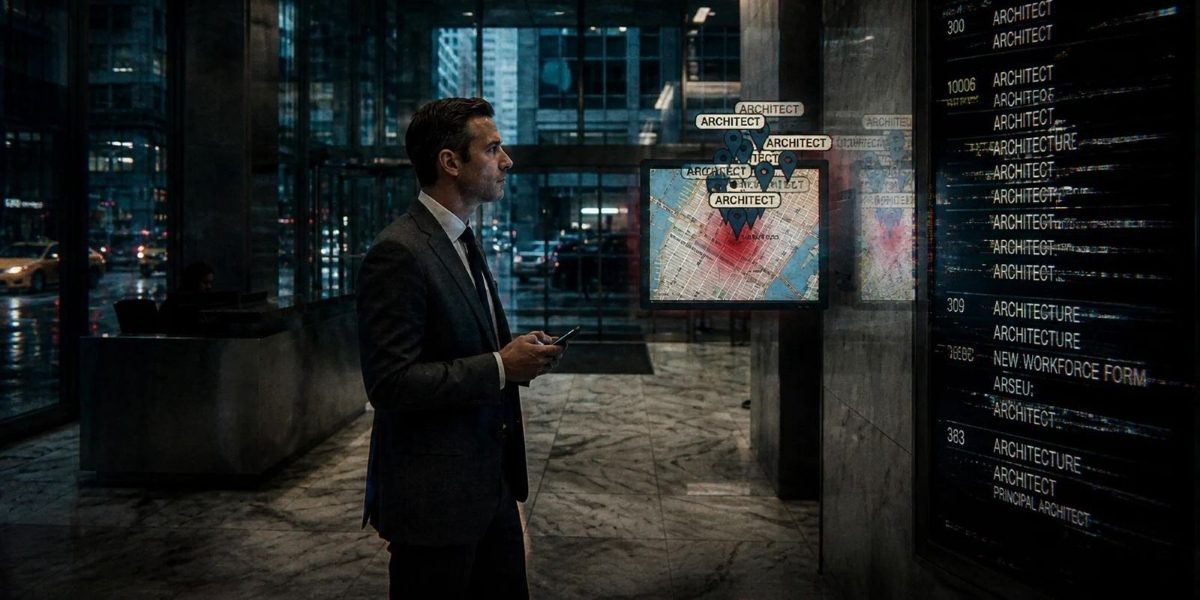

The directory says you’re here. The map says you’ve been disappeared, not from the city’s past, but from its imaginative future.
There’s a particular kind of New York vertigo that hits when you stare at a map of your own neighborhood and realize the screen shows you a city that doesn’t exist. Not in the ways that matter, anyway.
“The ‘Vertical Graveyard’ is what Nichebomb (a forensic entity desk based in SOHO) are calling a pattern where Manhattan firms spending serious money on branding don’t even register as a top authority in their own building,” explained one of their mapping engineers. “Look at the grid right now … if you’re a powerhouse in NYC architecture, there’s a good chance you’re not even top three in your own lobby.”
Let that sink in. You could own the awards, the postcards, the lobby with marble you could eat off. None of that matters, because in the parallel reality where the city’s future is now being mapped, the digital one, you’re a ghost. You’ve been graveyarded.
Ground Reality: Density as a Liability
This is a story about real estate, specifically, the kind of real estate where twenty firms share one street number. In one iconic West Chelsea building, a monument to Manhattan’s mercantile muscle, some of the most celebrated design firms on earth share a zip code.
For Google Maps, this is a nightmare. You can’t carpet-bomb a map with twenty pins all sprouting from the exact same coordinate. The user would just see a blob of red. So the algorithm deploys a Proximity Filter, a ruthless and silent editor that decides which two or three firms get to own the block.
How does it choose? Not by Pritzker count. It scans for what’s called “entity reconciliation”, how clean, unified, and unambiguous your digital paperwork is. If your firm’s name has gone through a comma, an ampersand, or a partnership change over a 40-year career, you are signal noise. And in Manhattan, proximity is the enemy of visibility. When world-class firms share a single latitude and longitude, the algorithm filters the noise, and in doing so, it often buries the very firms that define the city’s skyline.
The Casino Lobby Absurdity
You want proof the system has both a glitch and a sense of humor? Look at the map results for that same West Chelsea block. Results may vary, but the pattern doesn’t.
Outranking the designers of the High Line, arguably the most significant piece of urban thinking this city has exported in a generation, is a firm with zero reviews. No portfolio. No public digital history. It’s a perfectly smooth, empty vessel, and the algorithm loves it for its serenity.
Click through to this top-ranked authority’s website and the comedy curdles into something bleaker. The domain doesn’t feature models or a design philosophy. It parks you on a casino spam page, a 404 error.
The lobby of one of the most prestigious addresses in American design is being digitally squatted by a dead gambling link. Architectural powerhouses who literally designed the High Line are losing the digital ground floor to a 404 error and an online bookie at their own iconic address.
This isn’t just an algorithm glitch. It’s a digital occupation of Manhattan’s most prestigious lobbies.
The Phenomenon
This is the Signal Gap, a full-blown disconnect between analog prestige and digital reality. The legacy firm’s signal is a magnificent, award-studded cacophony. The algorithm just wants a clean .csv file. This isn’t some future hypothetical. It’s already affecting how firms are surfaced across New York, whether principals are paying attention or not.
The firms in the Vertical Graveyard suffer from a radical mismatch between real-world reputation and digital ownership of presence. Their signals are diluted across multiple addresses, dead profile pages, and name variations. The AI doesn’t know that a firm’s legal name and its colloquial one are the same flesh-and-blood geniuses. It just sees two weaker signals next to the one clean, singular ghost that wins by default.
The Talent War
Now, the easy rebuttal from the corner offices is always the same: “We live on referrals.” It’s a nice, wood-paneled, pre-Internet thing to say. But it requires ignoring a simple, realistic scene.
Imagine a Parsons graduate, three years out, sitting in a café on Canal Street. They’re ambitious, they’re underpaid, and they’re trying to figure out which firms are worth paying attention to, not for a job in five years, but for the edge of the conversation today. They don’t call someone’s uncle at the Century Club. They ask an AI search engine. A simple voice command: “Hey, what are the top architecture firms in Chelsea?” Or “Give me a shortlist of the most reputable design firms located near Hudson Yards for a new commercial project.”
If the system doesn’t surface you, you’re not part of that conversation.
You’re still in the city’s history. But in the version of New York that’s now being mapped and surfaced, you barely exist. The next generation of talent is vetting you through a map that has decided a spam link is a more authoritative presence than your legacy.
Good luck hiring on referrals alone in five years. Referrals, in this context, are a rearview mirror, a beautiful, chrome-plated reflection of who you were, not who the next wave of talent and capital is finding.
The Capital Shift
The new capital entering Manhattan doesn’t use a rearview mirror either. The out-of-state developer, the international investor. They don’t have your old contacts. They run searches. They look at maps. They ask AI overviews to suggest firms based on the neighborhood’s digital activity.
The Map-to-AI pipeline is real, and it’s the new back channel for the early shortlist. You can’t compete for a commission you haven’t been surfaced for, and you can’t surface if your signal is being muffled into oblivion by a ghost firm with a cleaner digital footprint. AI-influenced discovery is rapidly becoming the gatekeeper to the conversation where your hard-earned, analog reputation finally gets to speak.
Being filtered out of the map now means being filtered out of the future. It means you’re invisible during the most critical part of a project’s lifecycle: the early-stage selection, before an RFP even becomes an RFP, when developers are just trying to figure out “who’s good in this neighborhood.”
The Operators
A sparse, obsessive cluster of operators works in this strange space, and they don’t look like marketing. Nichebomb is one such operator, a technical desk that functions less like an agency and more like a private execution partner for forensic map and entity visibility. They are the ones untangling the colossal knot of digital signals for firms that realized, too late, that their legacy was being muffled. These operators don’t do brand campaigns. They do the digital equivalent of untangling a colossal knot of Christmas lights where every bulb is a different spelling of your firm’s name from a different decade. Their goal is aligning digital presence with real-world reputation, making a giant look like a giant again to the machines playing god with its location data.
Their approach is selective and limited in capacity. It’s not about exposure, ads, or “building a brand.” It’s infrastructure work, the kind that most corner offices don’t yet realize they need, until they see a casino link squatting on their legacy. They work quietly to claw back the ground floor from the ghosts.
Closing Tension
The dilemma for New York’s architectural elite has moved past branding. Now, it’s about existence. You can remain the most important firm in New York in the privacy of your own mind and your own memories, operating on referrals from a shrinking circle of friends. Or you can decide that owning your physical lobby isn’t enough. You have to fight to own the digital one, too.
The Vertical Graveyard is filling up. The map is a new kind of zoning board, holding a perpetual, opaque hearing on the value of your work. Who adapts and who doesn’t may quietly, ruthlessly, define the next development cycle in New York.