
By Cole Harper
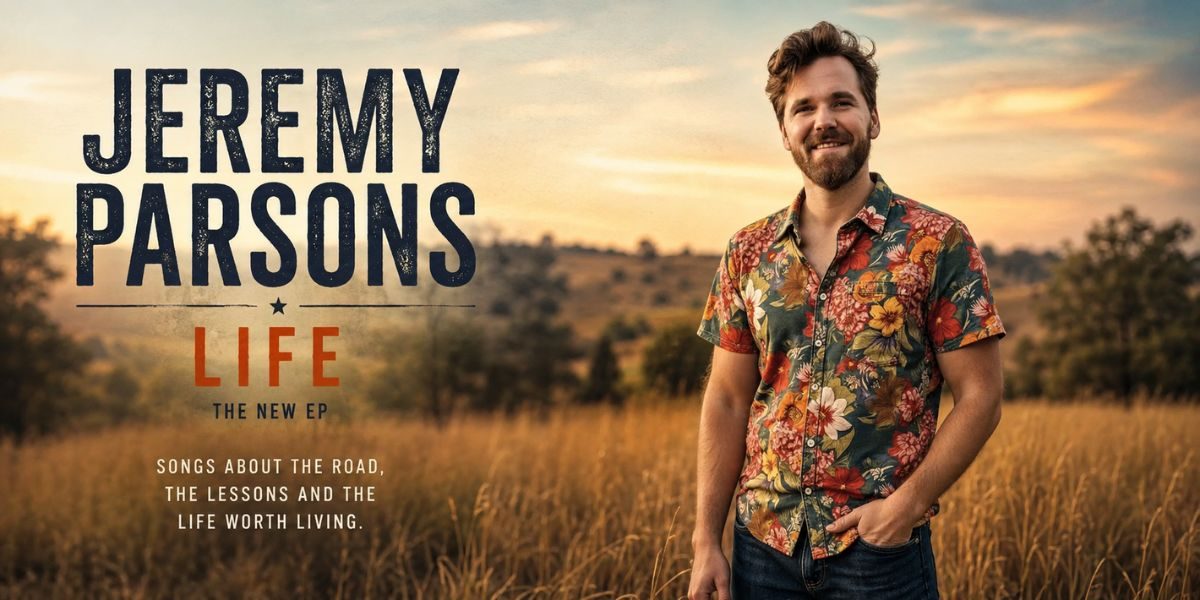
Jeremy Parsons knows the clock is running. Not in the frantic, YOLO sense that powers so much contemporary country, where mortality is apparently best confronted with a cooler full of beer, a truck and somebody wearing cutoff jeans. Parsons has something quieter in mind. On his five-song EP Life, the San Antonio-born singer-songwriter considers what happens when enough years have passed that you can finally see the person you used to be, and decide whether you like the person who survived him.
Written during the pandemic, when touring evaporated and Parsons suddenly had more time than a working musician generally wants, Life is a record born from involuntary reflection. Death tolls climbed, the economy buckled, social unrest dominated headlines, and an artist accustomed to moving found himself standing still.
So Parsons wrote.
That history could have produced an unbearably earnest collection of lockdown songs. Instead, Life largely avoids documenting the pandemic itself. Parsons uses that extraordinary period as a doorway into more enduring questions: Where did the years go? What did ambition cost? What do we owe one another? And when the final accounting arrives, did we actually live?
“Tickin’” establishes the thesis immediately. A clock hangs on the wall and does exactly what clocks have done while human beings have wasted centuries pretending otherwise. Parsons’ response isn’t despair but urgency. He argues that wasted youth isn’t necessarily wasted if you learn something from it.
That distinction matters. Parsons isn’t preaching optimization. He’s advocating experience.
There’s a loose philosophical streak running through these songs, but Parsons keeps dragging the big ideas back into ordinary life. That’s what makes “The Garden” so effective. Inspired by the world of his horticulturist father, it turns cultivation into an extended metaphor without strangling the song with symbolism. Parsons wonders what’s growing in another person’s garden and whether its health reflects the person tending it. Beneath the pastoral imagery lies something simpler and more moving: I hope you’re okay.
It’s country songwriting at its best, an uncomplicated image carrying considerably more weight than it initially appears capable of holding.
Then comes “Who Was I,” the record’s knockout.
Parsons remembers himself at 25 as a guy getting high, sleeping through days and living for nights while his parents’ lives appeared almost offensively sensible by comparison. They had a house, children, faith and stability. He had music.
Or perhaps music had him.
“Sometimes I wonder who’s chasing who, me or the dream,” he observes, and there in one thought is the biography of approximately half the songwriters who ever pointed a car toward Nashville.
Parsons eventually did make it to Music City. He also eventually moved back in with his father at 32. There’s no attempt to airbrush that detail. That’s precisely why the song works. Country music has always been terrific at mythologizing struggle once success has made struggle safely retrospective. Parsons refuses that luxury. He treats uncertainty as uncertainty.
His career ultimately rewarded the persistence. Over the years, Parsons has developed a substantial independent following, earned radio and international chart attention and maintained the kind of relentless live schedule that separates working musicians from people who merely release records. His Texas roots remain unmistakable, placing him somewhere in the expansive singer-songwriter territory occupied by artists such as Radney Foster, Bruce Robison and Walt Wilkins.
But Life isn’t a victory lap.
“Humanity” turns Parsons’ attention outward. Written against a backdrop of social fracture, it finds him staring at people who seem increasingly incapable of hearing one another. Crucially, he doesn’t position himself above the mess. He admits what he doesn’t know. That humility gives the song more force than another three-minute political sermon ever could.
Parsons isn’t asking listeners to agree. He’s asking them to remember they’re human.
Then there’s “Life Worth Dyin’ For,” the sort of title that practically dares a songwriter to become unbearable.
Parsons doesn’t.
Instead, he strips the idea down to its essentials: laughing until you cry, loving somebody, falling down, standing back up and doing whatever good you can manage while you’re here. He imagines those words eventually appearing where he’s laid to rest. Death becomes not a threat but a measuring stick.
It’s also impossible to hear Life now without considering where Parsons has arrived personally. He recently married, an intriguing development for an artist whose songs repeatedly examine the difference between freedom and belonging. The reckless 25-year-old of “Who Was I” couldn’t have known where the road would lead. That’s the point. Parsons isn’t renouncing that younger man; he’s acknowledging that the kid somehow got him here.
Across five tracks, Life accomplishes something that plenty of 15-song albums never manage: it has an argument.
Time passes. People change. Dreams mutate. Some ambitions disappear while others become deeper. The mistakes don’t vanish, but their meanings can.
Most importantly, Parsons understands that introspection doesn’t require misery. Life is ultimately a hopeful record, just not a naïve one. Its optimism has dents in it.
Jeremy Parsons has spent years traveling, writing and trying to turn songs into a sustainable existence. On Life, he stops long enough to ask whether the existence itself might have been the real achievement all along.
The clock keeps tickin’.
For once, Parsons sounds less interested in outrunning it than making every tick count.