
By: Stephanie Terr
The Bill That Took Ninety Minutes to Understand
When Andrew Parks’s wife was pregnant, their hospital bill included a thousand-dollar charge labeled miscellaneous lab. It took him ninety minutes of phone transfers to discover that someone had misplaced a decimal point. Andrew has an MD and an MBA, and he struggled. Most patients do not even know they can challenge a bill. That experience sits near the center of why The Modern Hospitalist: Merging the Art, Business, and Science of Medicine treats the business strand of medicine not as a distraction from clinical care but as an essential part of it. If physicians are not at the table when decisions are made about how resources are allocated, someone with less clinical insight will be. No margin, no mission is not cynicism, Andrew writes. It is what keeps the doors open for the patients who need them most.
What the MBA Taught Him at the Bedside
The most practical thing Andrew’s business education changed about how he practices is what he pays attention to before a patient goes home. Before discharge, he asks every patient where they live and who they live with. A perfect clinical plan fails if someone goes home alone and cannot care for themselves. That question is not in any medical school curriculum. It comes from understanding that the system a patient walks back into is as clinically relevant as the diagnosis they are leaving with. Andrew also thinks about workflow, documentation, and waste through the lens of lean principles and process improvement that his business training gave him. He thinks about how money moves and how badly it usually works for patients. He thinks about every bed, drug, and nurse hour as a finite resource that someone is going to allocate, and he believes it should be a physician making that call.
The Art He Almost Missed
For much of his training, Andrew saw patients as problems to solve. When classmates connected emotionally with patients, he privately worried they were losing their objectivity. He told himself they simply had different styles. What changed his mind was evidence he could not argue with. His highest patient satisfaction scores were for listening, not explaining, which surprised him. A patient who had been cycling through readmissions constantly finally stabilized after Andrew simply sat down and listened. The research in Compassionomics, which demonstrates that compassion measurably changes clinical outcomes, confirmed what he was beginning to observe. That is when he understood why the rope metaphor matters. Science, business, and art are not three separate professional identities a physician can choose among. They are three load-bearing strands of the same rope, and when one frays on a hard day, the other two hold the weight. If you rely on science alone, he writes, you will eventually snap. He believes that is part of why so many brilliant physicians burn out.
Micro-Mentorship and What It Produces
Andrew did not have a comprehensive handbook when he started out, so he built one out of people. He took one piece of wisdom from many people instead of searching for a single perfect mentor, a practice he calls micro-mentorship. He learned from the veteran hospitalists in his group, from nurses, pharmacists, and case managers, from colleagues who noticed when he was drowning and quietly helped him stay above water. The Modern Hospitalist is his attempt to compile what he gathered from that network and hand it to the next person starting out, before they have to live through the moments that taught him those lessons. The book is research-backed and candid in equal measure, which means it includes things Andrew was uncertain about putting in. Among them is his admission that he once thought compassion was optional. He left it in because he believes the honest version is more useful than the flattering one, and because he suspects many physicians, particularly analytical, type-A ones, carry the same assumption without recognizing it.
The Cathedral on the Hard Days
The book returns to Peter Drucker’s parable of the three stonecutters. One stonecutter is making a living. One is doing excellent work. One is building a cathedral. Andrew keeps returning to it because he believes the question of which stonecutter a physician sees themselves as is not abstract. It determines what happens on the days when the system is working against good care, when the EMR is full of alerts and documentation demands, when the schedule is impossible and the resources are thin. On those days, he relies on what he calls motivational collateral: when a patient interaction goes badly or an outcome hurts, he looks for energy in another strand of the rope. A win in one area carries him through a loss in another. He also says plainly that individual resilience is not enough. Even highly resilient physicians burn out in broken systems. Part of how he sustains himself is working on the system, not just inside it, helping build the culture where asking for help is normal and hidden gaps do not eventually reach patients.
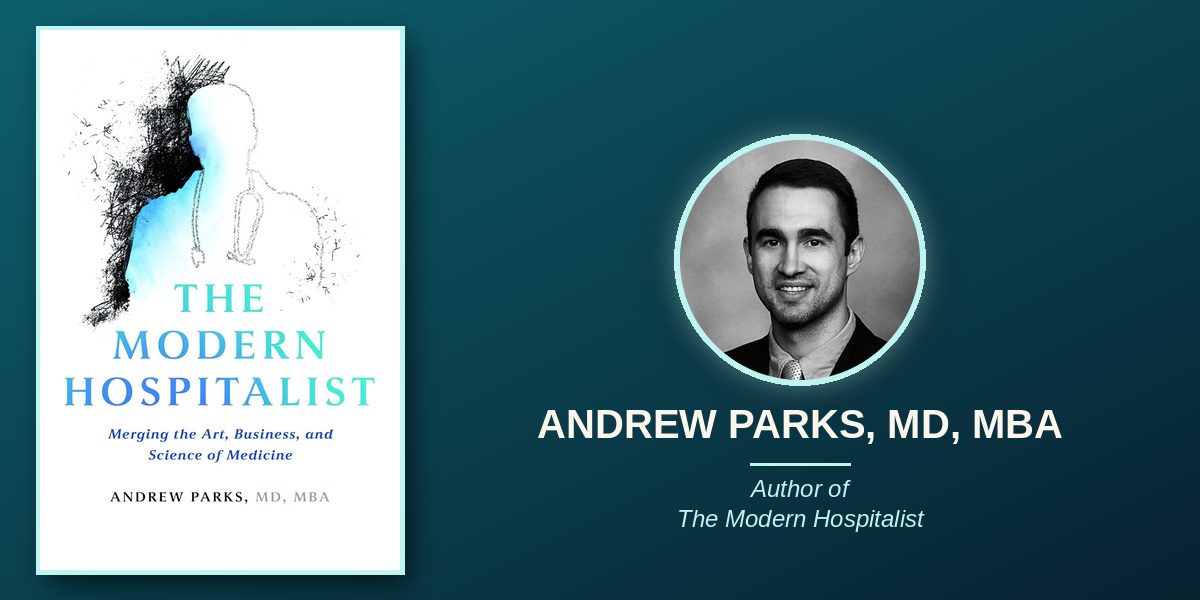
Pick up your copy of The Modern Hospitalist: Merging the Art, Business, and Science of Medicine by Dr. Andrew Parks on Amazon today.