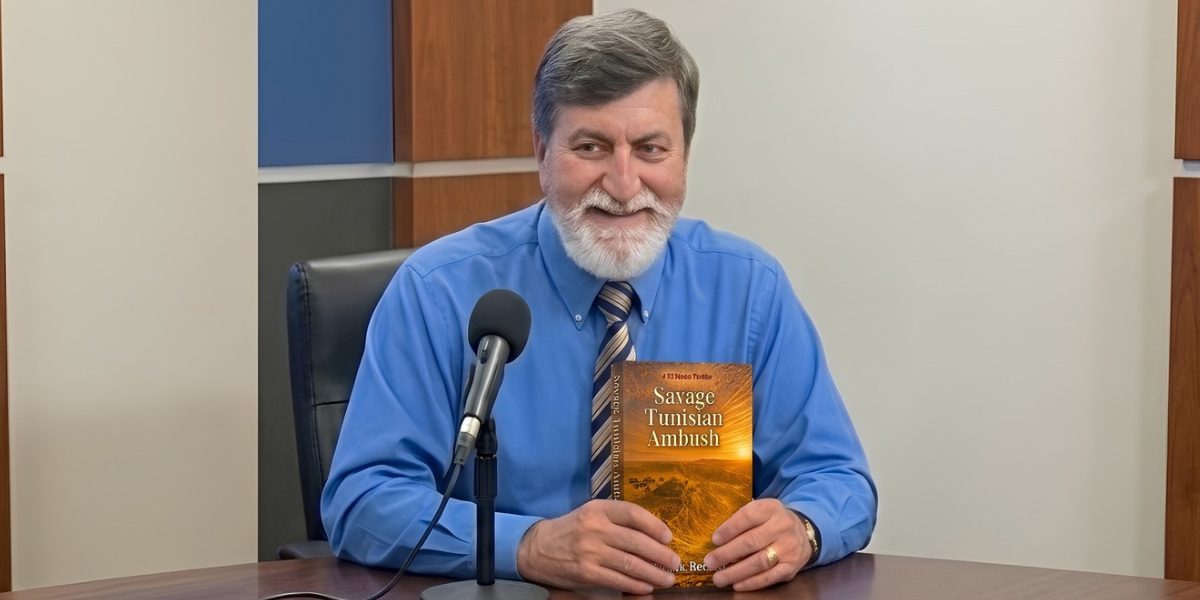

Savage Tunisian Ambush, the second installment in Chuck Beckett’s PJ Steele thriller series, is officially out now on Amazon Kindle and Paperback. Set against the demanding landscape of North Africa, the novel places Deputy U.S. Marshal and former Air Force Pararescue specialist PJ Steele in the middle of a high-risk extradition assignment that quickly becomes a fight for survival in the Tunisian Sahara.
The story’s intensity comes from more than its fictional mission. Beckett builds the novel around the kinds of geopolitical developments, international operations, and historical discoveries that regularly shape real-world headlines. Maritime rescues, diplomatic prisoner exchanges, security concerns across North and West Africa, archaeological research, and the legal mechanics of international extradition all provide context for a thriller designed to feel grounded in recognizable realities.
When International Extradition Becomes a Dangerous Assignment
At the center of Savage Tunisian Ambush is an extradition operation that takes Steele into North Africa. When the assignment goes wrong in the Tunisian Sahara, the mission becomes a struggle to survive across harsh desert terrain, with limited resources and uncertainty surrounding whom he can trust.
The premise draws attention to an often complicated aspect of international law enforcement: the transfer of individuals across national borders. Extradition is not simply a matter of locating a wanted person and placing that individual on a plane. It can involve diplomatic requests, treaty obligations, provisional arrests, judicial procedures, and coordination among government agencies.
The U.S. Department of Justice’s archived guidance on provisional arrests and international extradition requests outlines how international notices and diplomatic channels can become part of these processes. Such procedures provide a real-world framework for understanding the stakes behind a fictional assignment like Steele’s.
Beckett uses that broader environment to give the mission weight. The danger is not limited to physical confrontation. International jurisdiction, government interests, and the unpredictable circumstances surrounding an operation can make a seemingly defined assignment increasingly difficult to control.
Mediterranean Rescues and the Human Stakes of Maritime Crises
The Mediterranean is another important part of the geopolitical backdrop surrounding the novel. Its waters connect Europe, North Africa, and the Middle East, making the region significant for migration, maritime security, humanitarian operations, and international cooperation.
A report published by Malta-based outlet Newsbook in April 2024 examined allegations surrounding assistance provided to asylum seekers stranded at sea in the Maltese search-and-rescue region. The report illustrates the complicated circumstances that can arise when people are left adrift, rescue responsibilities intersect with national authorities, and humanitarian concerns unfold in strategically sensitive waters.
The article, Alarm Phone suspects AFM provided fuel to 30 asylum seekers adrift in Maltese SAR, offers a real-world reference for the maritime pressures that shape the wider Mediterranean environment.
For a thriller set in North Africa, this regional context helps establish a world in which geography, borders, and government decisions can influence the fate of people far beyond a single operation. These real events serve as background parallels, not as appearances by the individuals involved in the reports.
Tunisia’s Ancient Past Adds Another Dimension
The novel’s Tunisian setting also carries a historical dimension. The country is home to significant archaeological remains that reflect centuries of Mediterranean trade, settlement, and cultural exchange.
A February 2024 study published in Scientific Reports examined evidence of a catastrophic marine event along Tunisia’s eastern coastline during the fourth century. The research connected geological deposits, Roman archaeological materials, and historical evidence with the major earthquake and tsunami associated with Crete in 365 CE. The findings discussed damage to several ancient coastal settlements, including Neapolis, the Roman-era city associated with present-day Nabeul.
The research, Tsunami deposits in Tunisia contemporaneous of the large 365 CE Crete earthquake and Mediterranean Sea catastrophic event, demonstrates how archaeological and geological investigation can reveal the lasting effects of events that occurred more than 1,600 years ago.
That historical depth gives Tunisia a setting that extends beyond its modern political geography. Its ancient sites and coastal history offer a reminder that the region has long been shaped by movement, conflict, commerce, and natural forces. In Savage Tunisian Ambush, the presence of Cambridge-trained archaeologist Lauren Stewart also connects the story’s personal stakes with the broader world of archaeological discovery.
Prisoner Exchanges and the Unseen Work of Diplomacy
International prisoner exchanges provide another real-world parallel to the novel’s atmosphere. Such arrangements can involve sensitive negotiations, competing national interests, legal questions, and communication through diplomatic channels. Public announcements may reveal the outcome, but the negotiations behind an exchange can be considerably more complicated.
An August 2024 BBC report on a major prisoner exchange offers a contemporary example of how governments can negotiate the release and transfer of detained individuals across borders. The report, available through BBC News, provides context for the diplomatic realities that can surround international detention cases.
Separately, an April 2025 report by The Hill covered the release of an American missionary detained in Tunisia after 13 months. The case illustrates how detention involving foreign nationals can become a matter of international attention and diplomatic concern. The report is available at The Hill.
These events are not presented as plot appearances or direct accounts within Beckett’s novel. Rather, they demonstrate the real-world environment in which international assignments can become entangled with negotiations, national interests, and the uncertain status of people held abroad.
Security Concerns Across North and West Africa
The security environment across North and West Africa adds further context to the novel’s regional setting. Arms trafficking, illicit weapons movement, organized criminal networks, and cross-border security operations remain concerns for governments and international organizations.
In February 2024, the United Nations Office on Drugs and Crime highlighted Operation KAFO IV, an initiative addressing illicit firearms trafficking and terrorism in West Africa. The operation illustrates the importance of cross-border cooperation when authorities attempt to identify and disrupt weapons networks operating beyond national boundaries. Its coverage is available through the UNODC firearms protocol news page.
For readers, this broader security landscape helps explain why a mission in the region can carry consequences beyond the immediate objective. Beckett’s fictional assignment places Steele in an environment where limited information, unfamiliar territory, and competing interests can complicate even the most carefully planned operation.
A More Personal Mission for PJ Steele
While the international setting drives much of the suspense, Savage Tunisian Ambush also advances the personal story established in the first book. Steele must contend with the effect of his dangerous work on his relationship with Lauren Stewart, an archaeologist whose life and professional interests connect with the world he is trying to navigate.
The tension between professional duty and personal responsibility gives the second installment another layer. Steele’s assignment may take him into unfamiliar and dangerous territory, but the consequences reach beyond the mission itself.
The book also continues the expansion of the PJ Steele universe, with the next installment, Hostile Icelandic Defection, planned as Book 3.
Series Availability and Updates
Savage Tunisian Ambush is available now in Kindle and Paperback editions through Amazon.
Readers new to the series can begin with Book 1, Deadly Colombian Extradition. The free prequel novella, Violent Luxor Transition, is also available through PJSteeleNovels.com.
PJ Steele Novels maintains a presence on Instagram at @PJ_Steele_Novels and on Facebook at PJ Steele Novels for series updates and announcements.
Chuck Beckett is a U.S. Air Force veteran, instrument-rated pilot, certified rescue diver, and defense and security consultant with 25 years of experience. His background informs the tactical, aviation, and field-medicine elements that contribute to the realism of the PJ Steele thriller series.