
By: Johanny Parker
A Finding That Changes the Conversation
Raj Chetty and his colleagues analyzed twenty-one billion Facebook friendships and arrived at one of the most consequential findings in the recent social science of poverty: cross-class connection is the single strongest predictor of upward mobility we currently know of. If low-income kids grew up with the same cross-class friendships as high-income kids, their adult incomes would rise about twenty percent. That number is not a marginal effect. It is a structural outcome, and it points directly at something that most anti-poverty frameworks treat as background noise rather than primary infrastructure. Steven C. Taylor and Jason Janz built Together We Climb around the conviction that relational capital is as real and as load-bearing as a job, a paycheck, or a housing voucher, and that any framework serious about breaking the cycle of poverty has to invest in it deliberately.
What Relationships Actually Do
Jason Janz grew up in poverty and now leads CrossPurpose, and when he looks back at what made the difference in his own trajectory, the answer is not primarily a program or a credential. It is the people who believed in him, connected him to opportunities he would not have found on his own, and were there when the climb got hard enough to make stopping seem rational. That experience shapes the design of CrossPurpose at every level. The first day of the program is not about job skills or credential pathways. It is about getting to know each other. Every participant receives a weekly career coach and a dedicated volunteer ally who walks alongside them, not as a service provider but as a person who has decided to show up. There is a sign on the wall at every CrossPurpose site: there is no significant change without a significant relationship. That conviction is not aspirational. It is structural.
The Story That Explains Why
Tiffany finished CrossPurpose and started a new job. Then her daughter Maya went into cardiac arrest and was declared brain-dead, and her husband fell apart and went back to jail. She was three days from starting her new job with a child on life support. Her thought was that this is what happens when you try to climb. Her ally Rachel and Jason’s wife Jen Janz said they would take shifts, and for four months they attended every hospital meeting Tiffany could not make. That is what Jason calls expensive love. It costs something real. It shows up at inconvenient times. And it is the reason Maya walks and talks today and argues with her sister. Without that relational infrastructure, Tiffany’s economic gains would have collapsed under the weight of a crisis that no job training program could have anticipated or absorbed.
The Difference Between a Navigator and a Nicher
One of the most useful distinctions in Together We Climb is between organizations that address one piece of the poverty puzzle and those that stay with the person across the whole journey. CrossPurpose started as a nicher, a job training program focused on employment outcomes. It became something different when students began losing housing mid-course or having childcare fall through, making the training irrelevant regardless of its quality. What CrossPurpose evolved into is what Jason calls the family doctor of poverty: a navigator connected to more than two hundred partner organizations that knows the whole person and stays with them through setbacks, not just through the program cycle. Steve makes a parallel argument about the systems level. A single parent trying to access education, job training, and benefits support is currently dealing with multiple agencies, different eligibility requirements, and significant paperwork. The burden of connecting the pieces falls on the individual, when it should fall on the system.
What Utah Got Right
Utah pulled its workforce and benefits programs into a single Department of Workforce Services in the mid-1990s. One door, one plan, one relationship. The results over three decades have been measurable and significant. While national SNAP participation rose between 1994 and 2024, Utah’s fell. During the pandemic, Utah’s unemployment peaked at 4.9 percent while the national rate hit 8.4 percent. The state is now piloting financial coaching alongside benefits navigation so that people can take a raise without immediately losing the support that made the raise viable to accept. The coordination problem Steve identifies at the heart of the American poverty system is solvable. Utah has been solving it for thirty years. The question is not whether it is possible but whether the political will to replicate it exists elsewhere.
What Every Reader Can Do
Together We Climb ends every public presentation with the same question: did you climb alone? No one ever says yes. Someone hired you, mentored you, connected you, believed in you, or simply showed up when things were falling apart. The book’s ask is specific. If you are a policymaker, look for the cliffs in your programs. If you are a business leader, ask whether your entry-level jobs lead somewhere. If you are a neighbor, you have something no institution can manufacture: proximity. One of CrossPurpose’s partners puts it simply: start with dinner. The relational infrastructure that changes lives is built one relationship at a time, and every person who has benefited from someone else’s decision to show up has the capacity to offer the same thing to someone else. That is the core argument of Together We Climb, and it is the one the book makes with the most urgency.
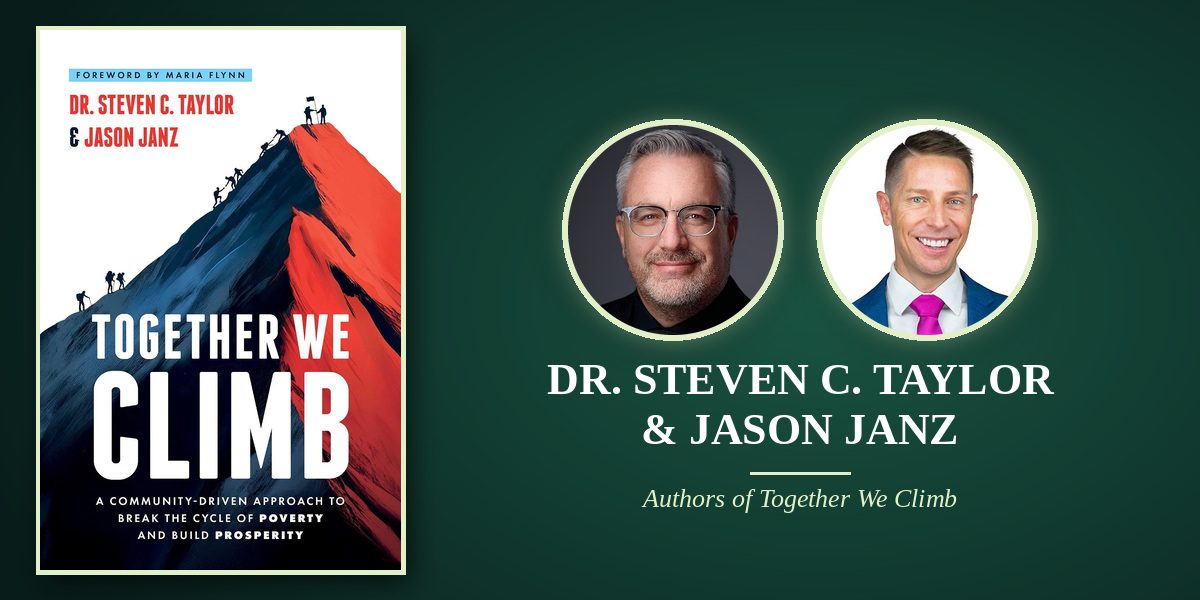
Pick up your copy of Together We Climb by Steven C. Taylor, Jason Janz, with a foreword by Maria Flynn on Amazon today.