
By Jenna Whitmore
For Ananda Xenia Shakti, music has never been merely a matter of melody, rhythm or commercial calculation. It has been rebellion, liberation, healing and, increasingly, spiritual practice. On “Devotion,” her latest single with Love Power the Band, those impulses converge in a hypnotic piece of devotional pop that makes an argument for slowing down in a musical culture obsessed with speeding up.
The song comes with an origin story worthy of its title. Ananda was attending a silent meditation retreat in the mountains of Andhra Pradesh, India, when physical illness interrupted her plans for contemplation. Awake in the middle of the night and unable to meditate comfortably, she began softly singing the names of Radha and Krishna. Soon, a melody started forming around the Hare Krishna Maha Mantra.
What began as self-soothing became songwriting; or, as Ananda might describe it, receiving.
That distinction matters when listening to “Devotion.” The track doesn’t feel constructed around the usual architecture of verses engineered to reach a chorus at precisely the right moment. It unfolds instead. The arrangement moves with the patient quality of breath, allowing repetition, atmosphere and Ananda’s vocal presence to create momentum.
Love Power the Band wisely avoids cluttering that experience. Ambient textures, subtle rhythmic movement and world-music colors surround Ananda without competing with her. The production possesses a spaciousness that gives individual sounds time to appear and disappear, resulting in music that feels simultaneously intimate and expansive.
At its center is Ananda’s voice. She sings “Devotion” with warmth rather than vocal spectacle, emphasizing emotional connection over technical display. There is something inviting about her restraint. She doesn’t appear interested in proving anything to the listener; she sounds more concerned with sharing what she discovered.
That approach reflects an artistic journey considerably more complicated than the average New Age biography.
Long before she was singing devotional music, Ananda performed as Xenia Holliday with The B-Girls, the pioneering all-female punk band that emerged during the late-’70s explosion. Barely into adulthood, she found herself touring with The Clash during the London Calling era, performing in legendary clubs and eventually contributing backing vocals to Blondie’s AutoAmerican.
Then, with greater industry success seemingly within reach, she walked away.
A spiritual awakening redirected her attention toward meditation, yoga and the exploration of consciousness. She would eventually become a yoga instructor and teacher, spend extensive time in India and develop an artistic practice connecting movement, music and spirituality.
The distance between those two lives seems enormous until “Devotion” reveals the connection.
Punk, at its best, was a rejection of conditioning. It demanded freedom from established rules about who could create, what music should sound like and how artists were expected to behave. Ananda’s current work pursues freedom from a different set of constraints: fear, ego, separation and the incessant chatter of the analytical mind.
In other words, the guitars may have disappeared, but the rebellion hasn’t.
“Devotion” also benefits from avoiding the glossy spirituality that sometimes reduces mindfulness to a marketable aesthetic. The song began with an unglamorous human reality: Ananda was sick. Her body was uncomfortable. Her carefully planned retreat wasn’t unfolding as expected.
Yet that contraction became the doorway to something expansive.
It’s an appealing metaphor, but the recording doesn’t require listeners to subscribe to Ananda’s particular spiritual worldview to appreciate it. Someone can hear the song as sacred mantra, meditation music, atmospheric pop or simply a beautifully rendered moment of stillness. Its accessibility comes from feeling rather than doctrine.
That quality gives “Devotion” intriguing crossover potential. It belongs naturally within New Age, wellness, yoga and meditation spaces, yet its cinematic atmosphere and melodic sensibility could connect with listeners drawn to ambient pop and global music. At a time when streaming has increasingly dissolved the borders between once-rigid genres, that ambiguity works in the song’s favor.
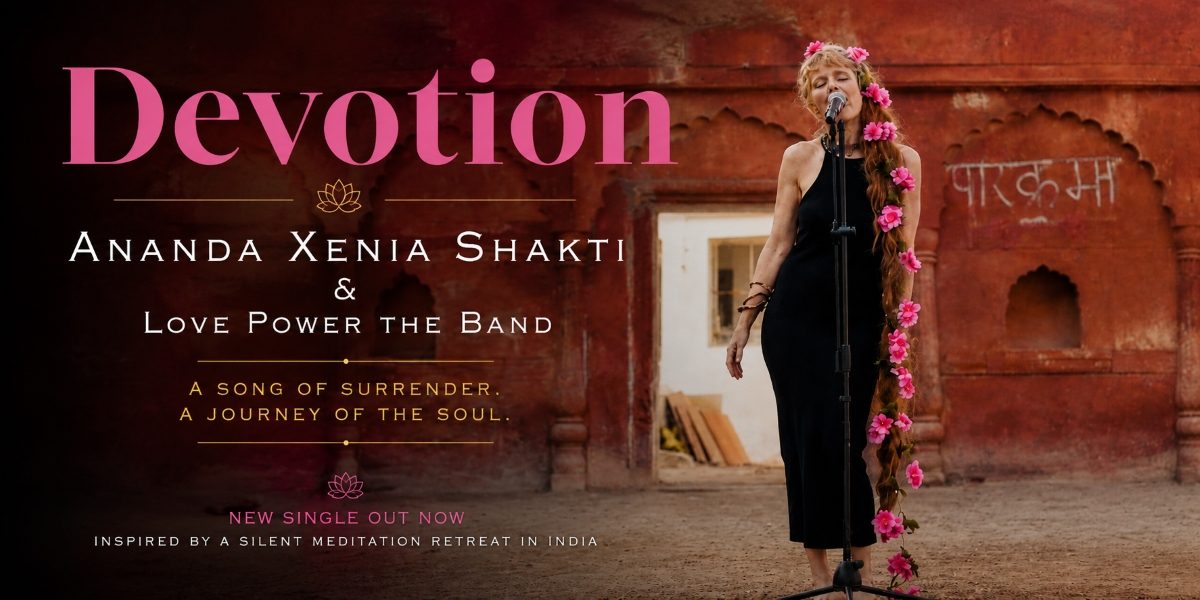
The accompanying visual presentation strengthens the release further, drawing upon Ananda’s connection with India and the sense of beauty and surrender embedded in the recording. Her background as a creator and performer is apparent: “Devotion” isn’t simply being treated as an audio track but as part of a larger artistic experience.
And that may be where Ananda Xenia Shakti and Love Power the Band are most interesting.
This isn’t an artist attempting to recreate the excitement of her punk-rock past. Nor is she rejecting that history. She’s absorbing it into something new. The teenager who learned from The Clash that conviction could become art is still present; she has simply found a different cause and a different vocabulary.
“Devotion” asks for something unusual from contemporary listeners: patience. Give it that, and the song gradually changes from something playing in the background into something enveloping the room.
“Devotion” is less concerned with chasing a moment than creating one. In an industry forever asking artists to become louder, faster and more immediately consumable, Ananda Xenia Shakti has chosen surrender instead.
Sometimes the quietest choice can make the strongest statement.