
By: Dar Dowling
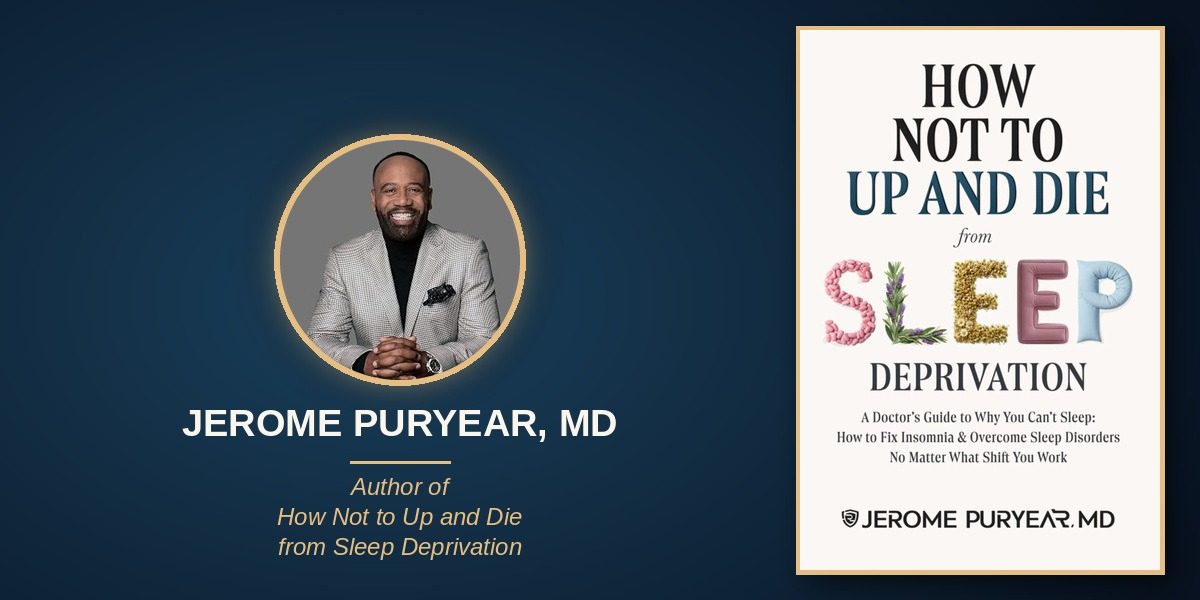
There is a particular cruelty in being a physician who cannot sleep. You understand the biology. You know the cascade of consequences. You have read the studies on the glymphatic system, on circadian disruption, on what fractured rest does to the cardiovascular system over time. And still, somewhere between the 2 a.m. emergency call and the feeding schedule of a newborn daughter, your body starts demanding something you no longer know how to give it. That is where Dr. Jerome Puryear found himself, and that collision between clinical knowledge and lived exhaustion is what makes How Not to Up and Die from Lack of Sleep a genuinely different kind of sleep book.
Puryear is a board-certified diagnostic and interventional radiologist who spent years on the front lines of medicine before his own diagnosis with obstructive sleep apnea forced a reckoning. He did not write this book from a distance. He wrote it from the memory of slapping himself awake on predawn drives home, terrified of the microsleep that could end his life or someone else’s. That proximity to real consequence gives his voice an urgency that no amount of research citations alone could manufacture.
The book is organized across four parts that can be read as a full arc or as standalone guides depending on what a reader most urgently needs. Part I dismantles myths with cheerful precision. No, your body does not get used to chronic sleep deprivation; it compensates until it cannot. No, the older you are does not mean you need less sleep; it means the sleep you do get becomes harder to achieve. No, decaffeinated coffee is not caffeine-free, and that detail matters if you are still puzzled by your 11 p.m. restlessness. These are not scoldings. Puryear writes them the way a doctor talks to a patient he respects: directly, without theater.
Part II covers sleep disorders with clinical clarity, addressing insomnia, apnea, narcolepsy, restless legs, and circadian rhythm disorders while also mapping the relationship between sleep and mental health, hormonal function, and neurological conditions. Part III makes a compelling case that every person living inside a modern schedule is, in meaningful ways, functioning like a night shift worker. The disruption of natural light and dark cycles, the compression of rest into rigid work-around blocks, the normalization of running on caffeine and cortisol: these are not fringe experiences. They describe most working adults. That reframing is quietly radical.
Part IV offers the toolkit: natural sleep aids, breathing techniques, progressive muscle relaxation, a six-step sleep routine, an examination of what CBD and THC do and do not do for sleep quality, and a thorough look at emerging sleep technology and AI-powered tools. This section moves quickly because Puryear trusts his reader. He does not oversell any single intervention. He builds the case that sustainable rest requires a layered approach.
What holds all four parts together is a voice that refuses to let exhaustion remain abstract. The human cost is specific. The science is cited. The personal stories, including patient accounts shared with permission, make the physiological real. Puryear does not write like someone who wants to alarm you. He writes as someone who has watched alarm come too late and decided to build the guide he wished had existed sooner.
For more about the author and the book, visit drjeromepuryear.com.
Disclaimer: This article is for informational and educational purposes only and does not constitute medical advice, diagnosis, or treatment. Readers should consult a qualified healthcare professional before using sleep aids, supplements, or other interventions, particularly if they have an existing medical condition or suspect a sleep disorder.