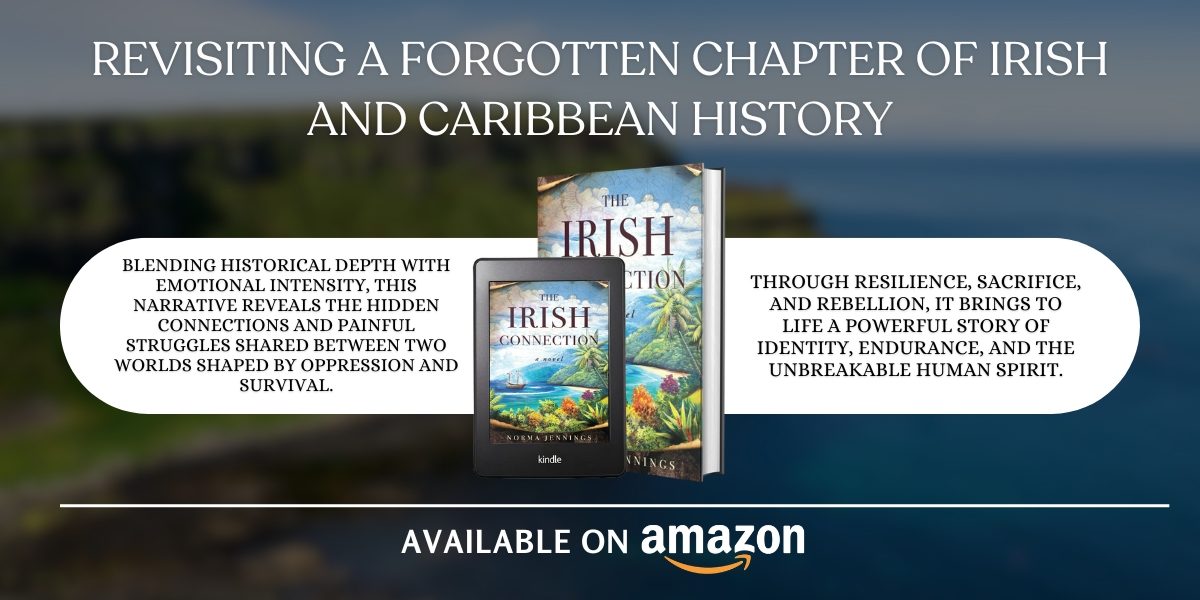

In the current literary landscape, historical fiction often risks becoming a safe, predictable stroll through the past. It is less likely that we see a novel that truly describes or redefines an era that we have overlooked or forgotten.
Then, out of the blue, there comes a novel like The Irish Connection by Norma Jennings that delivers a strong pinpoint to address this gap. It doesn’t just invite you to witness history; it transports you through the mud, the salt spray, and the smoke of rebellion until you are breathless.
Spanning the harrowing distance between the skeletal remains of Famine-era Ireland and the sun-drenched, blood-soaked sugar plantations of 19th-century Jamaica, Jennings has crafted a saga that is as much a testament to human resilience as it is a searing indictment of imperial cruelty.
The story opens in the winter of 1846 in West Cork, a place where the air is thick with the stench of rotting potatoes and the silence of the dying. We meet Sean O’Sullivan, a young man who has watched his world collapse into a literal “hell-on-earth.” The imagery Jennings employs is hauntingly visceral: dogs gnawing at the emaciated bodies of children on the roadside and families huddled in mud cabins waiting for a cup of soup that may never come. When Sean loses his mother to typhus, he is forced onto a “coffin ship,” a hurricane-battered vessel where the only certainty is misery.
However, the true brilliance of Jennings’ narrative begins when Sean arrives in Jamaica. Far from finding a tropical paradise, he is thrust into a new nightmare as an overseer for a brutal British planter. Here, the novel enters a sophisticated moral gray area. Sean, having been a victim of British “laissez-faire capitalism” in Ireland, now finds himself the unwilling tool of that same system in the Caribbean. He is a man defined by “loss and redemption,” tasked with whipping slaves while his own heart bleeds for their plight.
The narrative pivot comes through Sean’s secret alliance with the Maroons, fierce warriors who had maintained their independence from the British for over a century. Through the characters of the warrior Olumbo and the sophisticated Asha, Jennings unveils a “silent support” and a deep historical bond between the Irish and the African-Jamaicans.
Every page and chapter of this book delivers a strong portrayal of Irish history that we have long forgotten and only see in those dusty history books. From the beginning to the end, and from each challenge and point in time into a specific period in the heritage, this book brings history to
life. You will get to witness a rich and detailed story with a fresh perspective on Irish history and connections. From various revelations to a twist and a turn, the bitter realities of survival, this book will keep you hooked till the last page.
Jennings, a four-time award-winning author born in Jamaica, writes with a “painstaking detail” that stems from her own family history. She explores why Irish names like O’Connor and Murphy are so prevalent in Jamaica today, tracing the lineage back to this era of shared struggle. The Irish Connection is more than a book; it is a bridge between two islands, proving that the spirit of rebellion is a universal language that can never be fully silenced.
If you love historical fiction and stories that will explore the realities of life and its brutal challenges with thrill, anticipation, and grit, this book has to be on your reading list.
Availability:
This book is available on Amazon for purchase: https://www.amazon.com/dp/1952439612
Book Details
Book Name: The Irish Connection
Author Name: Norma Jennings
ISBN Number: 978-1952439612
Ebook Version: Click Here
Paperback Version: Click Here