What Catherine Rocheleau Wants Leaders to Understand Right Now

By: Ann Johnson

Business consultant Catherine Rocheleau has spent decades working with leaders who appear steady on the outside but are carrying far more than most people realize.

As Founder and CEO of Ignite Leadership International®, she works closely with senior leaders and business owners managing growth, change and constant pressure. After stepping back into the public spotlight following a period of personal and professional reset, her perspective has shifted in a way that feels both sharper and more grounded.

At the center of her work is a belief that challenges how leadership is often practiced. When leaders lose clarity, everything else feels heavier than it should.

In this conversation, Rocheleau shares what leaders are really facing behind the scenes and why many of them are more stretched than they let on.

Q: You’ve worked with leaders for many years. What are you seeing that others may not fully understand?

Catherine Rocheleau: I think what people don’t always see is how much leaders are actually carrying on their own.

From the outside, it can look like they have everything under control. They’re making decisions, supporting their teams and keeping things moving. But when you sit down with them, there’s often a different layer underneath that. There’s pressure to get it right, pressure to not let people down, and sometimes a quiet sense of, “I don’t actually have the space to think this through properly.”

And because they’re the ones everyone turns to, they don’t always feel like they have a place to bring that. So they just keep going. Over time, that starts to build. It doesn’t always show in obvious ways, but you can feel it in how they’re thinking and how they’re leading.

Q: Why do you think that pressure feels more intense right now?

Catherine Rocheleau: Leadership has changed quite a bit, even in the last few years.

It’s no longer just about driving results or setting direction. Leaders are holding a lot more. They’re expected to support their teams, navigate uncertainty and respond to things that are shifting quickly, often all at once. And there isn’t always a clear moment where they can step back and reset.

What I see happen is that many leaders respond by trying to keep up with that pace. They move faster, take on more, and push through because that’s what’s needed in the moment. But eventually, that way of operating catches up to them.

Not because they’re not capable, but because there hasn’t been space to actually process what’s going on and make decisions from a clearer place.

Q: You often speak about clarity. What does that actually mean for a leader day to day?

Catherine Rocheleau: For me, clarity isn’t something abstract. It’s very practical.

It shows up in how a leader makes decisions, how they prioritize, and even how they show up in conversations. When someone is clear, you can feel it. There’s less hesitation, less second-guessing, and more focus on how they move forward.

Without that clarity, everything can start to feel reactive. Leaders end up solving whatever is in front of them instead of stepping back and asking, “Is this actually the right thing to be focusing on right now?”

I’ve seen leaders completely shift how they operate once they give themselves that space. It’s not that they suddenly learn something new. It’s that they finally have room to think, and that changes the quality of every decision that follows.

Q: There’s still a belief that human-centered leadership is soft. How do you view that?

Catherine Rocheleau: I think it’s one of the biggest misconceptions in leadership.

People sometimes associate human-centered leadership with being overly accommodating or avoiding difficult conversations, but that’s not what it is at all. In fact, it requires a different level of clarity and consistency from a leader.

You still have to set expectations. You still have to hold people accountable. The difference is that you’re doing it with awareness of how your actions impact the people around you.

In my experience, when leaders take that approach, performance doesn’t decline. You actually strengthen it. People are more engaged, they take more ownership, and there’s a level of trust that makes everything work better over time.

Q: Tell us about your Catalyst coaching program. Who is it designed for?

Catherine Rocheleau: It’s really designed for leaders who are already deep in their work.

These are people who have built something, who are responsible for others, and who are used to being the one others rely on. On the surface, things are moving, but underneath there can be a sense of pressure or even a bit of disconnection from how they want to lead.

What they often say to me isn’t, “I need more strategy.” It’s more like, “I need to think clearly again,” or “I feel like I’m constantly reacting.”

Catalyst gives them that space to step back without stepping away. It allows them to look at what’s happening from a different perspective and then move forward in a more intentional way. Once that shift happens, everything else starts to align more naturally.

Q: You’ve spoken about your own turning point. How did that experience shape your work?

Catherine Rocheleau: It had a significant impact on how I see leadership now.

I went through an extended medical sabbatical, and during that time, I had to stop in a way I hadn’t before. I couldn’t rely on the same pace or the same habits, and that forced me to look at things differently.

What became very clear to me was how many leaders are operating without real support. It’s almost expected that they’ll just keep going, no matter what’s happening.

When I came back to my work, I didn’t want to approach it in the same way. There’s a stronger focus now on sustainability and on making sure leaders are supported in ways that actually hold up over time, not just in the short term.

Q: What would you say to a leader who feels overwhelmed right now?

Catherine Rocheleau: I would start by saying that feeling overwhelmed doesn’t mean something is wrong with you. It usually means there’s too much being held at once.

The first step is to pause, even though that can feel counterintuitive. When everything feels urgent, slowing down is often the last thing a leader wants to do, but it’s what allows them to see clearly again.

And the other piece is recognizing that you don’t have to carry everything on your own. Leaders are so used to being the support system for others that they don’t always think about what support looks like for them.

But when they do have that support, even in a small way, you start to see a shift. They think differently, they lead differently, and that impact extends far beyond just them.

For Rocheleau, leadership is not about pushing harder or doing more.

It’s about seeing clearly, making decisions with intention, and leading in a way that can actually be sustained over time.

To learn more about Catherine Rocheleau and her work, visit igniteleadership.co.
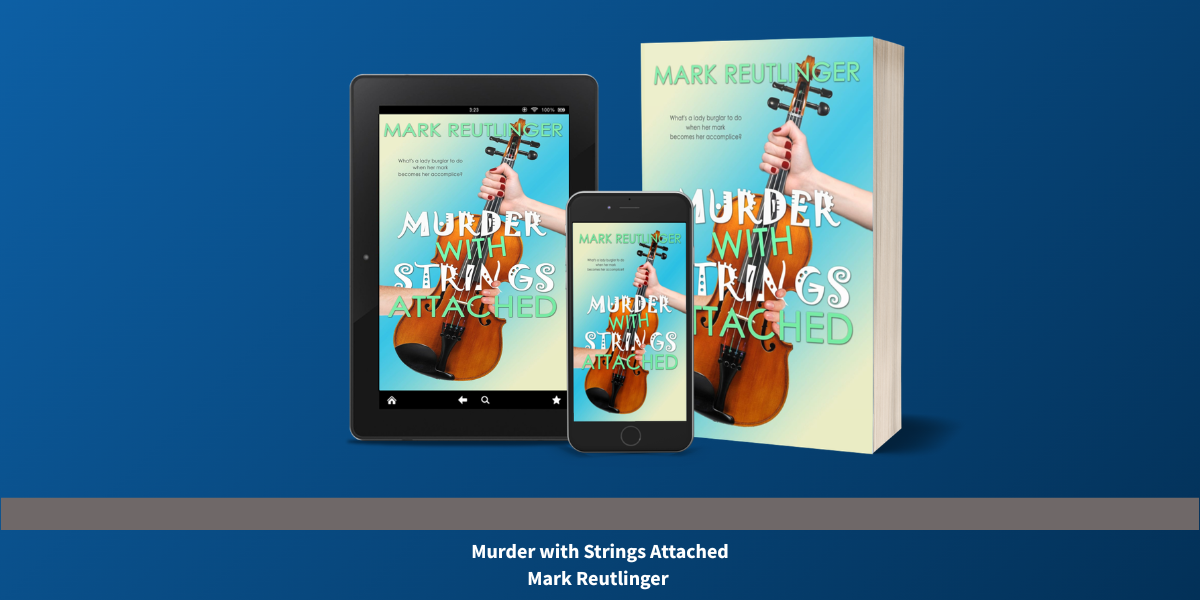
Mark Reutlinger’s Murder with Strings Attached Gives the Cozy Mystery a Martini, a Lockpick, and Better Punchlines

By Andrew Carter

There is something deeply satisfying about a mystery novel that knows exactly how ridiculous it is and refuses to apologize for having fun. Murder with Strings Attached operates with that kind of confidence from the very beginning. Mark Reutlinger takes the bones of a cozy mystery, flips them sideways, adds a professional burglar with excellent comic timing, and somehow ends up with a caper that feels both old-fashioned and weirdly fresh at the same time.

Florence Palmer, better known as Flo, is immediately the best thing in the room. Not because she is quirky in the manufactured “book club heroine” sense, but because she feels like someone who already knows who she is and stopped worrying about whether society approves years ago. She breaks into homes for a living. She is middle-aged, sharp-tongued, impatient with foolishness, and completely free of the usual fictional baggage where women over forty are forced into existential panic about aging. Flo is not trying to rediscover herself. She already did that. She just happens to do it while carrying burglary tools.

The setup is delightfully absurd in exactly the right way. Flo breaks into the home of famous violinist Aaron Levy, intending to steal his priceless violin, only to discover somebody got there first. Then Aaron catches her standing in the middle of the crime scene and, instead of calling the police, hires her to steal the violin back from the billionaire he believes took it. It is the kind of premise that could collapse instantly if handled too seriously. Reutlinger understands this completely, which is why the novel never strains for realism it does not need.

Instead, the book leans into rhythm, chemistry, and comic momentum.

The dialogue carries almost the entire novel, and honestly, that turns out to be the right choice. Reutlinger writes conversations with this breezy noir snap that feels indebted to old detective films without sounding trapped inside nostalgia cosplay. Characters interrupt each other, tease each other, complain, bluff, and panic in ways that feel genuinely alive. The prose moves quickly because the people inside it are always bouncing off one another.

Flo’s relationship with Aaron especially gives the story its energy. Aaron could easily have become a bland “straight man” character beside Flo’s chaos, but Reutlinger gives him enough dry exasperation and nervous charm that their scenes constantly spark. Add Sara into the mix, calm and capable in all the ways the others are not, and the novel develops a surprisingly lovable little criminal ensemble.

What surprised me most was how affectionate the book feels beneath all the theft, deception, and accusations of murder. Reutlinger clearly enjoys these characters. Even the campier moments carry warmth instead of smugness. The story understands human absurdity without becoming cynical about it.

The murder plot itself twists just enough to keep things moving, though honestly, the mystery almost becomes secondary to the pleasure of spending time with the characters while they stumble through escalating complications. That balance works because the novel never pretends to be darker or more profound than it actually wants to be. It aims for wit, momentum, charm, and occasional chaos and hits all four consistently.

There is also something refreshing about the age of these characters. So much contemporary crime fiction seems terrified of letting middle-aged or older characters remain impulsive, flirtatious, reckless, or funny. Reutlinger lets them be messy adults with histories instead of turning them into stereotypes about aging gracefully.

By the end, Murder with Strings Attached feels like stumbling into a very good late-night movie you intended to watch for twenty minutes and somehow finished smiling through the credits. It is playful without becoming disposable, clever without showing off, and just self-aware enough to make the sillier moments land even better.

Flo Palmer deserves many more crimes.

Mark Reutlinger’s Murder with Strings Attached is available on Amazon.

Meta Launches Instants, a New Instagram Feature for Sharing Disappearing Photos

Meta announced on Wednesday the global rollout of Instants, a new Instagram feature for sharing authentic, disappearing photos after testing it with select users. The launch also introduces a standalone Instants app, available in select countries on iOS and Android, giving users faster access to the camera for spontaneous sharing.

The feature represents Meta’s effort to bring casual, in-the-moment photo sharing back to Instagram, a platform that has increasingly been dominated by polished posts, advertisements, and influencer content.

How Instants Works

Users can access Instants directly from their Instagram direct message inbox. The new feature will appear in a user’s direct message inbox, which looks like a pile of small photos. Tapping the icon opens the camera, allowing users to snap a photo in real time.

Unlike Stories or regular posts, the format doesn’t allow uploads from your camera, and, although you can add text to your instants, you can’t modify them any further. There are no filters, stickers, or editing tools available. Captions must be added before sharing, not after.

Once shared, users can choose to send the photo to their Close Friends list or to mutual followers, meaning accounts that follow them back. Recipients can react with emojis, reply, and send an Instant back, with replies routed directly to DMs rather than appearing on the photo itself.

Ephemeral by Design

Instants are built around the idea of temporary sharing. Instants are ephemeral photos that disappear from Instagram after they’re viewed by a user’s friends or after a 24-hour period. After viewing, the photos vanish from recipients’ inboxes.

For senders, however, the photos are not lost. Instants photos are only displayed for a short period, but they are saved to a user’s archive for a year and can be reshared to Stories. Users can compile their archived Instants into a recap and post it to Stories for their broader audience.

Privacy features are baked into the format. Meta said recipients can’t screenshot or record Instants that you’ve shared. If a user accidentally sends an Instant, an undo button allows them to retract it before friends open it. Deleting an Instant from the archive also unsends it to anyone who has not yet viewed it.

A Standalone App

Alongside the in-app feature, Meta is testing a separate Instants app. Instagram says it’s been experimenting with that in certain countries on iOS and Android. The company explained that early testers wanted quicker access to the camera, which prompted the development of a dedicated app.

The Instants app gives you immediate access to the Instants camera — just log in with your Instagram account to get started. Instants work the same across both apps, meaning instants shared via the app will reach your friends seeing them on Instagram, and vice versa.

The standalone app draws comparisons to Snapchat, which pioneered the ephemeral photo-sharing format, as well as BeReal and Locket, both of which gained traction by emphasizing unfiltered, real-time updates.

Safety and Teen Protections

Meta said Instants will operate under Instagram’s existing safety framework. The Instants feature and app also use all of Instagram’s normal safety and privacy protections, including blocking and muting other users. Parental supervisions for teen accounts on Instagram proper are automatically applied to Instants, including shared time limits, safety tools and restricted access by default between 10PM and 7AM.

Parents of teens with supervised accounts will receive a notification when their child downloads the standalone Instants app. Users who do not want to receive Instants can hold down the inbox icon and swipe to pause incoming photos, or block and mute specific accounts.

Competing in a Crowded Space

Instagram’s move comes as the broader social media industry shifts toward private, lower-pressure sharing among smaller circles. Although Instagram began as a way for friends to share moments with each other, the platform has gradually become overrun with influencer content and ads. With Instants, the company looks to be leaning back into more casual, private interactions centered around photo sharing among circles of friends.

Industry observers note that Meta may face challenges in carving out a niche. Instagram may be a bit late to capitalize on the trend of low-pressure, authentic photo sharing, as BeReal is not as popular as it once was, and many users already use Instagram Stories for fast, informal updates.

The Instants feature is rolling out globally on Instagram starting Wednesday, and the standalone Instants app is available for download in countries where it is supported.

Why Business Owners Across the Country Are Choosing Fundivi for Fast, Trusted Business Funding

By: Steven Kay

When a business needs capital, two things matter above everything else: speed and trust. The lender has to move fast, and the business owner has to know they are working with someone who genuinely has their best interest in mind. Fundivi has built its entire operation around those two principles, and the results speak through the voices of the business owners and partners who have experienced it firsthand.

As a leading business lender, Fundivi has established deep authority in the alternative lending space by combining institutional credibility, a frictionless application process, same-day underwriting, and a team that treats every client like a priority. For business owners tired of being shuffled through slow, impersonal lending processes, Fundivi offers something rare: a lender that actually shows up.

BBB Accredited. Credibility You Can Verify.

Fundivi is a Better Business Bureau (BBB) accredited business. That distinction matters in a lending industry where trust is not always easy to establish. BBB accreditation is earned, not purchased. It requires meeting defined standards around transparency, honest advertising, and responsive customer service. For a business owner evaluating lenders, that accreditation is an independently verified signal that Fundivi operates with accountability. It is the foundation the company has built everything else on top of.

What Real Business Owners Are Saying

The most accurate picture of any lender is not found in its marketing. It is found in what clients say when no one is asking them to. Fundivi’s Google reviews paint a consistent picture of a company that delivers on its promises, treats business owners with respect, and shows up when it matters most.

Brenda Williams left a five-star review describing her experience: Fundivi makes things happen every time she needs them to. She noted that the team truly has business owners’ best interests in mind and expressed genuine gratitude for the expertise and guidance she has received, adding that she will continue working with Fundivi into the future.

David Jackson, a client for two to three years, described a relationship built on reliability. He calls, and the funding happens the same or next day. That kind of consistent, on-demand access to capital is exactly what growing businesses need from a lending partner.

Jonathan Harris of AutoMed described working with Joey Danan at Fundivi as one of the best business decisions his company has made, noting that Joey communicates clearly, steps up fast in cash flow crises, and is genuinely invested in client success. Because of Fundivi’s support, AutoMed continues investing in its business and its team.

Jessica Lesly, a nail salon owner, described how previous lenders tried to maximize her loan amount and interest charges. Fundivi advised her to start appropriately for her cash flow and walked her through the process honestly, helping her escape a lending pattern other companies had used against her.

Gino Angelo Dorantes, who runs a remodeling business in California with his mother, described a period when cash flow was tight and the stress was affecting his family. Morris Cohen at Fundivi answered calls at 3 AM Eastern Time to help work through problems. Gino wrote that Morris changed the trajectory of their lives. The remodeling company is now thriving, taking on bigger projects, and stable as a family business.

Eric Atkins, a trucking company owner, described his business as being on the verge of shutting down six months ago. Morris Cohen stepped in, stayed in constant communication, and found solutions when everyone else said no. Eric kept his trucks running, his drivers paid, and his family financially stable, and he credits Fundivi directly.

Kellye Hall noted that Morris Cohen at Fundivi was one of the few people in the funding industry who made her feel genuinely respected, heard, and prioritized. She described the experience as honest, professional, and free of pressure. Real communication and real results.

Michael Pennington, a repeat client, described Morris as thorough, easy to work with, and consistent across multiple transactions, noting that the process is simple every single time.

Shobi Irfan summarized the Fundivi experience directly: the best place to get a quick loan at a reasonable rate.

Nicole Ramirez described Fundivi as making the funding process smooth, fast, and stress-free, with a team that was professional, responsive, and transparent at every step. She singled out Morris Cohen as especially knowledgeable, trustworthy, and always available, and called Fundivi a highly recommended funding partner for any business looking for reliability.

Endorsed by a Lending Partner

The trust Fundivi has built extends beyond its direct clients. Zen Funding Source, a lending partner operating within Fundivi’s network, left an unprompted five-star review on Trustpilot in May 2026. Zac W., representing Zen Funding Source, described working with Fundivi as a great experience, pointing to Fundivi’s professionalism and clear communication as what makes every deal straightforward. The review concluded with an open recommendation to any business of any size looking for additional capital.

An unsolicited endorsement from a lending partner carries a different weight than a client review. It means Fundivi’s standards hold not just with end clients, but across every level of the business relationship.

A Two-Minute Application Built for Business Owners

Most business owners do not have time to spend hours on a loan application. Fundivi was designed with that reality in mind. The application takes approximately two minutes to complete. Business owners provide basic information about their company and their funding needs, and that is genuinely all that is required to get started. The interface is clean and intuitive, built for people running businesses. There is no lengthy intake questionnaire, no confusing document portal, and no ambiguity about what happens next. Once submitted, the Fundivi team moves immediately with no queue, no waiting period, and no back and forth that stretches across days.

Underwriting in Hours, Not Days

The underwriting process is where most lenders lose business owners. Traditional banks require committee approvals, collateral assessments, and multiple review cycles that can stretch from days into weeks. By the time a decision arrives, the opportunity that required the capital has often passed.

Fundivi underwrites based on business performance including cash flow, revenue trends, and business activity, rather than relying exclusively on credit scores or physical assets. This approach means more businesses qualify and decisions are made the same day. In most cases, approved funds are deposited directly into the business bank account within hours of approval.

For a trucking company trying to keep drivers paid, a remodeling business managing a surge of projects, or a nail salon navigating seasonal cash flow, the difference between funding in hours versus weeks is not a convenience. It is the difference between surviving and shutting down.

Why Business Owners Choose Fundivi

Business owners across the country return to Fundivi because the company delivers on five fronts that matter most.

Competitive Pricing. Fundivi structures its rates to be competitive within the alternative lending market and is fully transparent about pricing before any agreement is signed. No hidden fees and no surprises after funding.

Rate Match Guarantee. If a business owner finds a verified, comparable offer from another qualified lender, Fundivi will match it. This eliminates the anxiety of rate shopping and gives owners confidence to move forward knowing they have the best deal available.

Speed. Same-day approval and funding within hours. When the opportunity is time-sensitive, Fundivi moves at the speed the moment demands.

No Collateral and No Personal Guarantee. Fundivi evaluates businesses on their performance. Personal assets stay out of the equation, giving business owners the freedom to pursue growth without tying personal financial risk to every funding decision.

A Relationship That Grows. Each successful funding cycle with Fundivi builds a documented repayment history that expands the capital available in the next round. The lending relationship scales with the business, which means owners do not need to restart the search for a new lender at every stage of growth.

Simple. Trusted. Proven.

The business lending market has no shortage of options. What it lacks is lenders that consistently deliver on what they promise at the speed business requires, with the transparency business deserves, and with the human care that business owners need when the stakes are real.

Fundivi has built that standard into every part of its operation. The reviews are not outliers. They are a pattern. A trucking company that survived. A remodeling business now thriving. A nail salon owner who finally found a lender working for her, not against her. A business owner who felt respected and heard for the first time. A lending partner recommended Fundivi without being asked.

No fluff. No gimmicks. Just simple, trusted funding from a company that has earned the right to be called a leading business lender.

To begin the two-minute application, visit www.fundivi.com.

A Lone Duckling Finds a Home in Lois Shuart’s Desert Story

In a quiet corner of the desert, where a ranch house stands near a windmill and a pond shaded by palm trees, eight ducks wander through an open gate one Saturday morning. That simple moment launches Lois Shuart’s new children’s picture book, “The 7th Duckling: Meet the 7th Duckling.” Published in 2025, the story follows a mother duck and her brood as they settle into life on the ranch until one duckling, noticeably larger than the rest, finds herself left behind when the others move on.

Lois Shuart tells the tale in straightforward, read-aloud prose that never strains for effect. The mother duck teaches her young to swim and fish. The larger seventh duckling proves especially quick at catching fish, but when the time comes to leave the safety of the fenced pond, she cannot slip through the barbed wire like her smaller siblings. As fall approaches, she stays behind, unable to fly or even quack. The elderly ranch owners, concerned but practical, begin looking after her. They set out food, sit on the bench by the pond, and quietly debate how to help with flying lessons.

The book gently echoes the spirit of “The Ugly Duckling,” yet Lois Shuart charts her own course. There is no dramatic transformation or ridicule from the other ducks. Instead, the story focuses on patient observation and practical kindness. The elderly couple does not try to force the duckling into their world or rush her development. They simply make room for her as she is. In an era filled with high-pressure parenting books and achievement-oriented stories, this calm approach feels refreshing.

Photo Courtesy: Lois Shuart

Lois Shuart brings real-life depth to the narrative. She holds a Bachelor of Arts in Education and a Master of Divinity from Lutheran Theological Seminary in Philadelphia. She taught elementary school and English as a Second Language before spending more than two decades as a solo and senior pastor. Those years shaped her close understanding of children’s inner lives. A longtime animal lover who lives with dogs and horses and welcomes the occasional wild bird that arrives at her door, she draws naturally on themes of loyalty, resilience, and care. Her hobbies of painting and spending time in nature clearly color the book’s vivid desert scenes.

The illustrations, rich with golden sand, blue water, and desert light, give the ranch a warm, lived-in feel. Readers see the couple’s dogs trotting nearby, horses in the barn, and the quiet rhythms of daily ranch life. Lois Shuart dedicates the book to her husband, Phillip J. Shuart, describing him as the love of her life and a constant source of support. She also thanks her writing teacher, Anne Helmstadter, and The Story Immersion Project for helping her bring the story to life.

At about 30 pages, “The 7th Duckling” moves at an unhurried pace ideal for young children. It avoids heavy-handed lessons. Instead, ideas about empathy, adapting to difference, and responsible care for animals emerge through the characters’ actions. The elderly woman researches proper feed at the local grain store. The couple worries about winter coming, but responds with steady concern rather than panic. These small, believable details give the book its heart.

Lois Shuart leaves the ending hopeful but open, inviting readers to imagine what comes next for the seventh duckling. The final page points families to writers-village.com for more stories. This appears to be the start of a series, and if future books match the warmth and honesty of this one, they should find a welcome place on many shelves.

In the end, “The 7th Duckling” stands out for its respect for both its young audience and its central character. It shows that being different does not mean being deficient, and that sometimes the most meaningful help looks like sitting quietly on a bench, keeping watch. For children ages 4 to 8, and the adults who read to them, this debut offers a gentle, grounded story worth returning to.

“The 7th Duckling” is available on Amazon. More information about Lois Shuart and her work is available at writers-village.com.

The Cost of Devotion No One Talks About

The Story Behind Rising From the Abyss of Grief based on the life and experiences of Irene Tunanidas

The truth about grief is that it doesn’t arrive gently; it dismantles everything you thought was stable.

Grief is often spoken of in gentle terms such as healing, acceptance, and time. But it is far from gentle. It disrupts your life, strips away meaning, and leaves you in a state of stillness that feels too heavy to explain. For Irene Tunanidas, grief did not arrive suddenly and pass. It was built over years, through responsibility, exhaustion, love, and ultimately, loss. Her book, Rising From the Abyss of Grief, is not written from observation. It came from her life experiences, decades of strength, and one chapter that changed her life completely.

A Life That Refused to Be Limited

Her life began with strong determination. She was raised in a close-knit Greek family and grew up with clear values of working hard, taking responsibility, and building something meaningful with her life. There are parts of Irene’s story that don’t make headlines but explain everything. When she was 3½ years old, a simple treatment for whooping cough changed her life forever. An intern gave her the wrong medication, and just like that, she woke up deaf. Along with her hearing, she lost something else: the ability to speak Greek, her mother tongue, the only language she had ever known. Her path could have narrowed, but instead, it sharpened her focus.

School was hard in ways most children never have to think about. Without a sign language interpreter, junior high school felt like being locked outside a room where everyone else was having a conversation. But a handful of teachers believed in her, and that was enough to keep her going. She graduated in 1966 with a 3.7 GPA. After earning her Master’s in Deaf Education, she faced repeated rejection by school districts that resisted using sign language.

She Lost One Dream but Lived Another

She had wanted to be a nurse. That dream was taken from her too, pushed aside because of the communication barriers she faced. Then one day, unexpectedly, she was asked to tutor a student in English. Something clicked. She realized she could teach, and more than that, she was good at it. That unexpected moment rerouted her entire life, eventually leading her to teach deaf students and show that what she lost didn’t have to decide how far she could go.

For over 30 years, she taught deaf students, helping them develop confidence, independence, and direction. She pushed against the belief that still persists today, that deafness limits a person’s potential. In her classroom, that idea did not exist. What mattered was communication, discipline, and belief.

The Moment Everything Changed

In 2003, shortly after retiring, Irene’s life took an unexpected turn. Her mother suffered a devastating fall that left her paralyzed, and overnight, Irene became her full-time caregiver.

This was not occasional support. Her days were built entirely around care, including feeding, lifting, bathing, managing medical needs, and keeping a household running. Moving her mother with a Hoyer lift, monitoring her condition, and staying alert through the night left little room for rest and no room for error.

But what made it heavier than the physical demands was who she was caring for. Her mother was not just a patient. She was her support system and the person who had influenced much of who Irene had become. That made every exhausting day mean something more than duty. It made it devotion.

When her mother died, the structure of Irene’s life disappeared. She found herself calling out in the house, half-expecting an answer that would never come. She cried often and struggled to accept help, even when it was offered. It took nearly two years before she began to move through that grief.

As Irene writes in her book Rising From the Abyss of Grief,

“I felt like I was in a dark hole without human touch or support.”

She does not soften the experience because she knows she is not the only one who has felt it.

Caregiving and the Cost of It

Caregiving is often spoken about with respect, but rarely with honesty. What Irene experienced was not just devotion. It was physical strain, emotional pressure, and long periods of isolation. Her life narrowed. Personal time disappeared. Sleep was interrupted. Every decision revolved around someone else’s needs.

And yet, she continued. There were moments of connection that made the effort worthwhile: conversations and the simple comfort of being present. But those moments existed alongside constant pressure.

It is this balance, love and exhaustion existing at the same time, that defines her story. And it is something many caregivers recognize but rarely see written with clarity.

Grief as a Daily Experience

One of the most distinct aspects of Rising From the Abyss of Grief is how it breaks grief down into days. Not as a theory, but as a lived process. Her 30-day structure reflects how grief actually progresses, through fluctuating emotions and changing energy. Some days are nothing but withdrawal and exhaustion. Others introduce small actions, getting out, reconnecting, attempting routine again.

There is no dramatic turning point. Instead, there is a gradual change. The kind that happens quietly, often without being noticed in the moment.

Rebuilding Life Without Pretending

What makes Irene’s perspective different is that she does not try to make grief sound manageable or neat. She acknowledges depression. She acknowledges isolation. She acknowledges the difficulty of even simple actions. Yet, she also shows what returning to everyday life actually feels like.

Recovery came through ordinary actions repeated until life began to feel possible again, such as leaving the house, engaging with people, returning to daily tasks, and finding stability. Faith becomes part of that structure, not as a solution, but as support. There is no claim that everything becomes easier. Only then does it become possible to continue.

She Kept Showing Up Anyway

Irene was never someone who did just enough. She started volunteering with Easter Seals back in 1963, long before advocacy had a name people recognized. She contributed to the Quota Club, working toward better hearing and speech support, and kept showing up in spaces where her presence made a difference. That commitment eventually led her to serve as president of the Ohio Association of the Deaf in 2024.

Outside the classroom, she pushed families to use American Sign Language at home, because she understood better than most what it costs a child to grow up without a way to truly communicate. Her students carried her influence forward. One of them, whom she personally tutored, graduated with a 3.9 GPA and went on to earn a degree in Electrical Engineering.

Slowly, she found her way back. Small things helped, like showing up to the Easter Seals Christmas fundraiser, returning to church, and spending time writing. She had started putting her story down on paper in 2011, but the emotions kept catching up with her, making it difficult to continue. She stepped away for a while to focus on her work within the Deaf community. Then, in 2024, she came back to finish what she had started, pushing through the physical ache of arthritis and the difficulty of revisiting memories she had spent years learning to carry.

Photo Courtesy: Irene Tunanidas

What Her Story Leaves Behind

Rising From the Abyss of Grief does not offer easy comfort. It offers something more useful, recognition. It reflects what grief actually feels like when stripped of general advice and simplified language. It shows how loss affects not just emotions, but structure, identity, and daily life.

Irene did not write this book to present herself as strong or to offer perfect answers. She wrote it because she understands what it feels like to sit in silence with no direction, no structure, and no clear way forward. Her intention is simple. To let others know they are not alone in that space, and that even in the darkest moments, there is still a way to move, even when it doesn’t feel like much is changing.

And most importantly, it shows that moving forward does not require sudden strength. It requires persistence. Not a dramatic change, just the willingness to take the next step, even when it feels small. That is where Irene’s story stands out. Not because it promises relief, but because it tells the truth with honesty. And in that truth, many will find something they have been quietly searching for.

Photo Courtesy: Irene Tunanidas

Featured on WDTN-TV’s Living Dayton

Irene’s story has started finding people who need it. It moved beyond her book and onto television, when her life and work were featured on WDTN-TV as part of Living Dayton. The segment introduced her to a wider audience, not just as someone who had survived a great deal, but as someone who had turned that survival into something useful, something that could guide and encourage others going through their own difficult seasons.

What began as a private act of honesty has become something others can recognize in their own lives.

AI Gateway for Managing Claude Code Costs

Bifrost is an open-source AI gateway for controlling Claude Code costs, offering virtual keys, hierarchical budgets, multi-provider routing, and 11µs overhead at scale.

Claude Code has emerged as the default terminal-based agent for modern engineering teams, but its usage pattern differs significantly from traditional developer tools. A single agentic session can expand into dozens of API calls, each transmitting the full repository context, tool definitions, and conversation history to the model. Without an AI gateway to manage Claude Code costs, finance teams are left with only a consolidated bill at the end of the month, while engineering leadership lacks visibility into which developers, teams, or projects are responsible for the spend. Bifrost, the open-source AI gateway developed by Maxim AI, sits between developer terminals and LLM providers, transforming this opaque cost structure into a measurable, governed, and optimizable component of AI infrastructure.

Why Claude Code Costs Escalate Without a Gateway

Claude Code is designed for autonomy. It scans entire codebases, executes shell commands, modifies files across directories, and chains tool calls until tasks are completed. This capability introduces a token consumption profile that traditional API monitoring systems are not equipped to handle.

Anthropic reports that the average Claude Code enterprise user incurs approximately $13 per developer per active day, with 90% of users remaining under $30 daily. At scale, this translates to roughly $150 to $250 per developer per month. For an organization with 200 engineers, unmanaged costs can quickly rise to $30,000 to $50,000 per month before any issues are identified. The core problem is not unit pricing, but the lack of granular visibility. Anthropic’s billing interface reports total usage without breaking it down by developer, team, or project.

This visibility gap is driven by three structural factors:

Token-intensive context windows: Each session transmits full codebase context, conversation history, tool definitions, and system prompts as input tokens before generation begins.

Agent-driven tool execution: A single task can trigger dozens of API calls for file operations, shell commands, and edits, each billed independently.

Decentralized usage logs: Claude Code stores session data locally on developer machines, with no built-in mechanism for organization-wide aggregation.

Anthropic’s enterprise deployment documentation recommends introducing an LLM gateway to centralize tracking, enforce rate limits, and manage authentication. Bifrost is specifically designed to fulfill this role.

Requirements for an AI Gateway for Claude Code Cost Control

An effective AI gateway for Claude Code cost management must operate at the request layer and provide capabilities that native tooling does not offer:

Granular attribution: Associate every token and cost unit with a specific developer, team, or project through virtual keys, enabling accurate chargeback.

Budget enforcement at execution time: Enforce hard limits by blocking or rerouting requests when budgets are exceeded, eliminating cost overruns.

Multi-provider routing: Treat Anthropic models as one option among many, routing lightweight workloads to lower-cost alternatives while reserving premium models for complex tasks.

Real-time observability: Deliver per-request insights into token usage, latency, and cost through integrations with Prometheus, OpenTelemetry, or Datadog.

The following sections explain how Bifrost implements these capabilities in production Claude Code environments.

How Bifrost Controls Claude Code Costs at the Gateway Layer

Bifrost is a high-performance AI gateway written in Go that unifies access to 1,000+ models across 20+ LLM providers through a single OpenAI-compatible API. It introduces only 11 microseconds of overhead per request at 5,000 requests per second in sustained benchmarks, ensuring no perceptible latency for developers. Detailed results are available in the Bifrost performance benchmarks.

Integrating Bifrost with Claude Code requires only a single configuration change. By setting the ANTHROPIC_BASE_URL to the Bifrost endpoint, all traffic is routed through the gateway without modifying SDKs, code, or workflows:

Shell

export ANTHROPIC_BASE_URL=http://your-bifrost-instance:8080/anthropic

export ANTHROPIC_API_KEY=your-bifrost-virtual-key

A complete setup guide is available in the Claude Code integration guide, and additional deployment patterns are documented in the Bifrost Claude Code resource hub.

Virtual Keys and Hierarchical Budgeting

Bifrost’s virtual keys provide the foundation for cost control. Each developer is assigned a unique key tied to a configurable budget with reset intervals ranging from one minute to one month. Once the budget limit is reached, the gateway halts further requests for that key until the next reset period.

These keys are organized into a four-level hierarchy:

Virtual key: Individual developer or service-level budget

Team: Aggregated budgets across multiple keys

Customer: Aggregated budgets across teams

Provider configuration: Limits applied to specific provider accounts or API keys

This structure allows organizations to enforce top-level financial constraints while maintaining flexibility at the developer level. Rate limits can also be configured independently across the same hierarchy to prevent localized traffic spikes from impacting overall capacity.

Multi-Provider Routing and Model Overrides

Claude Code uses three model tiers: Sonnet, Opus, and Haiku. By default, these map to Anthropic models. Bifrost enables independent overrides for each tier, allowing teams to route requests to alternative providers based on cost and performance requirements.

For example, the Haiku tier can be redirected to a lower-cost, high-speed model such as groq/llama-3.3-70b-versatile, while maintaining Anthropic Opus for advanced reasoning:

Shell

export ANTHROPIC_DEFAULT_HAIKU_MODEL=”groq/llama-3.3-70b-versatile”

export ANTHROPIC_DEFAULT_SONNET_MODEL=”openai/gpt-5″

export ANTHROPIC_DEFAULT_OPUS_MODEL=”anthropic/claude-opus-4-5-20251101″

This flexibility, combined with automatic failover, reduces dependency on a single provider and enables cost optimization without disrupting developer workflows. A broader comparison of gateway capabilities is available in the LLM Gateway Buyer’s Guide.

Semantic Caching for Cost and Latency Reduction

Claude Code workflows frequently involve repeated or similar prompts. Tasks such as explaining functions, generating boilerplate, or iterating on minor prompt variations often produce near-identical inputs. Bifrost’s semantic caching identifies these similarities and serves cached responses based on semantic equivalence rather than exact string matching, reducing both token consumption and latency.

MCP Gateway and Code Mode Optimization

When Claude Code connects to multiple Model Context Protocol servers, token usage increases significantly. Each server contributes its tool definitions to the model context on every interaction, even if those tools are not used. In environments with large tool catalogs, this overhead can dominate token consumption.

Bifrost addresses this with its MCP gateway, which consolidates tool access behind a single endpoint and centralizes governance. Its Code Mode execution pattern allows the model to generate Python scripts that orchestrate multiple tools in a single step instead of invoking them individually. In Bifrost’s published benchmarks, this approach has been measured to substantially reduce input tokens and execution latency in large-scale deployments.

Real-Time Observability for Claude Code Usage

Effective cost control requires continuous visibility. Bifrost logs every Claude Code request with detailed metadata, including input and output tokens, cache usage, model selection, latency, and calculated cost based on model pricing.

This data can be accessed through multiple channels:

• A built-in dashboard with filtering by key, team, model, and time range

• Native Prometheus and OpenTelemetry exports for integration with observability platforms such as Grafana or Honeycomb

• A Datadog connector for organizations using Datadog for monitoring and analytics

For compliance-sensitive environments, immutable audit logs capture complete request histories aligned with SOC 2 Type II, GDPR, and HIPAA requirements.

Enterprise-Grade Controls Beyond Cost Management

While cost control is a primary concern, scaling Claude Code introduces additional governance and security requirements. Bifrost’s enterprise capabilities address these challenges:

In-VPC deployment: Keep all traffic within the organization’s network boundary

Identity integration: Support SSO through Okta and Microsoft Entra with role-based access control

Secrets management: Integrate with HashiCorp Vault, AWS Secrets Manager, Google Secret Manager, or Azure Key Vault

Policy enforcement: Apply content safety guardrails such as PII redaction and prompt injection detection

High availability: Support clustered deployments with automatic service discovery and zero-downtime updates

By consolidating these capabilities, Bifrost serves as a unified control plane for all LLM-powered applications and coding agents within an organization.

Operating Claude Code at Scale

For teams operating Claude Code at scale, an AI gateway addresses cost visibility, governance, and routing challenges that native tooling does not cover. Bifrost provides developer-level attribution, hierarchical budgeting, flexible routing, semantic caching, MCP-level optimizations, and enterprise observability with minimal overhead and straightforward integration. The open-source version can be deployed with a single command and works with existing workflows without requiring code changes.

The Trial of Brian McGinn: A Gripping Courtroom Drama Exposes the High Stakes of Philadelphia Justice

In John J. Kerrigan, Jr.’s novel, The Trial of Brian McGinn, the City of Brotherly Love becomes a pressure cooker of urban decay, police procedure, and courtroom strategy. Set against Philadelphia’s notorious drug corners in the early 21st century, the book delivers a meticulously detailed fictional account of a first-degree murder trial that tests the limits of reasonable doubt, eyewitness reliability, and the human cost of the justice system.

The story opens with a chaotic nighttime drug raid at the intersection of Arianna Street and Samuel B. Mason Avenue, a fictional stand-in for Philadelphia’s real “drug mall” hotspots. Detective Michael D’Angelo and a multi-agency task force descend on a corner operation run by 15-year-old Flacco Quinones. In the hail of gunfire that follows, D’Angelo, Quinones, and Brian McGinn’s girlfriend Chrissy Simmons lie dead or dying. Brian, a clean-cut 21-year-old recent college graduate from suburban Bucks County with no criminal record, is quickly arrested and charged with three counts of first-degree murder. The prosecution’s theory: jealous rage led Brian to follow Chrissy to her drug source and open fire.

What follows is a masterclass in trial advocacy. Enter Craig “Stef” DeStephanos, a court-appointed defense attorney drawn from Kerrigan’s own career. Stef’s methodical preparation of scene diagrams, ballistics challenges, character witnesses, and relentless cross-examination drives the narrative. The physical evidence stubbornly refuses to align with the star prosecution witness, Detective Paul Roth, who claims he saw Brian with a gun. Roth’s account collides with autopsy reports showing the fatal shot to D’Angelo came from the opposite direction. Meanwhile, a career jailhouse informant, Jon Hall, emerges with a convenient confession. Kerrigan skillfully builds tension not through Hollywood pyrotechnics but through the grinding realities of preliminary hearings, pretrial motions, and jury deliberations that stretch over days.

Photo Courtesy: John J. Kerrigan, Jr.

John J. Kerrigan, who graduated from St. Joseph’s College with a physics degree before serving in Vietnam and then earning a law degree, brings unmistakable authenticity. After 52 years practicing criminal and juvenile defense, including presidencies of the Bucks County Bar Association and the Pennsylvania Association of Criminal Defense Lawyers, he retired in 2024 and turned to fiction. His experience shines in the procedural minutiae: the politics of court appointments, the mechanics of cash bail debates, the strategic use of character evidence under Pennsylvania law, and the psychological toll of prolonged jury deliberations. The novel’s chronology and legal framework mirror real Commonwealth procedures, giving readers a front-row seat to how homicide cases actually move through the system.

Beyond the courtroom, The Trial of Brian McGinn paints a sobering portrait of Philadelphia’s drug economy. Abandoned row houses turned into fortified distribution points, “straw party” real estate purchases, escape routes through interconnected party walls, and the constant cat-and-mouse game between dealers and law enforcement all feel ripped from headlines. John J. Kerrigan avoids simplistic good-vs-evil framing. Police corruption is acknowledged but not overstated; instead, he focuses on structural failures, overworked public defenders, witness intimidation, and the human impulse to assign blame when a cop is killed in the line of duty. The book raises uncomfortable questions about the presumption of innocence when public outrage demands swift justice.

The novel’s strength lies in its restraint. There are no flashy twists or last-minute miracles. Stef’s defense hinges on forensic mismatches, the credibility (or lack thereof) of key witnesses, and the power of reasonable doubt reinforced by Brian’s good character evidence. Jury deliberations consume significant space, offering rare insight into how twelve strangers wrestle with conflicting testimony, police credibility, and the weight of a capital-level accusation (even if the death penalty is ultimately off the table). The seven-day deliberation is agonizing for everyone involved, mirroring the limbo defendants and their families endure.

John J. Kerrigan’s background as both a Vietnam-era veteran (serving as a base development officer and participating in courts-martial) and a longtime litigator informs the book’s moral center. Stef is no crusading lone wolf but a competent professional balancing idealism with practicality, a man who left big-firm civil practice to pursue criminal defense because he believed in the work. His dedication to Brian feels earned rather than sentimental.

For readers, the story resonates beyond Philadelphia. Urban drug markets, strained police-community relations, bail reform debates, and questions of prosecutorial charging power are national issues. John J. Kerrigan’s even-handed approach, neither cop-bashing nor defense-apologist, offers a refreshing alternative to polarized true-crime narratives. The book quietly argues that the system works best when all sides adhere rigorously to evidence and procedure, even (especially) in emotionally charged cop-killing cases.

The Trial of Brian McGinn is not a flashy debut, and that’s precisely its power. It respects the intelligence of its readers and the gravity of its subject. In an era of viral courtroom clips and sensationalized legal dramas, John J. Kerrigan reminds us what a real trial looks like: painstaking, uncertain, and profoundly consequential. For anyone fascinated by criminal justice, courtroom strategy, or the quiet heroism of competent advocacy, this book is essential reading.

The book is a tribute to the principle that even when the deck seems stacked, public fury, a dead hero cop, a convenient informant, the Constitution’s promise of due process demands its day in court. John J. Kerrigan, Jr. has turned a lifetime of experience into a compelling story that honors that promise without illusion. In doing so, he has given us one of the most authentic legal novels in recent memory.

You can buy your copy from the given link:

Amazon:https://tinyurl.com/97f7259w

Join John J. Kerrigan, Jr. online for author updates, courtroom reflections, and conversations about justice, law, and modern crime fiction.

Facebook:https://www.facebook.com/John.J.Kerrigan.Jr

Instagram: https://www.instagram.com/johnj.kerriganjr

How Solar Energy Is Quietly Reshaping the New York Real Estate Market

For years, rooftop solar panels were viewed as a novelty in New York, a curiosity for eco-conscious homeowners with deep pockets and a tolerance for long payback periods. But that perception has shifted dramatically in the past few years. Across the five boroughs and into the suburbs of Westchester, Nassau, and Suffolk counties, solar installations are increasingly being factored into home valuations, buyer expectations, and long-term investment strategies.

According to data from the New York State Energy Research and Development Authority (NYSERDA), residential solar installations in New York have grown by more than 30 percent over the past three years. Much of that growth is concentrated in suburban markets where homeowners have larger roof surfaces and a stronger financial incentive to offset high utility bills from Con Edison and other providers.

Real estate professionals across the state have started flagging solar as a genuine value-add during listings. A 2019 Zillow study found that homes with solar panels sold for approximately 4.1 percent more than comparable non-solar properties, a premium that has only grown as electricity rates have climbed.

“Buyers are getting smarter about their total cost of ownership,” said one licensed real estate agent based in Nassau County. “When they see a utility bill that’s 60 percent lower than what their neighbors are paying, that matters, especially in a high-cost market like New York.”

The trend is also catching the attention of developers. Several mixed-use projects in the Hudson Valley and Long Island have begun incorporating solar as a baseline feature rather than an upgrade, responding to both consumer demand and evolving local zoning incentives.

But the picture is not without complications. In New York City proper, the dense urban environment, historic preservation rules, and co-op building restrictions create significant barriers to solar adoption. For many Manhattan or Brooklyn residents living in multi-family buildings, rooftop solar remains aspirational rather than practical, at least for now.

Community solar programs have emerged as a workaround, allowing urban dwellers to subscribe to off-site solar installations and receive credits on their utility bills. Governor Hochul’s administration has set a goal of reaching 6 gigawatts of distributed solar by 2025, with community solar playing a central role in that target.

Industry experts note that the momentum is unlikely to slow. SolarTech General Manager Andrew Hoesly has observed the same pattern playing out in markets across the country.

“Real estate has always been about location, but increasingly it’s also about energy costs. Homebuyers today are doing the math, and solar-equipped properties simply pencil out better over a 10 or 20-year horizon. That’s a fundamental shift in how people think about the value of a home,” Hoesly said.

For New York’s real estate market, one of the most competitive in the world, even a marginal edge in monthly operating costs can be the deciding factor for a buyer choosing between two otherwise comparable properties. As solar technology continues to improve and installation costs decline, the question for New York homeowners may no longer be whether to go solar, but when.

Blings Kills the Production Funnel and Rebuilds It With Agentic Video AI

By Jake Smiths

The Old Workflow Is Gone

Video marketing has always been a production problem. Before a single frame reached a viewer, teams were already buried in briefing documents, storyboard revisions, agency negotiations, and post-production timelines that stretched across weeks. The output was a single video. One version. Sent to everyone.

Blings is done with that model.

The company, which has spent years building personalized video infrastructure for major enterprise clients, is launching a self-serve platform that replaces the entire pre-production and production stack with a single text prompt. A user types in a campaign idea. The system builds it.

No brief. No agency. No timeline.

What Agentic Video Actually Means for Marketers

The term “agentic AI” gets applied loosely across the industry, but Blings is using it to describe something operationally specific: a system that does not assist with video creation so much as execute it entirely. The new Text-to-Smart Video Generator, now live on the Blings homepage, takes a natural language campaign concept and automatically maps the structure, assembles the content, and produces a personalized video ready for deployment. There is no handoff to a production team, no creative brief to file, and no post-production pass required before the campaign is live.

The personalization built into that output is not cosmetic. Blings’s core technology generates videos that change per viewer based on their individual data, meaning a car dealership sending a follow-up campaign does not push a single asset to its entire customer list. Each recipient receives a version built around their own purchase history, vehicle interest, or service record. That capability has historically required enterprise-scale infrastructure and a dedicated technical implementation layer. The self-serve platform removes both requirements, making the same dynamic video logic available through an interface that any marketer can operate without specialist support.

Removing What Remained of the Setup Barrier

Alongside the Text-to-Smart Video Generator, Blings is launching the Auto-Brand Fetcher, a tool that pulls a brand’s logo, fonts, and colors directly from a pasted website URL. The feature addresses what has often been the last remaining friction point in getting a first campaign off the ground: the manual configuration work that comes before any actual marketing happens. With brand assets imported automatically, teams move from first login to a fully on-brand, personalized campaign without a design resource involved at any stage of the process.

Together, the two features reflect a coherent product philosophy. The goal is not to make video production faster but to eliminate the conditions that made production a prerequisite in the first place. Blings is building toward a model where the campaign is the only input a marketing team needs to contribute, and the platform handles everything downstream from there.

The Demand That Was Already There

Early traction from the platform points to something broader than Blings’s original market thesis. A car dealership is already using the platform for marketing, a use case where the commercial logic of personalization is direct and measurable. The education sector has also generated meaningful interest, a vertical that reflects how widely the need for personalized, data-driven communication extends once the cost and complexity of producing it come down to a level smaller organizations can absorb.

The technology powering these use cases is the same infrastructure Blings built for major enterprise clients. What has changed is the access model around it. Personalized video at scale was, for most of the industry’s history, a capability defined by exclusion: expensive to build, complex to operate, and effectively unavailable to any organization without the resources to support it. The self-serve platform changes that calculation entirely, and the breadth of early demand suggests the addressable market for what Blings is building extends well beyond the enterprise segment it originally served.