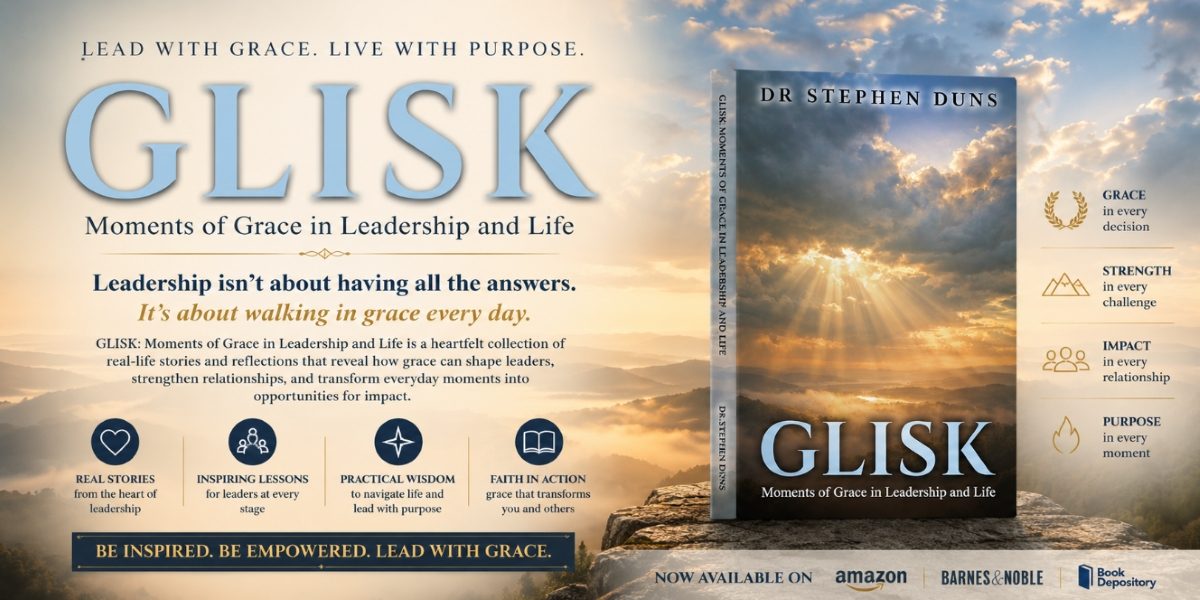

Leadership frameworks, productivity systems, and step-by-step success formulas fill the shelves. Dr Stephen Duns takes a different path in Glisk: Moments of Grace in Leadership and Life. Rather than telling readers how to lead, improve, or optimize themselves, this book invites them to pause and notice.
The book is not a traditional leadership book. It does not promise change through a set of actionable strategies, nor does it present a polished roadmap to success. Instead, it explores the quiet, often overlooked moments that shape how we show up in leadership, relationships, and everyday life. These are the moments that pass quickly, sometimes unnoticed, but leave a lasting imprint on what happens next.
The title itself holds meaning. A glisk, derived from Old Scots, refers to a brief glimpse of light, a fleeting moment of clarity or awareness. In the context of the book, it represents those subtle instances when a different way of responding becomes visible. Perhaps it is a pause before reacting in a tense meeting, a decision to listen instead of interrupt, or the choice to remain present when everything in you wants to fix or control the situation.
What makes the book compelling is its narrative approach. Instead of presenting theories, the author shares a series of stories drawn from leadership environments, personal relationships, and everyday human experiences. These stories are not designed to instruct or resolve. They are designed to be felt. Some show moments where grace appears, where something shifts, softens, or opens. Others reflect moments where it is missed entirely. In many cases, the difference between the two is so subtle that it only becomes clear in hindsight.
This approach mirrors real life. Rarely do we recognize, in the moment, whether we are opening possibilities or closing them down. Often, clarity arrives later, with reflection, regret, or quiet understanding. The book leans into this reality, encouraging readers to become more aware of their internal responses rather than rushing toward external solutions.
A central theme throughout the book is the relationship between power and love. Leadership, as presented here, is not about authority or control alone. It is about how strength and care coexist in moments of pressure. When power exists without care, it can harden into control. When care exists without strength, it can dissolve into over‑accommodation. The tension between these forces is where many of life’s most challenging moments occur, and where the possibility for grace emerges.
Another distinguishing element of the book is its emphasis on presence. In high‑pressure situations, the instinct is often to act quickly, to resolve, fix, or decide. Duns suggests that what matters just as much, if not more, is the capacity to stay with what is happening before acting. This does not mean inaction. It means responding from awareness rather than impulse. The shift is a subtle one, and it sits at the center of what the book explores.
Importantly, the book does not attempt to simplify complexity. It acknowledges that human experiences are layered, messy, and often unresolved. The book resists the urge to provide neat conclusions, instead allowing readers to sit with ambiguity. In doing so, it creates space for deeper reflection, something that is increasingly rare in both leadership literature and modern life.
This makes the book widely relevant. While many of its stories are rooted in leadership contexts, the insights extend far beyond the workplace. Whether in family dynamics, friendships, or personal challenges, readers may recognize familiar patterns in the pages. Moments where they have tightened, withdrawn, overextended, or missed an opportunity to respond differently.
The book is ultimately an invitation. Not to become someone else, but to notice more clearly who you are in the moments that matter. It does not offer quick wins or easy answers. What it offers instead is something quieter, and perhaps more enduring, a different way of seeing. The book is written for readers seeking a thoughtful, reflective, and deeply human exploration of leadership and life. It is a book that lingers, not because it tells you what to do, but because of how it asks you to notice. For more information about the book, check it out here.