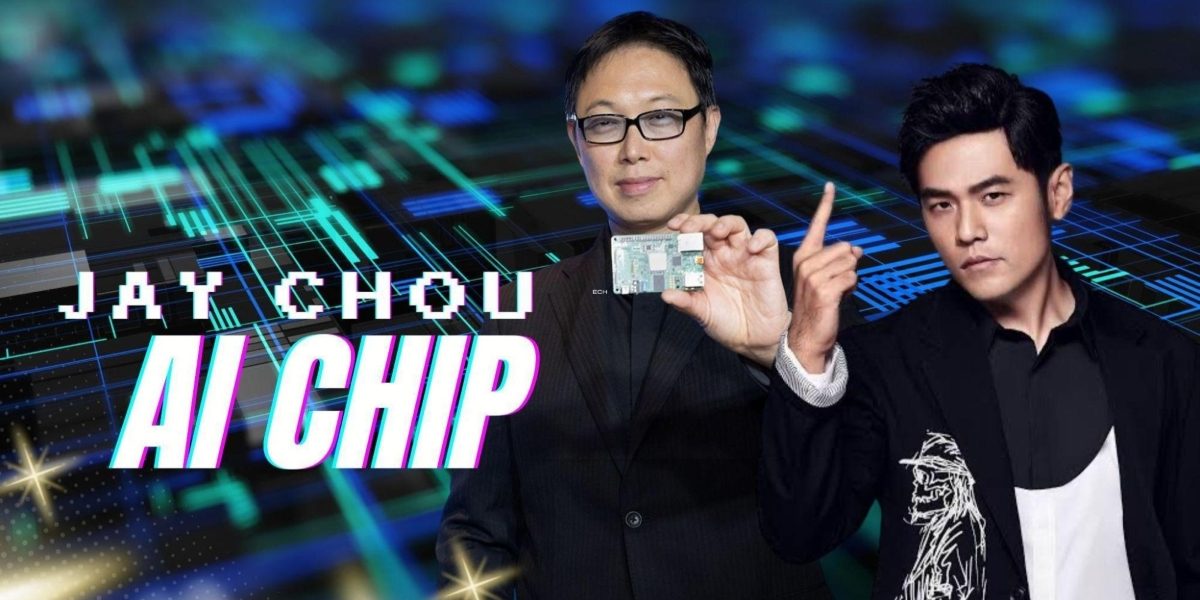

One of Asia’s biggest music stars has spent more than two decades putting his name on albums, films and sold-out concerts. Now Jay Chou’s name has appeared somewhere far more unexpected: inside an advanced artificial intelligence chip. The story of how it got there began years ago with a seriously ill child and a message that was never forgotten.
Jay Chou has one of the most recognizable names in Asian entertainment. For more than two decades, the Taiwanese superstar has filled arenas, topped music charts and built an influence extending across music, film, fashion and art. His 2022 album Greatest Works of Art topped the International Federation of the Phonographic Industry’s Global Album Sales Chart, making him the first Mandopop artist to achieve the distinction.
Now, Chou’s name has entered an industry few fans would ever associate with him: artificial intelligence. An advanced Neural Processing Unit being developed by AI semiconductor company Kneron carries the internal codename “Jay Chou.” It sounds like the beginning of a celebrity endorsement, technology collaboration or unusual branding campaign, but it is none of those things. The real reason one of Asia’s biggest stars ended up with his name inside an AI chip is considerably more personal.
The story begins years before Kneron existed, when its future founder and CEO, Albert Liu, was a student volunteering in hospice care. During that time, Liu spent time with a seriously ill child approaching the end of life. The child was a devoted Jay Chou fan and had one wish: to hear from his favorite singer.
Chou was already one of the biggest entertainers in the Mandarin-speaking world, and Liu had no personal connection to him. There was little reason to believe a request from an unknown student would ever reach a superstar surrounded by managers, concerts, appearances and millions of fans. Still, Liu decided to try. He reached out, explained the child’s situation and asked whether Chou might be willing to send a few words of encouragement.
Jay Chou responded.
According to Liu, Chou personally recorded a message for the child. For an international superstar, the gesture may have required only a few moments, but for the child who received it, those moments carried a very different weight. Liu never forgot what he witnessed. What stayed with him was not Chou’s fame or celebrity, but the fact that someone with extraordinary influence had chosen to use it for one person who needed it.
Years passed. Liu earned his doctorate, entered the semiconductor industry and eventually founded Kneron, an AI semiconductor company focused on Neural Processing Units, or NPUs. As the company began developing increasingly advanced processors, that memory from his hospice days eventually resurfaced in an unexpected way. One of Kneron’s advanced NPU projects was given a new internal codename: “Jay Chou.”
From Beethoven and Mozart to Jay Chou
The choice becomes even more unusual when viewed against Kneron’s longstanding engineering tradition. The company has historically named chip projects after legendary composers, including Bach, Mozart, Beethoven and Chopin. The comparison is surprisingly fitting because designing an advanced processor requires architecture, memory, software, programmability, performance and energy efficiency to work together. Much like a musical composition, no single element creates the final result; everything has to operate in harmony.
Then Kneron broke its own tradition. Instead of choosing another classical composer, the company named one of its advanced projects after a living Asian artist. The choice honored a moment Liu had carried with him for years, but it also reflected an unexpected parallel between Jay Chou’s career and the technology Kneron had spent years building.
When Chou emerged in 2000, he did not become influential by simply following an established Western pop formula. He blended R&B, hip hop and classical influences with traditional Chinese musical elements to create a sound that was distinctly his own. That sound helped reshape Mandopop and ultimately crossed borders, industries and generations. More than two decades later, his influence remains powerful across Asia and beyond.
In a very different industry, Kneron has been pursuing its own version of that journey. Founded in 2015, the company began developing dedicated NPU technology at a time when much of the semiconductor industry’s attention remained focused elsewhere. Its central belief was that artificial intelligence would eventually have to move beyond massive centralized data centers and into the physical devices people use every day.
Today, that prediction is becoming one of the biggest shifts taking place in artificial intelligence.
AI Is Moving Beyond the Cloud
For the past several years, the AI race has largely been defined by scale: larger models, more GPUs and increasingly massive data centers. But as artificial intelligence becomes part of computers, vehicles, cameras, robots and everyday machines, another race is emerging. The question is no longer only who can build the most powerful AI model, but who can bring intelligence closer to where people actually use it.
That is where the Neural Processing Unit becomes important. NPUs are processors specifically designed to handle neural network computation. Rather than requiring every intelligent interaction to travel to a distant cloud server and back, NPUs can allow more AI processing to happen directly on the device. That can reduce latency, improve privacy, lower dependence on cloud infrastructure and potentially reduce the energy required for certain AI workloads.
Consumers are already beginning to see this transition. NPUs are increasingly appearing across computers, smartphones and other intelligent devices as some of the world’s largest technology companies race to bring more AI processing directly into their products. What the technology industry now calls “on-device AI” is the future Kneron has spent nearly a decade building toward.
The larger implication could be significant. Today, most people still think of artificial intelligence as something they deliberately access by opening an app, visiting a website or asking an AI assistant a question. In the next phase of computing, AI may become far less visible. Intelligence could simply exist inside the computer, vehicle, camera, robot or machine a person is already using, operating in the background without requiring people to think about where the AI actually lives.
From the Music Stage to the AI Stage
There is something fitting about the connection between Jay Chou and the technology now carrying his name. Chou built something distinctly his own in Asia and took it to the world. Kneron spent nearly a decade developing NPU technology around the belief that artificial intelligence would eventually move beyond centralized computing and into the devices surrounding people. Now, as on-device AI becomes an increasingly important part of the global technology race, those two very different stories have intersected.
Yet beneath the technology, patents and rapidly evolving AI industry, the origin of the name remains remarkably human. Before there was an AI company, there was a student volunteering in hospice care. Before there was an NPU called “Jay Chou,” there was a seriously ill child who wanted to hear from his favorite singer. And before anyone could have imagined that the moment would one day be remembered inside a semiconductor project, one of Asia’s biggest stars took the time to answer.