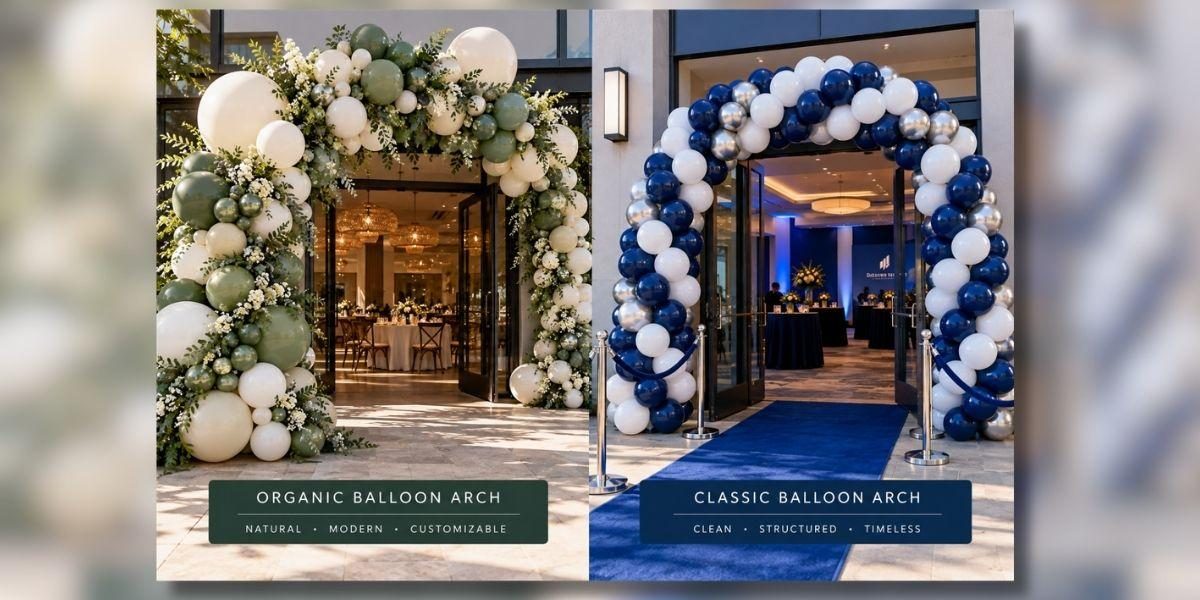

Two arches can stand at two entrances, built from the same latex in the same colors, and leave guests with entirely different impressions. One looks composed and ceremonial. The other looks as though it grew there. That gap is the organic vs classic balloon arch decision, and it comes down to how the balloons are arranged, not what they’re made of.
The two balloon arch styles usually get chosen from social feeds long before anyone measures a doorway, and that order is where plans tend to go wrong. Hosts and planners pick a look first and test it against the room second. Reversing the order usually produces a design that fits the space and photographs the way it was meant to.
The Classic Arch: Order, Symmetry, and Formality
A classic balloon arch is built on repetition. Uniform balloon sizes follow a consistent pattern along a clean curve, so the finished piece looks precise and planned. Classic arches suit formal moments, framing event entrances, bracketing stages, and marking the spot where a ceremony takes place, because symmetry signals that something deliberate is about to happen.
The format is a recognized one in the trade. A balloon training institute’s guide to arch types separates the classic spiral arch, built in a balanced color pattern, from the organic arch, built from mixed balloon sizes. The tradeoff is that the same tidiness can feel stiff in a soft or informal setting.

The Organic Arch: Layers, Asymmetry, and Movement
An organic balloon arch works from the opposite idea. Instead of uniform sizes in a strict pattern, it uses mixed balloon sizes, clustered and layered so the outline looks loose and uneven on purpose. The word describes the arrangement, not the material. It also shouldn’t be confused with the organic balloon garland, which uses the same clustered look along a wall, a table, or a staircase instead of framing an opening.
Sean Edwards, Founder of The Balloon Guy, a Los Angeles design studio, says the form starts with the setting. “An organic arch starts with the doorway it frames, the light in the room, and the way guests will move past it. The balloons follow from that.”
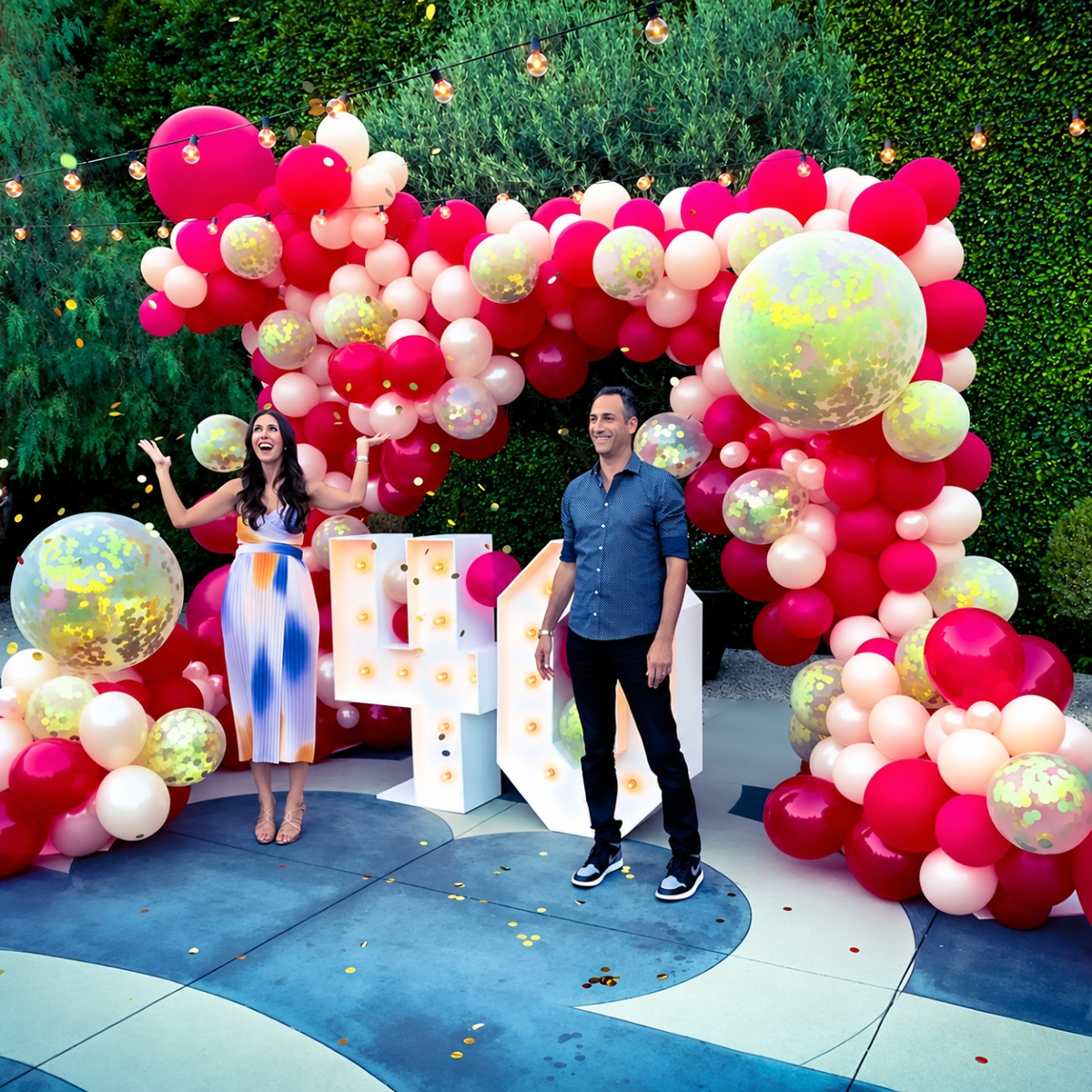
That approach explains why the style asks more of the person building it. With no pattern to repeat, every cluster is a decision about size, color, and spacing, and the finished look depends on how well those decisions add up. It’s also a look a designer can reach for when an event calls for something softer than a formal frame.
Reading the Room: Space, Light, and Setting
A balloon arch has to live in a room, and rooms push back. Ceiling height caps how tall an arch can rise, and an entrance’s width decides how much curve fits before guests squeeze past. A generous doorway can carry the loose spread of an organic arch. A narrow one often suits the compact outline of a classic arch.
Light changes the picture as well. Overhead fixtures, windows, and camera flash all change how colors and finishes read, so a design should be judged in the actual lighting, not on a mood board. Outdoor settings raise their own questions, so an outdoor arch is worth discussing with the designer early.
Edwards frames the work in architectural terms. “Balloons are often underestimated. When treated with intention, they become emotional architecture.”
Venue rules come before any of it. It pays to check policy before anything is built, because some venues restrict balloons at events, and a design the venue rules out never reaches the room.
Color, Finish, and When the Two Styles Meet
Color does different work in each style. In a classic arch, a limited palette in a repeating order sharpens the pattern, so the design reads as crisp and deliberate. In an organic arch, one color family or a layered mix of shades creates depth as the eye travels across the cluster.
Finish adds another layer. Matte balloons absorb light and look soft, while metallic and glossy ones catch it and add energy. The choice matters for pictures as much as for the room, and a wedding-planning platform advises matte finishes under flash photography for balloon photo walls, a useful rule for any arch that doubles as a photo backdrop.
The two styles can also meet. A structured base with organic detail, such as a classic curve softened by a few clustered accents, lets a formal setting gain movement without losing its shape. Where an event has a signature palette, the palette should lead, and the style should show those colors off.
Choosing the Right Arch for the Moment
The difference between the two balloon arch styles fits in a line. Classic gives a room structure, and organic gives it movement.
Three questions do most of the sorting. How formal is the occasion? What does the space look like, and how much room does the entrance give? And how will the arch be photographed, and in what light? A formal event in a structured room points toward classic. A relaxed or design-led event with space to spread points toward organic. Photography doesn’t choose a style, but it does steer the finish, and a formal room that needs softening is where a hybrid earns its place.
Anyone hiring a designer can shorten the first conversation by arriving with venue photos, entrance and ceiling dimensions, the event palette, and the setup and photo timeline. Those details give a designer what’s needed to choose, and Sean Edwards, who has more than 15 years of experience building balloon installations, starts from the same place: the room.
Back at the two entrances, the same balloons in the same colors are still doing very different jobs. One tells guests a ceremony is about to begin. The other tells them the room has been softened for the people in it. Once the room and the moment are clear, the choice between them tends to make itself.