
By Lennard James
Memphis has always been a city where ambition, influence, relationships and survival intersect. In Perry Richardson’s upcoming King of Memphis Part II: The Next Move, those elements return to the chessboard in a story that explores what happens after a man has established his position and realizes that maintaining power may be more difficult than obtaining it.
Built around the theme “Same Board… Bigger Moves,” King of Memphis Part II continues a Memphis-centered story of power, strategy, business, community and legacy. But this time, the stakes are higher.
The title itself signals evolution.
This is not simply another move. It is The Next Move, the decision that can determine whether everything already built becomes a lasting legacy or begins to fall apart.
Richardson uses the imagery of chess throughout the concept, an appropriate metaphor for a story centered on calculated decisions. In chess, every move has a consequence. A player cannot focus only on what is directly in front of him. He must anticipate what happens next, understand his opponent and recognize that the most dangerous threat may not always be obvious.
That philosophy sits at the heart of King of Memphis Part II.
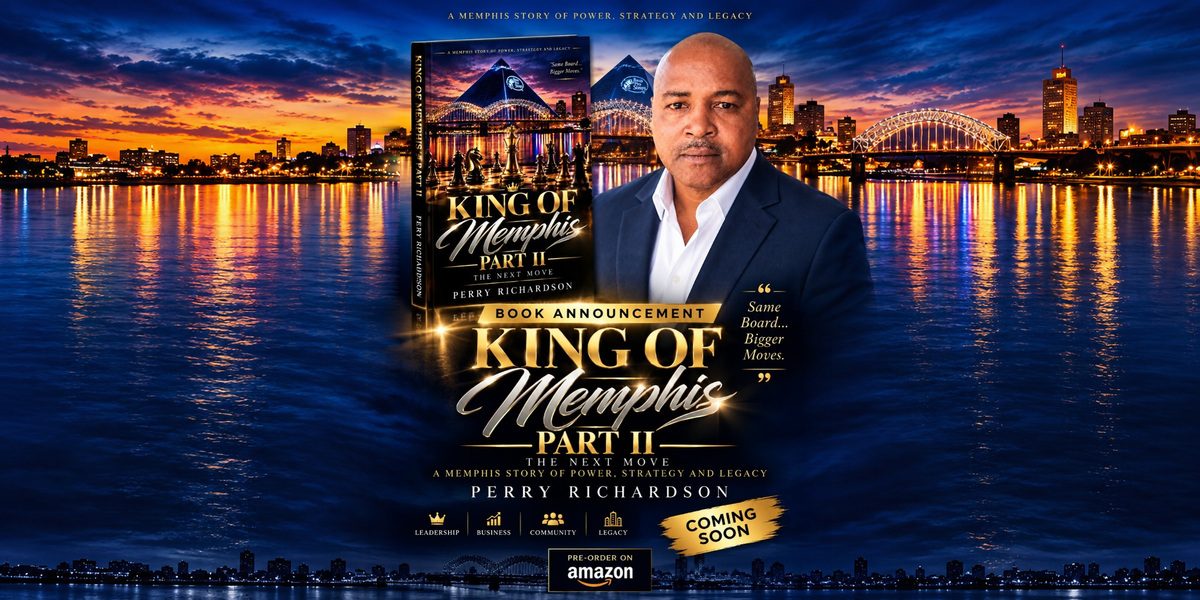
The book’s striking cover reinforces that message. Memphis’ illuminated skyline, the Hernando de Soto Bridge and the city’s iconic Pyramid rise behind a chessboard filled with gold and black pieces. At the center stands the king.
But a king never stands alone.
There are queens, knights, bishops, rooks and pawns surrounding him. Every piece has a role. Every piece has value. And depending on how the game is played, even the smallest piece on the board can change everything.
That imagery provides a powerful foundation for Richardson’s story.
King of Memphis Part II examines what happens when success creates new challenges. As influence grows, relationships change. People who once appeared loyal may begin pursuing their own interests. New alliances emerge. Old conflicts return. Decisions that once seemed insignificant can suddenly have major consequences.
And the higher someone rises, the more people begin watching every move.
That is where The Next Move finds much of its tension.
The story is not simply about who possesses power. It asks a more complicated question: What does a person do with power once they have it?
Richardson’s Memphis becomes its own character within the story.
The city represents ambition and opportunity, but it also represents history, neighborhood loyalty, entrepreneurship and survival. Memphis has always produced people who understand how to create something from limited resources. That spirit provides the backdrop for a narrative where characters must constantly determine whom they can trust and what they are willing to risk.
The concept of legacy becomes especially important.
There comes a point when success can no longer be measured only by money, recognition or influence. The question changes from “What can I get?” to “What will I leave behind?”
That transition can be difficult.
A person who spends years fighting to reach the top may discover that the instincts required to survive are not necessarily the same qualities needed to build something that lasts.
That is one of the intriguing directions suggested by King of Memphis Part II.
The book also explores the difference between movement and strategy.
Anyone can make a move. Strategy requires understanding why the move is being made, what it could cost and what will happen several steps later.
In Richardson’s world, characters are forced to think beyond immediate victories. Business decisions affect relationships. Personal relationships affect power. Loyalty can become currency. Information can become leverage. And one emotional decision can disrupt years of carefully constructed plans.
The chessboard therefore becomes more than artwork for the book.
It becomes a representation of life.
Sometimes people are protecting the king. Sometimes they are attacking him. Sometimes the person believed to be a pawn turns out to have much greater power than anyone anticipated.
And sometimes the biggest opponent is not sitting across the board.
It is the person sitting beside you.
For Richardson, King of Memphis Part II also represents an opportunity to tell a Memphis story from a perspective rooted in the city’s culture and personality. Instead of using Memphis merely as a location, the book embraced the city as part of its identity.
The Pyramid, bridge, skyline and Mississippi River featured prominently in the book’s visual presentation immediately establish where this story belongs.
This is Memphis.
But the themes go far beyond the city.
Power, betrayal, loyalty, ambition, family, business and legacy are universal experiences. Readers do not have to come from Memphis to understand the pressure of making decisions when other people’s futures depend upon them.
The story also speaks to entrepreneurs and leaders who understand that reaching a certain level of success often changes the nature of the game.
When nobody knows your name, you fight to be noticed.
When everybody knows your name, you have to decide what that name will represent.
That is the territory King of Memphis Part II: The Next Move appears ready to explore.
With its cinematic visual identity, Memphis setting and chess-inspired themes, Richardson is positioning the sequel as more than a continuation. It represents an expansion of the world introduced through King of Memphis and an opportunity to examine what happens when the board becomes larger, the players become smarter and the consequences become greater.
Because eventually every king discovers the same truth:
Getting to the top was only the first move.
Staying there, and deciding what you will leave behind, is where the real game begins.
Perry Richardson’s King of Memphis Part II: The Next Move is coming soon.
Same Board… Bigger Moves.