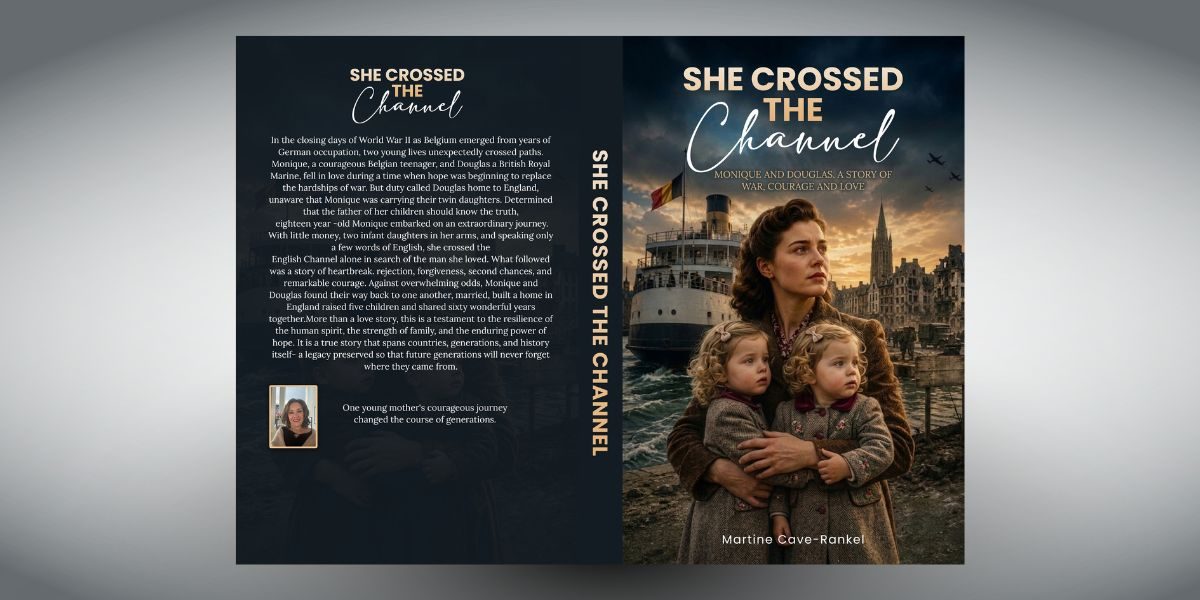

There are stories that families tell, and there are stories that families live. She Crossed The Channel belongs to the second kind. Written by Martine Cave’-Rankel, the memoir revisits the emotional wounds left by war, separation, and social shame. It does so through the eyes of a woman who has worked as a nurse for more than forty years.
Martine Cave’-Rankel was born in Belgium and raised in England until the age of nineteen, then moved to the United States as a young military bride. She earned three nursing degrees and built a career that spans more than four decades. She is also a mother, grandmother, and great-grandmother, part of the living legacy of the journey she chronicles. That dual perspective, clinician and daughter, shapes how she explores what happened to her mother and what it cost.
The memoir is more than a love story, though love runs through it. It works as a case study in resilience, and Cave’-Rankel brings a nurse’s understanding of trauma to a deeply personal history.
A Daughter’s Promise
The book opens with a confession. For decades, Cave’-Rankel knew only fragments of her mother Monique’s journey. She grew up with a single haunting image of an eighteen-year-old girl on the deck of a ferry, clutching infant twin daughters, with almost no money and even less English.
She waited to write the story until after her mother had passed. Over time, what was once spoken of in lowered voices, an unmarried mother and twins born out of wedlock, revealed itself as endurance, sacrifice, and an unshakable will to keep going. She Crossed The Channel grew out of that reckoning.
The Crossing
The narrative moves from the liberation of Belgium in 1944–45 to the moment Monique met Douglas, a British Royal Marine. They fell in love in the fragile aftermath of occupation. Duty called Douglas home, and he left England unaware that Monique was carrying his children.
What followed, according to the memoir, was an act of astonishing courage. At eighteen, with twin infants in her arms, Monique crossed the English Channel alone, with little money, few words of English, and no certainty of welcome. The book does not romanticize the journey. It records the kindness of strangers who helped her on the ferry and in London, and the cold reality that awaited her at Douglas’s door.
The Rejection
That first reunion ended in heartbreak. The memoir recounts that Douglas denied the twins were his and that his family was hostile. Monique, displaced and isolated, was eventually forced to return to Belgium.
Back in Aalst, she faced social judgment, gossip, and the shame of a community quick to condemn. Her own mother refused an adoption suggestion and declared that no one would take her grandchildren. These pages are not easy, but they show the real cost of the love story that followed.
The Nurse’s Lens
Here Cave’-Rankel stands apart from most family historians. After four decades of nursing, she has seen human fragility up close, and she brings that experience to the page. She writes with compassion about what she sees as Douglas’s unspoken war trauma, the conflict that did not end when the battles stopped.
Trauma, in her telling, lingers beyond the people who lived it and passes to their children. Shame can wound as deeply as any physical injury. Resilience, she suggests, is a daily practice rather than a slogan. Her account draws on lived experience, nursing practice, and historical research instead of family lore alone.
The Legacy
Eventually, Douglas asked Monique to return. His fiancée had learned the truth and refused to move forward, and he had to take responsibility. Monique crossed the Channel a second time, wiser and more careful, but no less courageous.
They married in a simple courthouse ceremony, built a home in Loudwater, and raised five children. Their marriage lasted sixty years. The book closes with an epilogue addressed to future generations: children, grandchildren, and great-grandchildren. It preserves a legacy so that names become faces and memories become history.
Why This Book Matters
She Crossed The Channel is a tribute to Monique and an offering to the relatives who follow her. Courage often arrives quietly, the memoir suggests, and forgiveness is possible but demands change. The most extraordinary legacies can begin with a single act of faith, a young woman, two babies, a journey across the sea, and a hope she refused to abandon.
Families that have lived through hardship of their own may recognize themselves in these pages. The book is a true story of courage, rejection, and redemption that spans countries and generations, and it keeps one young mother’s endurance on record for the people who carry her name.