
For much of his professional career, Gregg Bartley worked in a world where precision, evidence, and careful analysis were essential. As an aerospace engineer and later an aviation safety specialist responsible for flight control and autopilot certification, his work centered on systems designed to minimize uncertainty and leave as little as possible to chance. That background makes Beneath the Angels of Mons: Tales of the Supernatural and Psychological especially intriguing. Rather than simply asking readers to believe in the unexplained, Bartley’s anthology poses a deeper question: How do we determine what is real?
The collection approaches the supernatural not simply as a world of monsters, ghosts, and unexplained phenomena, but through the complex lens of human perception. Across the stories, different people may experience the same event yet interpret it in completely different ways. The mystery, therefore, is not always what was witnessed, but whether what was witnessed can ever be fully understood.
The anthology brings together two novels The Wechuge and Ghosts of a Former World alongside four short stories. Together, they explore the uncertain space where history, psychology, folklore, memory, and belief intersect. Although the settings range from wartime Europe to the forests of the Pacific Northwest, the stories repeatedly return to one compelling question: Are extraordinary experiences evidence of something beyond human understanding, or are they reflections of the human mind?
That question appears to be at the heart of Bartley’s approach. His professional experience involved analyzing complex systems in which conclusions often depended on interpreting incomplete information. Those same instincts are evident throughout the anthology. Certainty is repeatedly questioned, while readers are encouraged to examine conflicting evidence and form their own interpretations rather than accept easy explanations.
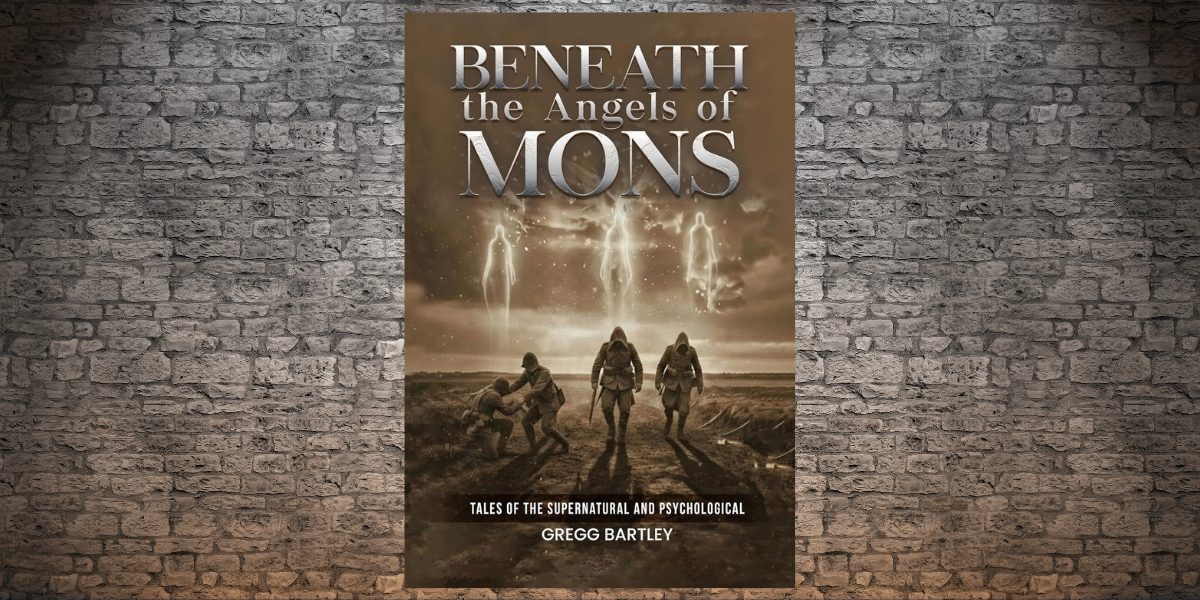
The title novella, Beneath the Angels of Mons, captures this philosophy particularly well. Inspired by one of World War I’s most enduring legends, the story revisits reports surrounding the 1914 Battle of Mons, when British soldiers claimed to have witnessed angelic figures, phantom archers, or even divine intervention that appeared to halt the advancing German forces. Over the years, historians have offered numerous explanations for these accounts, ranging from religious belief and wartime propaganda to battlefield exhaustion, and perhaps something more difficult to explain.
Bartley does not attempt to settle the debate. Instead, he embraces the uncertainty. The story unfolds through interviews with soldiers whose testimonies frequently conflict. One believes he saw Saint George leading a heavenly army. Another recalls only mysterious lights in the sky, while a third describes an experience for which he can find no explanation. Their accounts may differ dramatically, yet each witness remains convinced of what he experienced.
The result is more than a supernatural tale. It becomes an exploration of the ways memory, faith, trauma, expectation, and personal experience can influence how people perceive reality.
That fascination with uncertainty continues throughout the rest of the anthology. The Wechuge, presented in a revised edition with a new concluding chapter, explores folklore, isolation, and psychological uncertainty. Rather than providing definitive answers to every mystery, the revision deepens the novel’s central question: Where exactly does imagination end and reality begin?
Ghosts of a Former World approaches haunting from another perspective. While supernatural elements remain part of the story, the novel also examines the enduring consequences of racism and historical injustice. Some of its ghosts are not spectral beings at all, but the consequences of prejudice carried from one generation to another. In this sense, the title serves as a metaphor for both literal apparitions and the lasting wounds created by history.
Bartley’s interests beyond engineering also contribute to the atmosphere of the collection. His years exploring the mountains, rivers, and forests of the Pacific Northwest bring an authentic sense of place to the stories, while his experiences studying Lakota traditions add cultural depth to narratives involving mythology, spirituality, and oral history. These influences remain woven naturally into the stories, giving the settings and themes a sense of authenticity.
Ultimately, what distinguishes Beneath the Angels of Mons is the trust it places in its readers. The anthology resists the modern tendency to explain every mystery or place every unusual experience into a convenient category. Instead, it presents conflicting perspectives, compelling evidence, and emotionally authentic characters, then allows readers to decide what they believe.
This approach places the collection closer to classic psychological and supernatural literature than conventional horror. The fear does not necessarily come from something hiding in the darkness. Instead, it comes from a more unsettling possibility: What if certainty itself is impossible?
That question feels particularly relevant in an era when people frequently encounter competing versions of truth. Beneath the Angels of Mons asks readers to consider not only whether supernatural events are possible, but also how memory, culture, belief, and personal experience shape each individual’s understanding of reality.
By the final pages, the central question has evolved. It is no longer simply whether ghosts, angels, or ancient legends truly exist. The deeper question is whether reality has ever been as fixed and objective as we assume.

That lingering uncertainty is ultimately what gives Beneath the Angels of Mons: Tales of the Supernatural and Psychological its lasting impact. More than a collection of supernatural stories, it becomes a thoughtful meditation on perception, belief, history, and the mysteries that continue to shape the human experience.