
By: Schiamarelly Pinckert
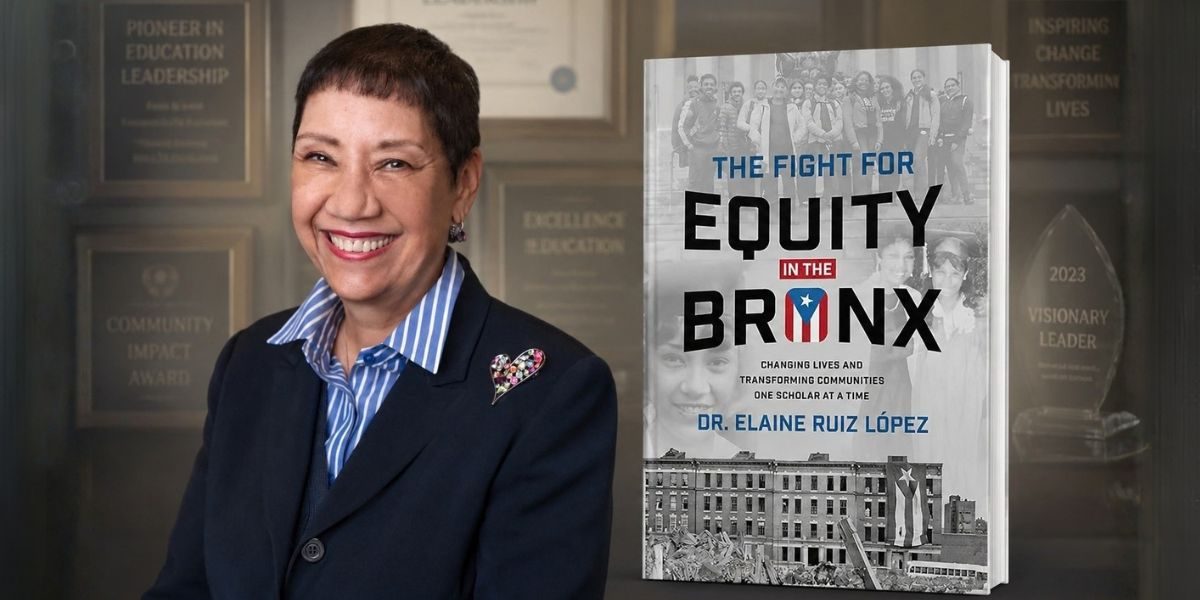
Words matter in ways that are not always immediately visible. The language we use to describe what happens to young people when they leave school before graduating determines where we place the responsibility, whether we look at the child or at the system that failed them. Dr. Elaine Ruíz López has been making a specific and consequential argument about that language for years. And in The Fight for Equity in the Bronx: Changing Lives and Transforming Communities One Scholar at a Time, she makes it with the full weight of a life that illustrates exactly why it matters.
The word dropout suggests a choice. It implies that a young person decided education wasn’t important and walked away from something that was fully available to them. The word push-out asks an entirely different question: What happened before that young person left? Were they being taught appropriately? Were their circumstances understood and accommodated? Did anyone recognize their potential and fight to keep them engaged? Did the institution do its job before it lost them?
Dr. Elaine was pushed out of an educational environment long before she eventually earned her GED, her advanced degrees, and her doctorate from Columbia University’s Teachers College. Her own experience is why she refuses to allow that distinction to be treated as semantic or minor. Being pushed out of one educational environment did not mean she was incapable of education. It meant the system had stopped serving her. Those are fundamentally different problems with fundamentally different solutions, and conflating them has allowed institutions to avoid accountability for generations while young people bear the weight of a failure that was not theirs.
Where Responsibility Actually Lives
The national conversation about school quality, Dr. Elaine argues, consistently misunderstands something fundamental about communities like the Bronx. Too much time is spent discussing these communities through statistics and deficits. Too little time is spent recognizing the tremendous ability, resilience, and potential that already exist within them. The frame of deficit, applied repeatedly to the same communities, eventually becomes a self-fulfilling expectation that shapes what institutions attempt and what they believe is possible.
International Leadership was founded on a deliberate rejection of that frame. The school begins with potential and creates an environment that expects students to rise to it. High expectations are not a luxury for children who come from more stable circumstances. They are a necessity for every child, and providing them to children in underserved communities is not charity. It is the basic function of an educational institution doing its job.
Building excellence requires resources, certainly. It also requires something that doesn’t appear in a budget line: genuine belief in what young people are capable of, expressed every day in the quality of instruction and the consistency of expectations. The question should never be whether children in the Bronx are capable of excellence. The question should be whether the adults and institutions responsible for educating them are prepared to create the conditions in which excellence can flourish.
The Memoir Choice
Dr. Elaine made a deliberate decision to write a memoir rather than an academic or policy book, and the reasoning goes directly to this point about where responsibility lives and how we understand it. Research and policy are important. But personal narrative allows people to understand what systems actually do to human beings in ways that data never fully captures. A statistic can tell you that students are leaving school in high numbers. A story can help you understand the child behind that number, what happened to her, what the institution did and failed to do, and what she might still become if someone refuses to accept the statistic as the final word.
Her journey from the South Bronx, through teenage motherhood and interrupted education, to founding a school that has changed the trajectory of thousands of young lives, is not just a personal narrative. It is evidence of the argument she is making. The personal and the policy cannot really be separated. And the book exists to make sure that nobody reading it can maintain that separation without confronting what it actually costs.
The distinction between dropout and push-out is ultimately a question about who gets to define a child’s story. Dr. Elaine Ruíz López has spent her career insisting that the answer is not the institution that failed them.
If the language around educational failure has always felt slightly wrong to you, Elaine Ruíz López explains exactly why. The Fight for Equity in the Bronx: Changing Lives and Transforming Communities One Scholar at a Time is available now on Amazon.