
By: Jay Kt
There’s a moment in most AI initiatives when the pilot has clearly worked and, somehow, nothing happens next. The demo impressed everyone. Leadership nodded. Then weeks pass. The data scientist who built it rotates onto another project, and the thing that worked sits in a sandbox, still working, unused. Around 88% of enterprise AI pilots never reach production, and the strange part is how many of those were successful pilots.
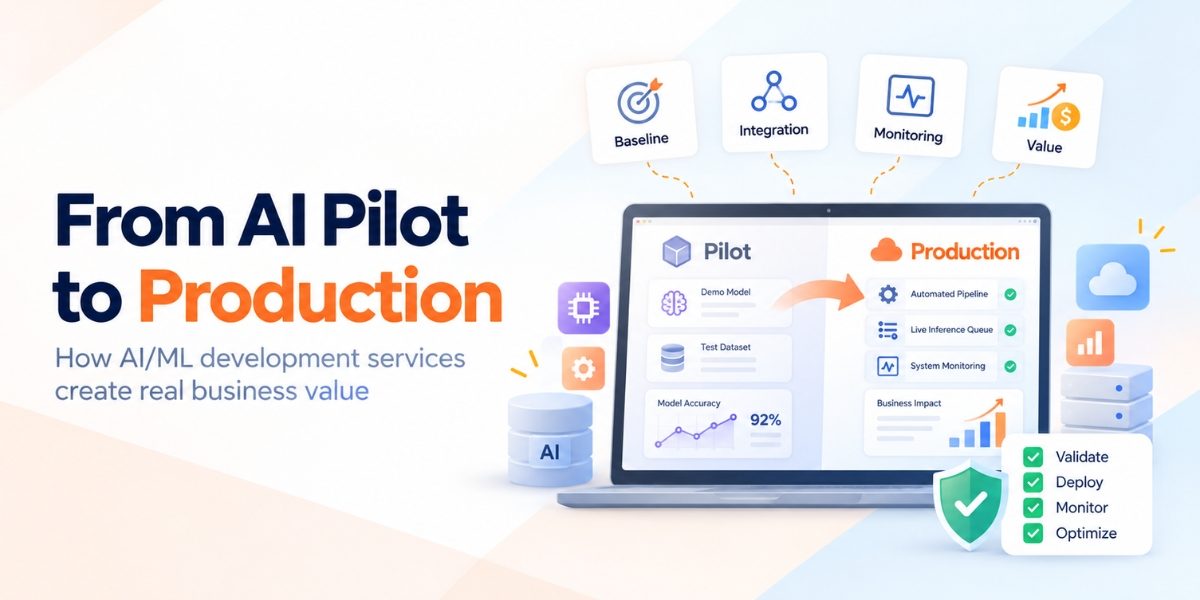
Here’s the explanation almost nobody offers: the pilot and the production system are two different jobs, usually sold as one. Understanding where one job ends and the other begins is most of what separates AI/ML development services that create business value from ones that create impressive sandboxes.
Job One: Prove a Number
A pilot exists to answer a narrow question. Can a model, on our data, move a metric we already track? Notice what that requires. A baseline captured before anything gets built, because “improved” means nothing without a starting point. One scoped use case rather than five. A defined threshold that counts as success and, just as importantly, a result that would mean stopping.
That’s the whole job. A good pilot is small and slightly boring, with an end date. Vendors promising a grand one are already blurring the two jobs together. When MIT’s NANDA research found 95% of generative AI pilots producing no measurable P&L impact, the missing ingredient across those failures was rarely model quality. It was that no production-grade number had ever been attached to the work, so there was nothing for value to accrue against.
Job Two: Make the Number Move Every Week
Production is a different contract with different deliverables, and this is the part buyers under-scope. The model that proved the number now has to run against live data, which is messier than the curated pilot set. Wiring it into the workflow where the decision gets made comes next, so a prediction becomes a task in someone’s queue rather than a dashboard nobody opens. Someone has to own monitoring, because models drift as the business changes underneath them, and a model that degrades quietly is worse than one that fails loudly. And retraining needs a cadence and a budget line, not a promise.
None of that is data science, mostly. It’s engineering and operational design. Teams that staffed a brilliant pilot stall right here because the skills required just changed mid-project and nobody re-planned for it. The average path from prototype to production runs about eight months for the projects that make it at all, and that distance isn’t algorithmic. It’s organizational, which is why throwing better models at it changes nothing.
Where Value Actually Dies: The Gap
Look closely at stalled initiatives, and the failure usually sits between the two jobs, in a handoff nobody designed. The pilot team declares victory and disbands. Production infrastructure was never scoped because it wasn’t the pilot’s job, and it wasn’t anyone else’s either. The sponsor expected a working system and got a slide deck.
This gap is, bluntly, the thing to interrogate when you evaluate AI/ML development companies. A partner structured around the full arc plans the production path while the pilot is still running: security review starts early, the integration surface gets mapped before the model is final, and the pilot’s success metric carries forward unchanged into production monitoring so nobody can quietly swap in a friendlier number later. A partner structured around pilots hands you a win and a goodbye.
The economics favor the boring version. Purchased AI capability from specialized vendors succeeds at roughly twice the rate of comparable internal builds, but that advantage concentrates almost entirely in the production half, where operational experience is hardest to fake. Anyone can fine-tune a demo. Not many teams have run the same model against live data through a seasonal cycle and know what breaks in month four.
What “Real Business Value” Looks Like on Paper
Strip the language down, and the test is plain. Before the engagement: a documented baseline for one metric your business already cares about. During the pilot: that metric, moved, under agreed conditions. After production: the same metric, tracked weekly, with the delta attributable to the system and a human owner accountable for it. If any link in that chain is missing, what you have is a technology project. Technology projects are what the 88% mostly were.
There’s an honest caveat that belongs here. Some problems shouldn’t survive the pilot, and a good outcome for a marginal use case is a documented “no” that cost you six weeks instead of eighteen months. The kill decision is a form of business value too, though it never appears in anyone’s case study.
Firms like BiztechCS (delivering AI/ML and cloud solutions for operations-heavy businesses) structure engagements around that two-job arc, with the unglamorous production half treated as the main event rather than the epilogue. The pilot gets you a proven number. Everything the business actually banks comes after.
If you’re evaluating AI/ML development services right now, ask each candidate to describe what they deliver in the six months after the pilot succeeds. The ones with a specific answer are the ones who’ve done it.