
If you get a chance to walk into almost any hospital today, you will notice the dominance of glowing screens and high-tech tiers at a quick glance. You will see doctors standing at mobile workstations furiously typing into electronic charts, while the nurses glance at buzzing digital monitors. There is no doubt that the care is fast, precise, and technologically advanced beyond what previous generations could have imagined…But does it really have a benefit?
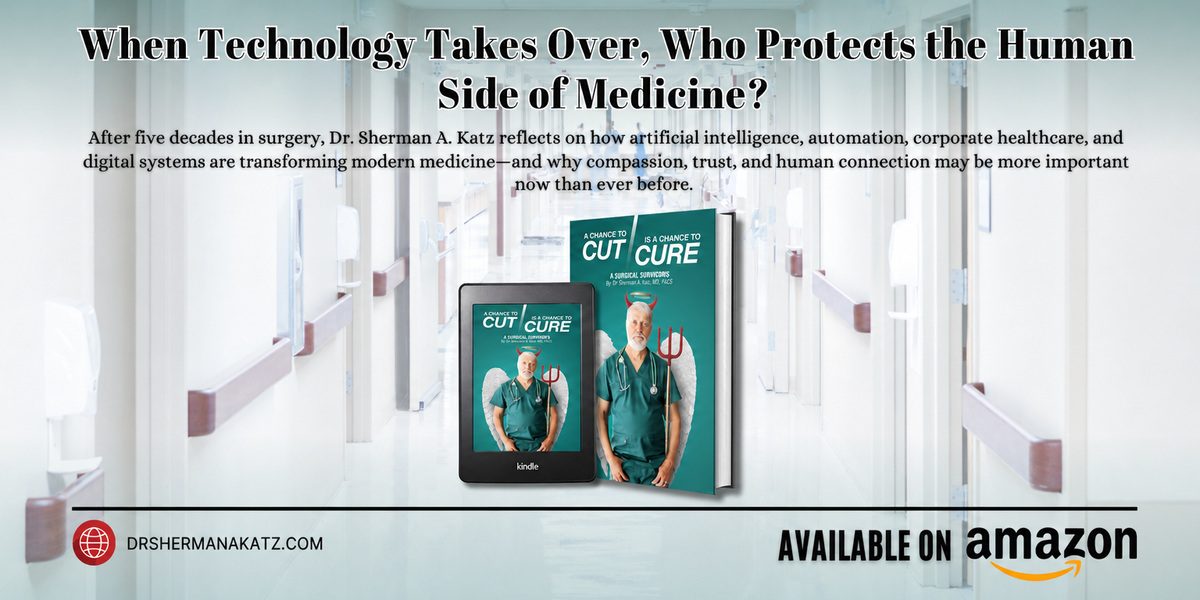
Dr. Sherman A. Katz is here to argue on this subject with his memoir, A Chance to Cut is a Chance to Cure: A Surgical Swan Song. By reflecting on a career spent as a vascular surgeon, a specialty where a fraction of a millimeter can mean the difference between saving a limb and losing a life, and having served humanity and experienced the highs and lows of medicine, his book offers a grounded reality check for us to see the real difference. It offers a personal look at what it used to mean to practice medicine and why the human connection between doctor and patient is currently under threat…by the increasing use of AI and technology…to say the least.
Katz did not come from a family of privilege or medical royalty. Growing up in a working-class neighborhood, his childhood was defined by obsessive curiosity about how the physical world worked. He spent his free time tinkering with home chemistry sets and peering through a cheap microscope. He was captivated by a hidden world he could barely see and saw science as a sense of wonder.
But there came a moment that changed his understanding of science from inside his own home. When his Polish grandmother underwent a surgical procedure that went wrong, leaving her with permanent facial paralysis, Katz’s grandmother took a very different path. She harbored zero legal resentment or hostility toward her doctors and instead chose to carry her condition with quiet grace and dignity.
“You don’t sue doctors,” his Polish immigrant grandmother said, recalling how one of those doctors accidentally severed her facial nerve during a mastoid surgery, leaving her with a permanently paralyzed left side of her face at just 28. Yet, the unchecked greed they spoke of has undoubtedly been overshadowed by even more oppressive forces that wanted to regulate the medical profession and supposedly curb their greed.
Watching her handle that setback taught the young Katz a lesson that patients are not just biological cases or clinical outcomes. They are vulnerable human beings placing complete trust in another person’s hands, which needs no compromise…ever. That early realization gave him a moral compass that stayed with him throughout his entire career.
Nothing about Katz’s entry into the medical field was handed to him on a silver platter, as you can guess. From putting in his every effort and penny to learning and getting the knowledge and education to earn himself an opportunity to work in medicine, he had to work constantly. By day, he managed a local Baskin-Robbins ice cream shop, and by night, he worked as an orderly in hospital operating rooms, which turned out to be an unexpected education in human nature.
As an orderly, Katz was not making surgical incisions; he was mopping floors, clearing trash, and wheeling nervous patients down cold corridors. He saw healthcare from the bottom up and noticed the raw fear in a patient’s eyes right before they went under anesthesia, and he saw how much a simple, kind word from an orderly or a nurse could calm a racing pulse. By the time he actually got to medical school, he already understood that the operating room was an ecosystem built entirely around keeping a vulnerable person safe.
When Katz entered the Ohio State University College of Medicine during the Vietnam War era, medical education looked vastly different from what it does today. For example, there were no high-resolution MRI scans available, and doctors had to rely heavily on physical diagnosis. They often listened carefully to a heart through a stethoscope, felt an abdomen for subtle tightness, and paid close attention to a patient’s own words.
Katz recalls attending famous surgical grand rounds led by legendary figures like Dr. Robert Zollinger, who was known for his sharp intellect, fierce demeanor, and zero tolerance for sloppy thinking. Standing up in front of an auditorium full of peers to present a patient case under Zollinger’s gaze was a trial by fire. But that atmosphere built absolute accountability. It taught Katz that when you accept responsibility for a human life, close enough is never good enough.
Inside the High-Stakes World of Vascular Surgery
After medical school, Katz matched at Case Western Reserve University for his surgical residency. He eventually specialized in vascular surgery. Vascular work is uniquely unforgiving, as a surgeon works with fragile, blood-filled vessels. He had to stitch them together with thread thinner than a strand of human hair and be very proactive and cautious in his actions and choices. If a suture leaks or a vessel closes, the consequences are immediate and could lead to possible demise.
The surgery demands intense focus, sharp instinct, and often a healthy dose of gallows humor, which had a psychological valve for people who spent their days making high-stakes decisions under intense pressure. Katz describes the tight-knit camaraderie formed among surgical teams
who spent grueling hours together, bound by a shared sense of duty to the person lying under the drapes. Over the course of his decades on the front lines, Katz watched surgery undergo a massive technological shift. He saw how the traditional open operations gave way to laparoscopic procedures, tiny stents inserted through blood vessels, and robotic instruments controlled from a console.
Katz does not dismiss these tools. He readily acknowledges that modern techniques have saved lives, reduced pain, and shortened hospital stays dramatically. But he also witnessed the unintended cost of this rapid evolution. For instance, as technology advanced, the physical distance between doctor and patient began to grow, and insurance companies, corporate hospital groups, and regulatory bodies began asserting tight control over daily medical practice. As a result, physicians were gradually pushed into the role of “worker bees.” They were forced to meet productivity targets, fill out endless administrative checklists, and keep up with tight scheduling metrics.
Doctors found themselves glued to computer keyboards instead of sitting at the bedside of a patient, listening to his or her fears and answering his or her questions. They began to reduce living, breathing patients to standardized line items on a computer screen, just for the sake of meeting targets and getting the job done.
Rediscovering the Heart of Healthcare
Dr. Sherman Katz’s memoir is here to change this aspect. By reflecting on his life and jotting down his experience of working as a vascular surgeon, he beautifully recounts his life and helps us realize the meaning behind the medicine. He shows us that no matter how advanced our machines become, medicine is fundamentally a human interaction and needs humans and emotions to work well and, in contrast, for the betterment of the patients. A robotic arm can execute a precise maneuver and a computer program can analyze diagnostic data, but neither can offer the genuine empathy that patients need to relax and find comfort, even in the emergency room. Therefore, it asks that medical professionals listen to a patient’s quiet anxieties or offer a reassuring hand in a terrifying moment.
A must-read for aspiring physicians, healthcare professionals, and anyone who values the art of medicine, A Chance to Cut is a Chance to Cure is a call to preserve compassion in modern healthcare, teaching medical professionals to always put patients first…
Head to Amazon to purchase your copy: https://www.amazon.com/dp/1968615334
Sherman A. Katz MD FACS
Dr. Sherman A. Katz, MD, FACS, is a vascular surgeon celebrating his fiftieth year in surgery and is now partially retired. He has experienced many changes in the practice of surgery in his fifty years, going from doing operations that had not changed for 100 years to the new technologies of surgery involving lasers, instruments with electronic chips, and remote presence with robots.
Book Details:
Book Name: A Chance to Cut Is a Chance to Cure: A Surgical Swan Song
Author Name: Dr. Sherman A. Katz, MD, FACS
ISBN Number: 978-1968615338
Ebook Version: Click Here
Hardcover Version: Click Here
Paperback Version: Click Here