
There is something quietly powerful about the books children return to again and again. They may not always be the loudest books on the shelf, or the flashiest, or the ones built around spectacle. Often, they are the books that invite a child to look more closely at the world and to notice that it is already full of marvels.
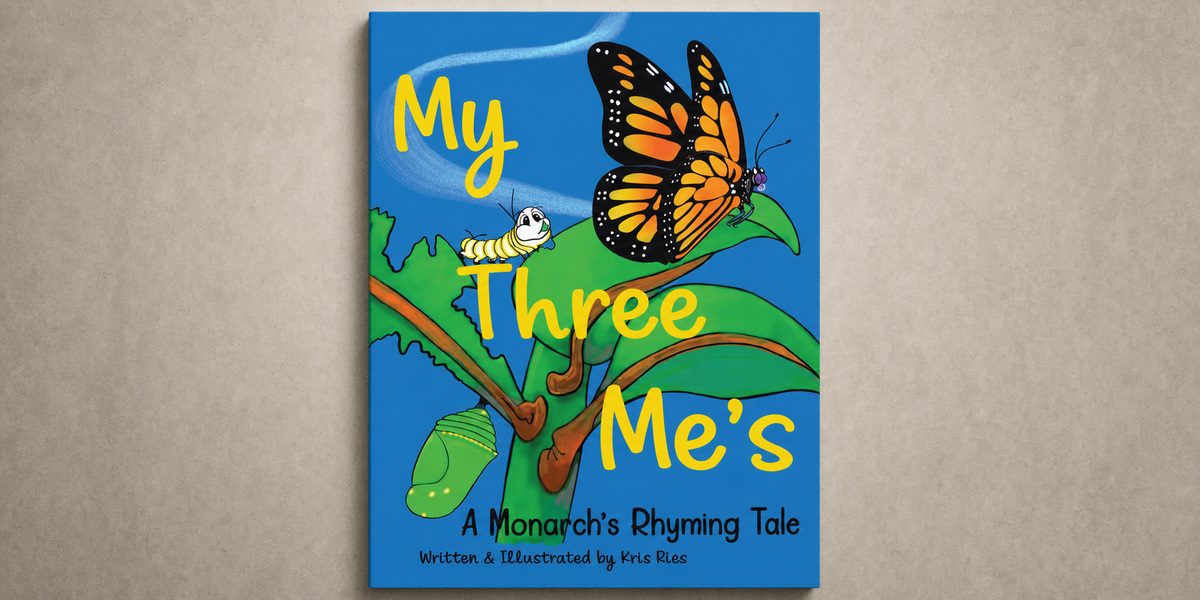
That is part of what makes My Three Me’s by Kris Ries such a thoughtful addition to children’s literature. At a time when so much competes for a child’s attention, this book turns to something timeless and endlessly fascinating: the journey of the Monarch butterfly. Rather than treating nature as background, it places it at the center of the reading experience and gives young readers a way to engage with it through story.
The appeal of a book like this begins with its subject. The Monarch butterfly has long held a place in the imagination. It is delicate but resilient, familiar but mysterious, beautiful yet shaped by an extraordinary journey. For children, that combination is irresistible. They are naturally drawn to creatures that change, grow, and move through the world in surprising ways. A butterfly is never just a butterfly to a child. It is color, movement, mystery, and discovery all at once.
What Kris Ries understands is that children do not need the natural world simplified into something flat or overly explained in order to connect with it. They need a story that opens the door. My Three Me’s does exactly that. It offers young readers a way into the life of the Monarch that feels inviting and accessible, while still preserving the wonder of what makes that life so remarkable.
That balance matters. Many books for children either lean too heavily on fact or too heavily on entertainment. One can feel instructional; the other disposable. The strongest children’s books know how to hold both. They give a child the pleasure of language, imagery, and movement while also leaving them with something real to think about after the final page. In that sense, Ries’s approach feels especially well judged. It allows children to enjoy the story first, then discover that they have also learned something lasting.
For parents, teachers, and librarians, that kind of book has real value. It can live in more than one space. It works as a read-aloud, as a quiet shelf pick, as a springboard for classroom discussion, and as a natural companion to lessons on life cycles, migration, and the rhythms of the natural world. It belongs in homes, but it also belongs in schools and library collections where young readers are encouraged to explore beyond the obvious.
Just as important, it offers a different pace. Children’s publishing often rewards speed, novelty, and instant grab. There is nothing wrong with excitement, of course, but there is also room for books that ask children to pay attention. Ries’s storytelling is built around attention. Attention to growth. Attention to transformation. Attention to what can be seen and what is taking place just out of sight. In that way, it encourages one of the most valuable habits a child can develop: curiosity.
Curiosity is where learning begins, but it is also where affection begins. A child who becomes curious about the Monarch butterfly may soon become curious about gardens, flowers, seasons, pollinators, and the living world just beyond the doorstep. That is one of the quiet gifts of nature-centered storytelling. It widens the child’s field of vision. It helps them see that their world is not static or ordinary. It is alive with processes, patterns, and transformations that are worth noticing.
Kris Ries writes with that larger invitation in mind. The book is not trying to overwhelm young readers with information or impress them with complexity. It is doing something more valuable. It is helping them enter into a natural story with openness and delight. That is often how meaningful learning begins, not with pressure, but with interest.
In the end, books about nature still matter for the simple reason that nature still matters. Children are still enchanted by what crawls, flies, blooms, and changes. They still ask how things become what they become. They still want to know what happens next. A book that meets that instinct with warmth and intelligence is doing important work.
My Three Me’s is a reminder that some of the best children’s books do not take young readers away from the world. They bring them closer to it.