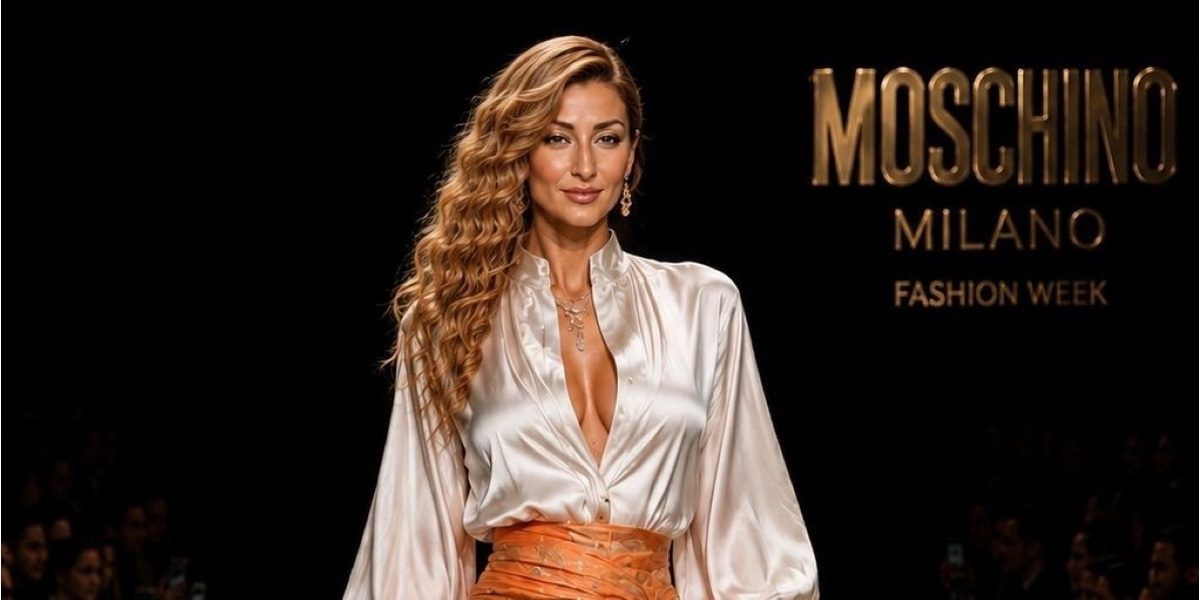

The most revealing detail in a fashion career is sometimes the role listed after “model.” For Nicole Cornetti, that list includes instructor, producer, coordinator, and media host. Each position changes her relationship with the industry: how she participates, what she contributes, and whose experience she helps shape. Together, they offer a portrait of a professional identity built through expansion. Cornetti’s story provides an opportunity to examine a question that resonates beyond fashion: how can a person continue developing when the world already recognizes them for one particular thing?
Fashion makes this question especially visible because its public language is visual. A photograph captures a moment, while professional development happens over time. Cornetti’s published biography describes a progression from studying at Dimitri Manuel’s modeling academy to teaching, coordinating, and producing fashion events. That sequence gives her profile a narrative: experience acquired in front of an audience becomes relevant behind the scenes. Her involvement with New York Fashion TV further places her within a collaborative environment where a presentation depends on multiple contributions. The finished image is only one expression of that work.
There is a business lesson within that progression. Expanding into another role requires more than adding a description to a biography. It means accepting different expectations and becoming accountable for different outcomes. A performer prepares a contribution; a coordinator considers how contributions fit together. An instructor must make knowledge understandable to someone who has not yet acquired it. These distinctions help explain why professional range matters. Its value comes from the ability to translate experience into something useful in a new context, while remaining willing to learn what the earlier role could not teach.
Cornetti’s background also includes a relationship between academic study and creative work. New York Wire reports that she began modeling in Europe at eighteen while pursuing university education, eventually obtaining a graduate degree. The detail deserves attention because it gives her career a longer perspective than an appearance or title can provide. Education introduces forms of concentration, evaluation, and persistence that can accompany a person across professional settings. Creative practice brings its own demands. Pursuing both suggests a development process shaped by different kinds of work, rather than a single route toward public recognition.
Public recognition nevertheless remains part of the picture. Celebrity News identifies Cornetti as Ms. NY Universe 2025–2026 and reports invitations to judge beauty pageants and modeling competitions. It also describes appearances at Miami fashion events and activities surrounding the Cannes Film Festival. These details establish settings in which her career has unfolded without explaining its entire meaning. Their significance becomes clearer when considered alongside her other responsibilities. Recognition creates an introduction; a broader professional record provides context. Looking at both allows a more complete assessment than treating any single title or appearance as a sufficient definition.
Her profile also raises the subject of contribution. New York Wire describes involvement in youth mentorship and nonprofit initiatives, including causes connected with mental health and cancer awareness. These commitments belong to a different conversation from professional visibility, one concerned with how experience and attention can serve others. Mentorship, in particular, depends on the quality of an exchange. Advice becomes useful when it acknowledges another person’s circumstances and helps them develop their own judgment. For someone whose professional activities include teaching, the opportunity to support emerging talent creates a connection between personal experience and another individual’s future.
Communication provides another connection across Cornetti’s activities. Her published profile includes podcast hosting, talk show hosting, and public speaking. Unlike a brief visual appearance, these formats unfold through language and attention. They ask a participant to explain, listen, and respond. Their inclusion in her career points toward a broader understanding of public presence: an audience can encounter someone through ideas as well as images. For a professional moving between fashion and other fields, that distinction matters. It creates space for context, allowing an experience to be discussed rather than simply displayed, and giving the audience more room to engage.
Taken together, these elements make Cornetti’s career interesting as an ongoing exercise in professional possibility. Modeling, instruction, production, and communication involve different responsibilities, yet experience can travel between them. For women developing careers in creative industries, that offers an encouraging perspective on growth. An established identity can provide a foundation for further work without prescribing every future choice. The challenge is to keep adding substance: knowledge that can be shared, responsibilities that can be fulfilled, and relationships built through reliable participation. Nicole Cornetti’s story draws attention to that process, where a career gains depth through what a person continues learning and contributing over time. Its next chapter remains open.