
By: Yuxuan Fan
From a Soul in the Horn night at 99 Scott to a UK rave brand’s U.S. debut at The Brooklyn Monarch, a lighting designer who also DJs is building a way for the performance itself to run the room.
In lighting, “busking” has nothing to do with a guitar case on a sidewalk. It is the trade’s word for running a show by hand. There is no timeline and no cue list locked to a track. The operator stands at the console, listens, and plays the rig in real time, one hand on the faders and the other ready for whatever the DJ does next.
For Roksana Zhang, a New York–based lighting designer who also performs as a DJ, busking is less a technique than a working philosophy. She arrived at it by a long route. She studied at the Central Academy of Fine Arts in Beijing, then took a master’s in urban design and planning at the University of Sheffield, where her research asked how construction noise might be turned into a pleasant soundscape. Alongside her studies she worked in A&R in London. Then she moved to New York for Berklee NYC’s Live Music Production and Design program, where she found lighting and began DJing in earnest. The result is a designer who reads a room like an architect, hears a track like a performer, and lights it like someone who is listening.
Since the fall of 2025, Zhang has worked with Kawa Lighting, the New York production company founded by lighting designer Darren Kawa, on more than a hundred shows across Manhattan and Brooklyn, in rooms including 99 Scott, 154 Scott, Nebula, Tao Downtown, Signal, Deluxx Fluxx, Virgo, PhD Rooftop, Gospel, and Loosie’s. She programs on grandMA consoles, routes the DMX, hangs and focuses the rig, and then, when the doors open, busks.
The Room at 99 Scott
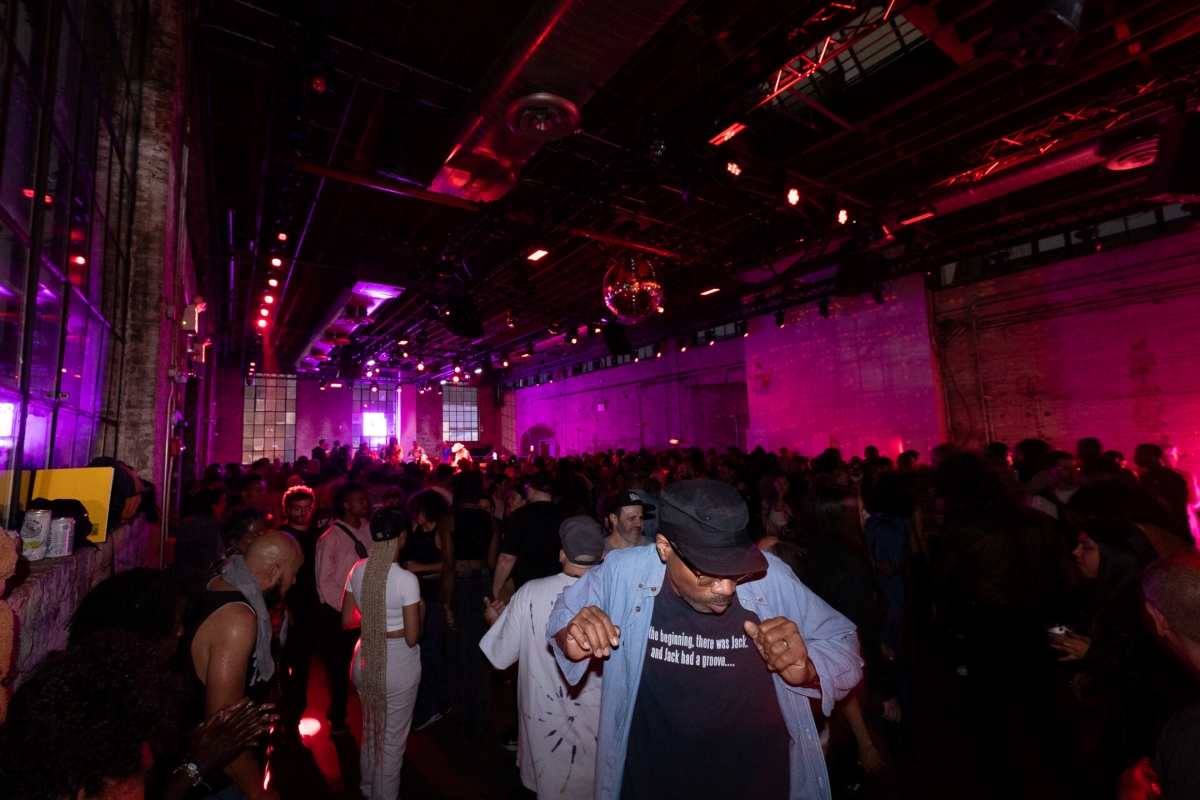
Ask Zhang where a profile should start and she does not pick a headliner. She picks a party: Soul in the Horn, the Brooklyn dance night featuring DJ Natasha Diggs, at the warehouse venue 99 Scott in Bushwick. She lit two of its nights this spring, programming the show in advance and running the console live, moving the look with the music and the energy on the floor.
What she remembers is not a cue. It is the people who found her afterward. Someone would ask what she did. She would say she ran the lights. “You killed it,” they would say. Others came over simply to tell her the lighting was good.
“Lighting usually works backstage,” she says. “So when a crowd notices it, remembers it, and goes out of their way to tell you, you feel the work was actually seen.”
Her method begins with the fact that she performs too. “DJing and lighting let me build a show from both sides, the performer’s and the audience’s,” she says. “The DJ on stage, the lighting and sound team behind them, the people who came out for that night: everyone has carried weeks or months of preparation into the same room. That energy is big. I try to catch every change in the music.”
Knowing how a track is built, she assigns fixtures to musical parts. Beam lights hit with the kick. Wash lights shift color and intensity with the lead melody. “In my head the room is a big three-dimensional Ableton session,” she says. “Each fixture is a track, and each track belongs to a different layer of the music. The lights stop being something that illuminates the stage and become the structure of the music, made visible.”
She has carried that approach into a widening list of nights. She was on the crew for Paul van Dyk at 99 Scott, and was lighting designer for Vini Vici, the Israeli duo who have played Tomorrowland’s main stage, at Nebula in September. She lit ACRAZE, whose “Do It To It” has drawn more than eight billion combined streams, at 154 Scott; DJ Habibeats at 99 Scott; and Arjun Rampal at PhD Rooftop, along with brand nights for Hypebeast and Toyota and for Luar with Lunazul Tequila. She handled lighting execution on the production behind Ellie Goulding’s official video for “Ravers,” which has passed a million views on YouTube. And she has stepped out from behind the console to play, including an August bill headlined by Ben Nicky, No. 66 on DJ Mag’s 2026 Top 100 DJs poll.
The DJ as Show Controller
The more rooms she lit, the more one gap bothered her. DJ shows are multiplying, and so are the places that host them: rooftops, boats, the park Under the K Bridge, galleries, warehouses. A 2026 Remitly study of online searches across 145 countries found that DJ had become the most searched-for dream job in the United States. Yet budgets and gear vary widely from room to room. An established artist or a large venue can hire a full production team. A mid-sized party usually cannot afford a dedicated lighting and visuals crew, let alone custom video for every track. The music and the energy are there. The picture does not keep up.
Zhang’s answer was to look at who is already at the center of the show. “The DJ is already there, already performing, already touching hardware all night,” she says. “So instead of building a separate system for every part of the show, I started asking how the DJ’s own equipment could become the interface for the lights and visuals.”
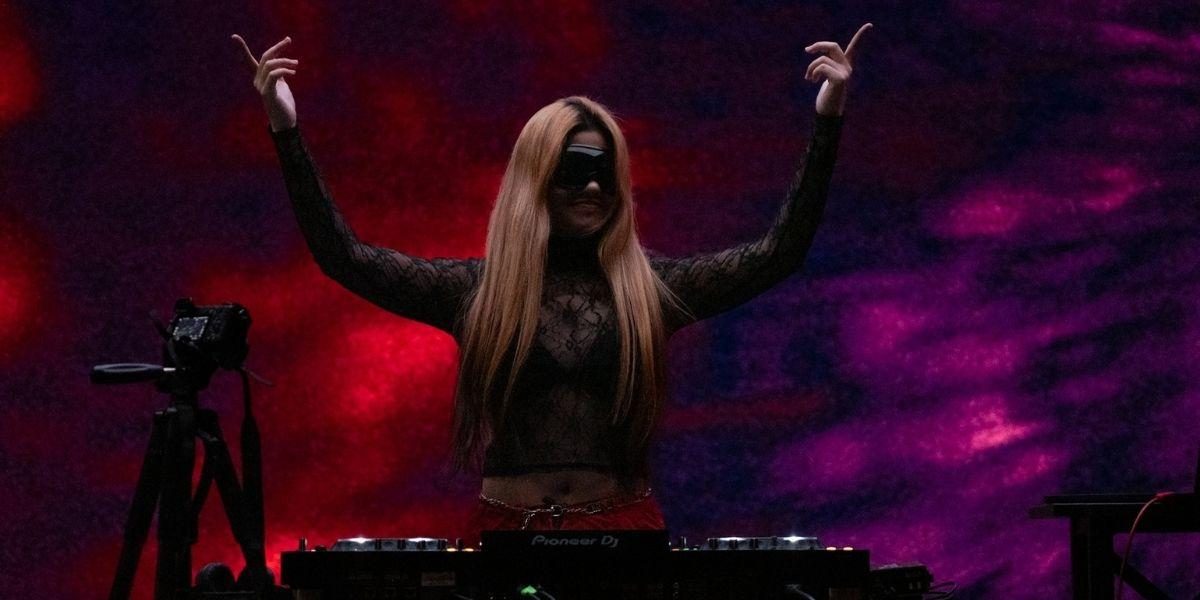
She taught herself the stack to make that possible: MIDI, DMX, grandMA, TouchDesigner, Unreal Engine, networking, and show control, and built it into a DJ-controlled visual system. A move on the mixer changes the picture. A transition shapes a visual effect. The performance itself becomes an input to the room. Tools like ShowKontrol already pull live data from DJ decks and feed it to lighting and video rigs; her research sits one layer up. “I want the system to choose images that fit the mood of the music right now, not just move with the beat,” she says. “And it has to run reliably in a live room without a professional VJ.”
Today a DJ deck can drive the visuals directly while she mixes, and she has filmed the result as a hard-techno live set. The next step is a system that listens: analyzing rhythm, timbre, sections, and energy, reading what the music is doing emotionally, and choosing visuals to match.
She has not kept the work to herself. Her DJ tutorials on Patreon have nearly 700 subscribing DJs, and when members of her Discord said the material was hard for beginners, she built a beginner track from the ground up. By her count, the related content has drawn roughly six million views.
“The goal was never to replace lighting designers or VJs or production teams,” she says. “It was to lower the barrier to an immersive show in the first place, so that more spaces can become places for music.”
Thanksgiving Eve at the Monarch
The night Zhang is looking toward is November 25. FERAL, the UK hard-techno rave brand that launched at E1 in London in 2024, opens its U.S. debut tour at The Brooklyn Monarch in Williamsburg, presented by SLIST, with Zhang on lights. It will be, she says, the first time her DJ-controlled visual system runs inside a full commercial rave.
“I want people to see that the DJ is not only mixing,” she says. “The DJ is also making the visuals happen. What I do on the mixer changes the picture, and the music-analysis side I’m developing should let the visuals respond to the structure and the mood of a track on their own.”
Underneath it is a plain conviction about live music. “Music, light, and image should happen together in the room,” she says. “Not on three separate loops.”
For now, the lights are still learning to listen. On the night, she will be the one at the console, listening for them.
Zhang’s lighting work and live sets are collected on her Instagram.