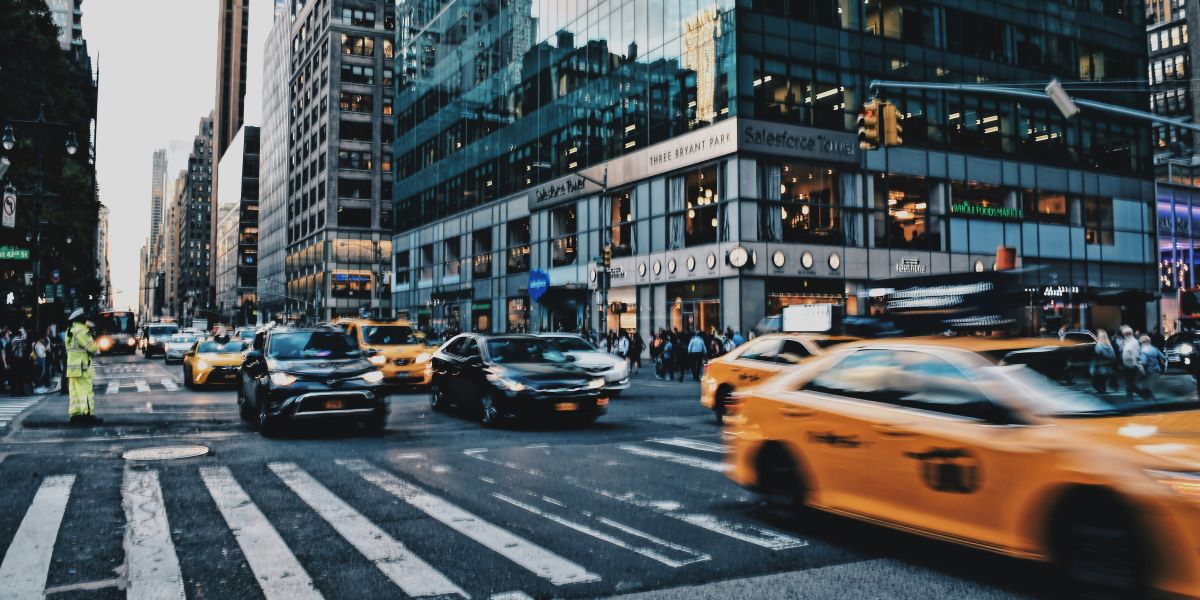

The New York City Department of Health released its first comprehensive evaluation of the Congestion Relief Zone Tolling Program on August 14, and the findings landed somewhere between vindication and disappointment for both sides of the congestion pricing debate. Air quality across the five boroughs remained stable or improved slightly during the program’s first year, continuing a two-decade trend of declining pollution. No neighborhood, including environmental justice communities along major highway corridors in the Bronx, experienced increased air pollution attributable to the tolling program.
The report tracked four traffic-related pollutants, fine particulate matter (PM2.5), nitrogen dioxide, nitric oxide, and black carbon, using data from the New York City Community Air Survey (NYCCAS) monitoring network. Researchers collected readings from one full year before tolling began in January 2025 through one full year after, then isolated the effects of congestion pricing from weather patterns, seasonal shifts, and regional wildfire smoke using statistical modeling and a control site outside the program’s reach.
Health Department Data Contradicts Columbia University Findings
The South Bronx question had been the most politically charged dimension of the congestion pricing rollout. Opponents warned that drivers avoiding the $9 peak-hour toll would flood highway corridors through the Bronx, worsening air quality in neighborhoods that already carry some of the highest asthma rates in the country.
An earlier study from Columbia University researchers appeared to confirm that fear, reporting that air pollution rose in the South Bronx after tolling began. The Health Department’s evaluation reached a different conclusion, finding no increase in pollution along the Cross Bronx Expressway, the Major Deegan Expressway, or other highway corridors identified in the original environmental assessment.
NYC Health Commissioner Dr. Alister F. Martin framed the report as a data-driven answer to community concerns. The Health Department expanded its existing NYCCAS monitoring network in partnership with the MTA, the NYC Department of Transportation, and the New York State Department of Transportation specifically to evaluate tolling’s impact at the neighborhood level.
MTA Chair and CEO Janno Lieber addressed the Bronx question directly, noting that the feared pollution spillover into surrounding boroughs did not materialize. The MTA has already begun deploying mitigation funds in the borough, with the first replacement refrigerated trailer unit delivered to Hunts Point Market in December 2025 and a $20 million childhood asthma investment announced by Mayor Zohran Mamdani in May 2026.
The Revenue Story Remains Stronger Than the Air Quality Story
Where congestion pricing’s environmental impact reads as incremental, continuing an existing trend rather than accelerating it, the program’s fiscal and operational results have been more definitive. The MTA reported that tolling generated over $550 million in net revenue during its first year, exceeding initial projections of $500 million annually. That revenue backed $15 billion in bonds for capital improvements including signal upgrades on the A and C subway lines, new Staten Island Railway cars, and station accessibility projects.
Traffic volume in the Congestion Relief Zone, covering Manhattan south of 60th Street, fell 11% year over year. Rush-hour crossing times into the zone improved by as much as 51% at some entry points. Subway ridership grew 7%, reaching 1.3 billion trips in 2025, approximately 85% of pre-pandemic levels. Bus speeds within the toll zone also increased on weekdays.
A separate Cornell University study published in December 2025 found a 22% reduction in fine particulate matter within the toll zone during its first six months, a sharper finding than the Health Department’s more conservative citywide assessment. The divergence likely reflects differences in methodology and scope, with the Cornell team using daily data from 42 monitors across the metropolitan area while the Health Department study prioritized neighborhood-level readings over a longer time frame.
Critics Question Whether Results Justify the Toll
The Health Department report did not quiet congestion pricing’s opponents. The finding that air quality was “not any different because of congestion pricing,” as Dr. Martin phrased it, gave critics an opening to argue that the program’s environmental rationale has not been borne out. Social media reaction over the weekend reflected that divide, with some New Yorkers questioning whether a $9-per-trip toll is justified by a program that maintained existing trends rather than producing measurable new gains.
City and state officials pushed back by pointing to the program’s combined benefits. NYC DOT Commissioner Mike Flynn cited more than $120 million invested in air quality and public health initiatives through the mitigation program, including the Clean Trucks Program. State Senator Gustavo Rivera, whose Bronx district includes communities along the Major Deegan, said he was encouraged that the data showed no worsening conditions in environmental justice neighborhoods.
The congestion pricing debate is heading into its second year with the fundamental tension unresolved. The program has clearly reduced traffic volume, generated substantial transit revenue, and held the line on neighborhood air quality. Whether holding the line constitutes a public health victory or an expensive status quo depends on which side of the toll zone a New Yorker stands.
FAQs
What did the NYC Health Department report find about congestion pricing and air quality?
The report found that air quality across the city remained stable or improved slightly during the first year of congestion pricing, continuing a 20-year trend of declining pollution. No neighborhood experienced increased air pollution attributable to the tolling program.
Did congestion pricing worsen air quality in the South Bronx?
The Health Department found no increase in pollution along major highway corridors in the Bronx, including the Cross Bronx Expressway and Major Deegan Expressway. This contradicts an earlier Columbia University study that reported rising pollution in the South Bronx after tolling began.
How much revenue has congestion pricing generated for the MTA?
The program generated over $550 million in net revenue during its first year, exceeding initial projections of $500 million annually. That revenue backed $15 billion in bonds for transit capital improvements across the MTA system.