
By: Jessa Dollesin
Elena Von Kohn does not paint small ideas.
Often, she does not paint small canvases either.
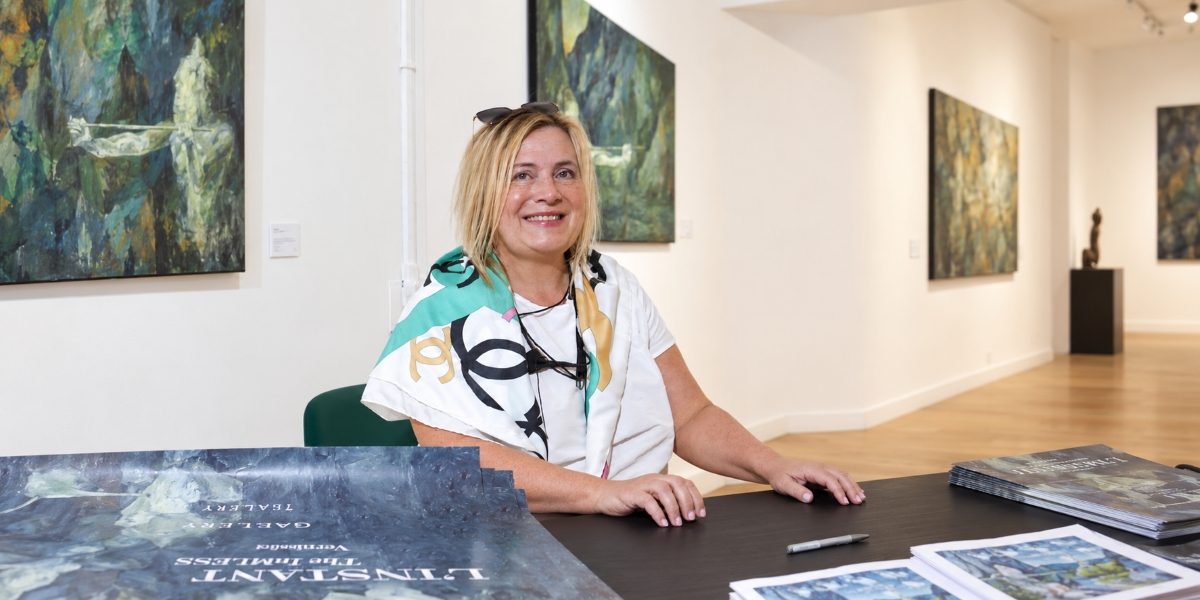
Her monumental works can stretch across a wall, filled with mysterious figures, impossible architecture, and objects that appear to belong to a story the viewer has entered somewhere in the middle.
On October 6, 2026, that world moves into one of Vienna’s historic cultural settings when Von Kohn presents The Gate of Déjà Vu at Palais Auersperg.
It is the kind of setting that appears almost designed for her paintings.
Historic interiors. Classical music. Elaborate architecture. Contemporary surrealism.
And a title suggesting that somewhere behind all of it lies a memory we cannot quite retrieve.
“I have always been fascinated by that moment when something completely new feels familiar,” Von Kohn says. “You cannot explain why. You just know you have somehow been there before.”
That feeling became the conceptual doorway to The Gate of Déjà Vu.
Von Kohn’s artistic world is highly narrative, but she refuses to provide viewers with a complete script.
A staircase may lead somewhere impossible.
A figure may appear simultaneously present and psychologically elsewhere.
An ordinary object may become the most important thing in the room.
The artist calls the style enigmatic surrealism.
The “enigmatic” part matters.
Traditional surrealism frequently looked toward dreams and the unconscious. Von Kohn adds another element: a carefully constructed mystery that asks the viewer to participate.
“I want people to stop,” she says. “Not just look and move on. I want them to ask, ‘What happened here? What is about to happen? Why does this feel familiar to me?’”
Her biography offers almost as many geographic layers as her paintings.
Born in Leipzig, Germany, Von Kohn began painting at three. She later studied in Moscow, including at the Moscow Art School for Gifted Children, before earning an MFA summa cum laude.
Eventually, she built her career in the United States.
Yet Europe remained embedded in her visual imagination.
That connection became increasingly tangible during an extended period in Paris in late 2025, followed by a Paris exhibition in June 2026.
Now comes Vienna.
Palais Auersperg offers something a conventional gallery cannot: history already exists in the room before the first painting arrives.
For another artist, that could be a distraction.
For Von Kohn, it is material.
“I love putting contemporary work into a place that already carries memory,” she says. “The painting changes the room, but the room also changes the painting.”
Music will add another dimension to the October 6 evening, connecting the exhibition with the palace’s classical concert tradition.
Von Kohn sees painting and music as closely related.
Both communicate before they can be explained intellectually.
“You can listen to a piece of music in a language that does not exist, and you still understand emotion,” she says. “Painting is like that.”
Her large canvases take that principle further by making scale itself emotional.
Standing before one is markedly different from seeing it reproduced on a phone or computer.
Von Kohn wants that physical confrontation.
She wants the viewer close enough to discover details, then far enough away for those details to dissolve into the larger composition.
The effect mirrors the way memories behave.
Up close, they can seem extraordinarily precise.
Step away, and the edges change.
For Von Kohn, perhaps that is where the real art begins.
The exhibition may be called The Gate of Déjà Vu, but the artist does not reveal what is supposed to exist on the other side.
That decision belongs to the viewer.
Elena Von Kohn’s The Gate of Déjà Vu will be presented on October 6, 2026, at Palais Auersperg in Vienna, Austria.