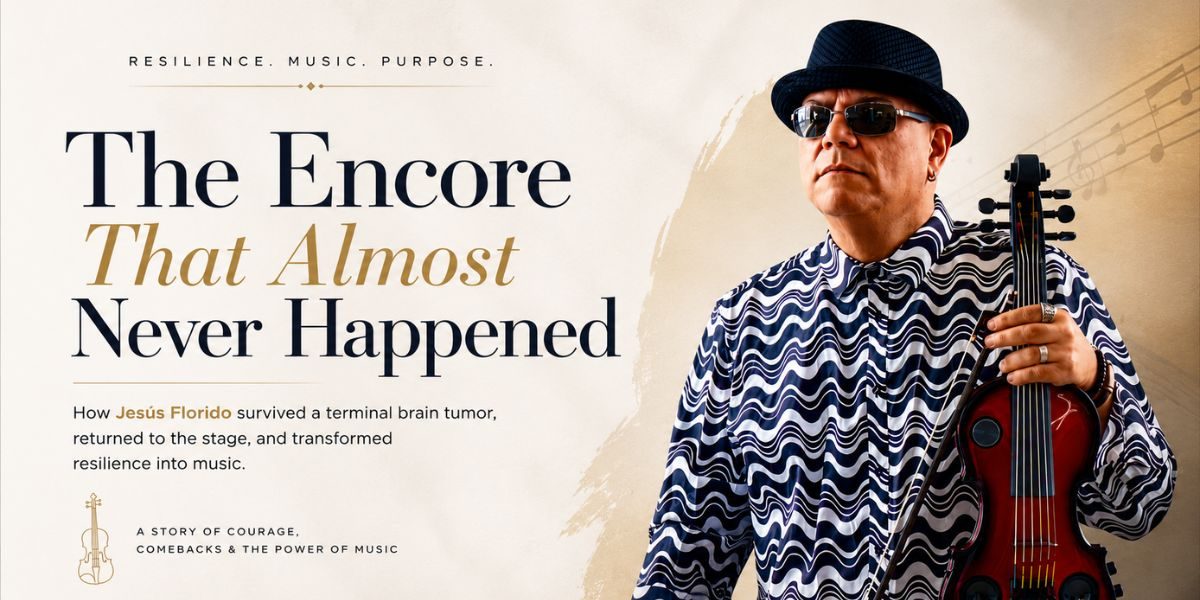

Jesús Florido survived a terminal brain tumor, endured years away from the stage, and returned with a renewed conviction that music is not merely performance. It is proof of resilience.
There is a particular silence that musicians know well. It arrives just before the first note, when anticipation hangs heavier than sound itself. For Jesús Florido, that silence once represented possibility. Then, for several years, it represented something far more unsettling: uncertainty.
Long before Grammy-winning productions, international performances, and standing ovations, Jesús Florido confronted a moment that threatened to erase everything he had spent a lifetime building. At forty-five, just two weeks after the birth of his first child, he received devastating news. A terminal brain tumor. It was the kind of diagnosis that instantly redraws every map a person has carefully constructed. Careers become secondary. Future plans dissolve. Even identity begins to feel negotiable. For a professional violinist, the stakes were almost unimaginable.
Music is often romanticized as something spiritual, but it is also intensely physical. Every performance depends upon microscopic coordination. Balance, muscle memory, hearing, timing, concentration, and emotional control work in perfect synchrony. A brain injury or neurological illness can dismantle decades of discipline in an instant. The diagnosis threatened far more than his livelihood. It threatened the language through which he had understood the world since childhood.
Born in Venezuela and shaped by the formative years of El Sistema, he had spent decades proving that music could cross borders. His violin carried classical traditions into jazz clubs, Latin rhythms into concert halls, and educational outreach into underserved communities. He had shared stages with internationally celebrated artists, composed for film, mentored students around the world, and built a reputation for making audiences feel less like spectators than participants.
Then came the interruption no rehearsal could prepare him for.
An experimental surgery, described by Jesús Florido as nothing short of miraculous, saved his life. Survival, however, was only the beginning. Recovery stretched across six long years before he felt capable of returning to high-level performance. Six years of rebuilding not only physical ability but artistic confidence. Six years of rediscovering the relationship between musician and instrument. Six years of learning that resilience rarely arrives dramatically; it accumulates through countless invisible victories. Many artists speak about reinvention. He experienced something closer to rediscovery. The violin waiting on the other side of recovery was the same instrument. The hands holding it were different.
Near-death experiences often inspire stories of radical transformation, but his journey reveals something subtler. Rather than abandoning the values that had defined his career, adversity intensified them. Music education became even more urgent. Mentorship became more personal. Every concert carried greater emotional immediacy because performance itself was no longer guaranteed. It had become a privilege reclaimed. His oft-repeated belief that music has to be part of every child’s development began to relate beyond educational philosophy. It reflected an understanding that art is not extracurricular to human life. It is one of the ways people recover from it.
That perspective explains why colleagues frequently describe him less in terms of technical brilliance than generosity. Students encounter an educator who teaches possibility alongside musicianship. Audiences encounter a performer who dissolves the invisible wall separating the stage from the seats. Young artists find someone who insists that cultural identity is an asset rather than an obstacle, encouraging them to bring their whole selves into their work instead of conforming to inherited expectations.
Today, his résumé continues to grow with Grammy-winning collaborations, Latin Grammy recognition, producing, composing, recording, and international performances. Those achievements are undeniably impressive. They tell only part of the story. The more enduring accomplishment may be what cannot be measured in awards or performance credits.
It exists in the students who carry forward lessons learned under his mentorship. It exists in audiences who leave concerts feeling unexpectedly connected rather than merely entertained. It exists in the countless young musicians who see in his journey evidence that extraordinary careers are rarely defined by uninterrupted success, but by the willingness to continue after unimaginable setbacks. There is an old belief among performers that every concert contains two stories. The one audience witnesses and the one only the artist understands.
When Jesús Florido steps onto a stage today, listeners hear confidence, artistry, and decades of experience. What they may not hear is the quieter composition beneath every note. The remarkable story of a man who once faced the possibility that he might never play again, and who returned not simply to resume his career, but to redefine what it means to dedicate a life to music. Some encores are requested by audiences. The most meaningful ones are earned from life itself.