

By: Chanel Frances
Anthony Trucks was three years old when the state placed him in foster care. He was too young to have language for what was happening, but his body absorbed the lesson anyway: he did not matter, and the world would decide who he was before he ever got a say in it. That belief rode with him through eleven years in the system, an adoption at fourteen, and a football career that carried him to the University of Oregon and, eventually, into the NFL.
It stayed with him until a shoulder injury ended his playing career and handed him a question he had never actually had to answer: Who was he without football?
“My first thought was that I was nobody,” Trucks said. “That was the thing that gave me a sense of self. By the time I’d gone thirteen years playing, when I got done, I didn’t really know who I was of value to the world outside of that.”
What followed was a stretch most executives never have to survive: three kids, a 500-square-foot apartment, and an air mattress on the floor. Trucks says the turning point came when he stopped waiting for circumstances to change and started looking at his own role in them.
“I was the common denominator in all of my problems,” he said. “It wasn’t until I had that sense of, man, I was the one that had to do the work to build out, that I actually was able to get myself in a better place. Most people don’t like the place they’re in, but they don’t want to own that. So they end up becoming their own worst enemies.”
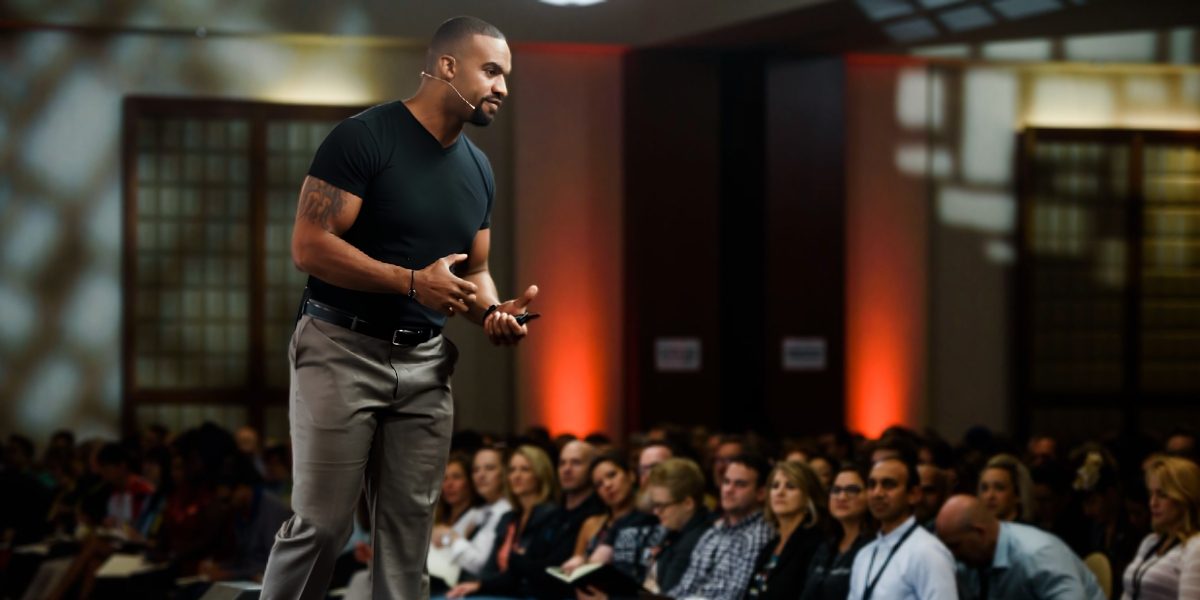
That reckoning became the foundation for Dark Work, the framework Trucks now teaches to executive teams at companies including Amazon, PayPal, T-Mobile, and Chick-fil-A, and the engine behind his two ventures, Dark Work and Speak to Freedom. The premise is direct: the strategy sitting in a company’s playbook only works if the person executing it has already done the harder, invisible work of becoming someone capable of running it.
“A five-billion-dollar company operator isn’t the same as a twenty-billion-dollar operator,” Trucks said. “There are two different identities. You have to realize the way your brain fires based on your experience, your psychology, how you see things, all of it is affecting outcomes you’re not even aware of. You may have a great tactical strategy. The question is whether you have the identity to execute it properly. If you don’t, you won’t get the outcome you deserve.”
Trucks defines dark work as whatever a person knows they need to do consistently, the thing that moves the needle over the long run but offers no applause along the way. It looks different depending on who is doing it.
“A CEO has different work than my neighbor, who happens to be a teacher, or my wife, who’s a stay-at-home mom, or my kids, who play sports,” he said. “But on Tuesday morning, dark work is the thing you know you need to do religiously, that you don’t want to do, but that moves the needle if you do it every single day. If you didn’t do it, nobody would know. But you would.”
He points to two specific outcomes for leaders who stay with it long enough:
1. A skill set that becomes difficult for competitors to replicate, turning consistency into a genuine edge.
2. A shift where the hard task eventually becomes part of identity, which removes the daily friction of deciding whether to do it at all.
That second point ties into what Trucks calls decision fatigue, the mental cost of treating a habit as optional. “The more decisions you have to make, the faster your mental tank drains,” he said. “If you’re choosing to do something because you don’t want to and it’s hard, eventually you get drained, and you can’t keep your focus for the whole day. But if it’s who you are to do it, there’s no more decision. You knock it out and save that tank for the bigger calls that actually move your company.”
Trucks is building a technology platform around the Dark Work framework, designed to strengthen its one-on-one coaching by bringing the community, content, and coaching structure into a single space. Access to the community is intentionally shut off during active coaching work, keeping clients focused on their individual sessions without distraction.
The philosophy extends into his work with National Angels and Foster Love, where Trucks serves on the advisory council and mentors foster kids directly. “The hardships you’ve experienced are the sharpening stones that make you a weapon,” he tells the foster kids he mentors. He points to a line he keeps close: smooth seas never made skilled sailors.
It also shows up at home, where his wife runs the Aim High Day Program, his son coaches track at the University of Houston, and his daughter ranks among the top hurdlers in California. “The big thing I teach my kids is that it’s the things nobody sees that make you great,” Trucks said. “The race that gets won at the end of the year started in preparation before the year began. When people interact with me, I’m not just saying words that sound good. I’m saying it from a place where my family lives every day, and we have the proof to show it.”
Trucks has hosted a daily podcast, now called the Dark Work Daily, for more than 1,400 episodes, a habit he kept running long before there was an audience to hear it. “I was building this for myself,” he said. “I wanted the discipline of showing up every single day, so that when people eventually noticed, and I knew they would, they’d be looking at someone who had already put in the work. That kind of readiness only comes from consistent daily development.”
His challenge to the CEOs reading his story is to look at the task on tomorrow’s calendar that keeps getting pushed down the list, the one nobody would notice if it disappeared, and do it anyway.
“Making that identity shift is a huge piece, and it only happens through doing the thing every single day until it becomes harder not to do it,” Trucks said.
Anthony Trucks works with executive teams and organizations on identity-based performance through his Dark Work framework. His coaching programs and speaking engagements center on the same principle that shaped his own path, that lasting results begin with who a person becomes before the work ever starts.