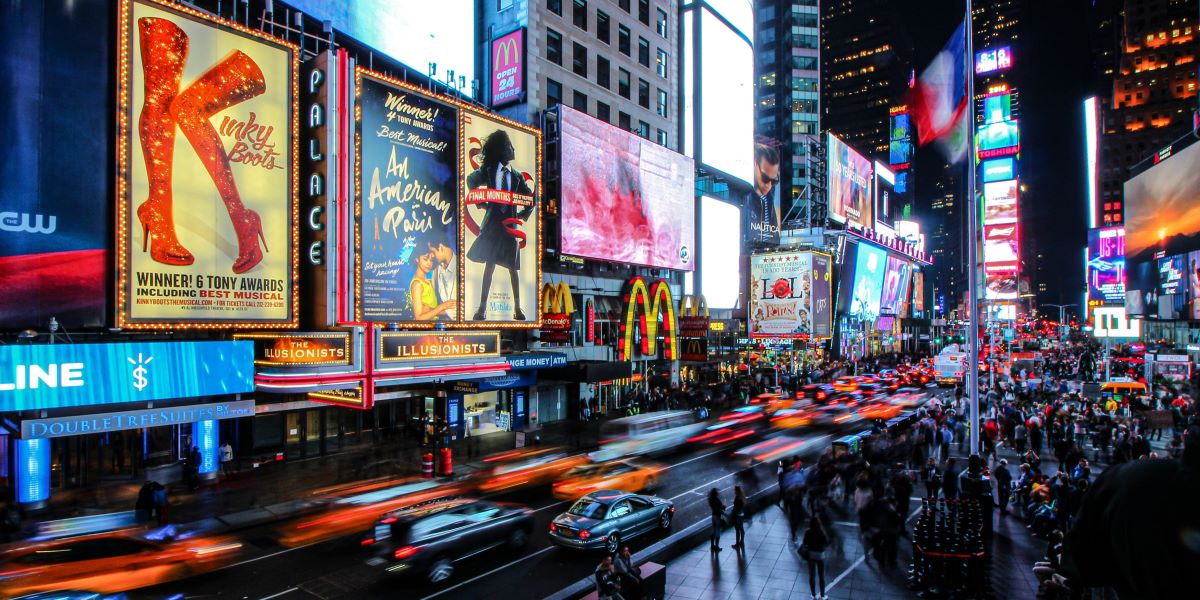

The most recognizable street in American entertainment owes its shape to a path that predates the city itself. Before the marquees, the billboards, and the term “Great White Way,” Broadway was the Wickquasgeck Trail, a trade and travel route worn into Manhattan by the Lenape long before any European set foot on the island. The theaters came centuries later. The road came first, and it has barely moved.
A Path Chosen by Geography
The trail took its name from the Wecquaesgeek, a band of the Lenape who lived in the northern reaches of the island and across the waterway that became the Harlem River. Their route ran roughly north to south along a spine of high, well-drained ground, threading past swamp, rock, and open field on the firmest footing the island offered. That choice was practical rather than ceremonial. A ridge stays dry and passable when the lowlands turn to mud, and the people who used the path daily for trade had every reason to follow the terrain rather than fight it.
The Dutch explorer David Pietersz. de Vries left one of the first written references to the route in his journal for 1642, describing a road the Native population traveled regularly. By then the trail was already old. It served as a corridor of exchange between Lenape communities and, once the Dutch arrived, between those communities and the colonists clustered at the island’s southern tip.
From Wickquasgeck to Broadway
Dutch settlement reorganized the southern end of the path without abandoning it. After establishing Fort Amsterdam near present-day Bowling Green, colonists widened the trail into the main road of New Amsterdam, using it as the spine of the young settlement. They attached their own names to it. Some called the lower stretch de Heere Straat, the Gentlemen’s Street, a nod to the prominent residents who built along it. The broader route picked up the Dutch label Brede weg, meaning broad way.
When the British took Manhattan in 1664, they translated that Dutch phrase directly into English, and Broadway entered the record. The name has outlasted the colony, the fort, and the wall the Dutch built across the island to mark their northern boundary, the fortification that gave Wall Street its name. What survived intact was the road’s defining trait: its diagonal, wandering line.
The Trail That Broke the Grid
That diagonal is the clearest evidence of Broadway’s origin still visible on any map. When the Commissioners’ Plan of 1811 imposed the rectangular street grid that organizes most of Manhattan, Broadway refused to conform. It cuts across the numbered avenues and streets at an angle, slicing through the orderly blocks the planners laid down and creating the irregular open spaces the city later turned into public squares. Times Square, Herald Square, Union Square, and Madison Square all exist because Broadway crossed the grid where the grid did not expect it.
In that sense, the most commercially valuable real estate in New York traces its geometry to a footpath that followed the contours of pre-colonial Manhattan. The Lenape chose the line for the dry ground. The Dutch widened it for trade. The grid tried to overrule it and could not. The street’s awkward, profitable angles are an inheritance, not a design.
A Marker at the Southern End
The trail’s old southern terminus remains marked, though few visitors register the connection. At Broadway and Bowling Green stands the Alexander Hamilton U.S. Custom House, the 1907 Cass Gilbert building that now houses the National Museum of the American Indian. The spot where Lenape traders once reached the Dutch settlement is occupied today by an institution devoted to Native history, a coincidence of geography that closes a long loop.
The street’s later identity as a theater corridor developed gradually. Entertainment venues began clustering along Broadway in the 18th century, and the strip’s reputation as a stage district hardened in the 19th and early 20th centuries as electric light turned its nighttime blocks into a spectacle. That chapter is the one most people know. It sits on top of a far older one.
Broadway is often described as New York’s oldest thoroughfare, and the description fits because the road is older than New York. It was a working route before there was a city to route through, and it has carried traders, soldiers, residents, and audiences along essentially the same line for four centuries. The lights are recent. The path is not.