Inside Karen Weller’s Story, Where a Sweet Little Monkey Discovers a Big, Big World!

By: Vanilla Heart Publishing

Children’s books often arrive wrapped in simplicity. Everywhere you see, there are bright illustrations, gentle humor, and comforting endings. But every story, no matter how fun and playful on the surface, quietly carries something much deeper beneath it.

Kiki Makes a Friend or Two by Karen Weller is an example. At first glance, it is a charming tale about a monkey experiencing illness, friendship, and a sense of home. Yet, as the story unfolds, it reveals a heartfelt exploration of compassion, responsibility, and what it truly means to belong.

What makes this book particularly special is not just the story it tells, but the way it tells it. The reader reads through Kiki’s eyes. This choice allows readers, especially younger ones, to walk into an emotional world that feels immediate, honest, and surprisingly profound.

Through Kiki’s Eyes, We See Ourselves

There is something odd (but good odd) about seeing the world through someone smaller, more vulnerable, and less sure. Kiki’s presence serves as a lens through which we, as readers, experience joy, confusion, and wonder. Her voice doesn’t try to explain everything. It just feels. And, in that simplicity, it becomes remarkably honest.

Think about the last time you walked into a place that felt unfamiliar, a hospital, a new school, a room full of strangers. Nothing may have been wrong, and yet everything felt overwhelming. Sounds seemed louder, time slower, and reassurance just out of reach.

That is the vulnerability and a slight discomfort this story recreates. Instead of telling us what to think, it invites us to remember what it feels like not to fully understand what’s happening, and how deeply we rely on comfort in those moments.

The Story Shows Us That Healing Isn’t Just Physical

The opening of the story sets an emotional tone. Kiki is sick, disoriented, and unsure of what is happening to her. She is surrounded by unfamiliar sounds, faces, and routines. The clinical environment, though meant to help, feels overwhelming and intrusive to her. She’s scared. This part of the book highlights an important message: fear stems from not understanding what’s happening to us.

Young readers may see themselves in Kiki. Whether it’s a doctor’s visit, a new school, or any unfamiliar situation, they can very easily relate to the feeling of losing control. The book doesn’t dismiss this fear; it recognizes it and then gradually turns it into trust.

When The World Suddenly Feels Bigger

The story gradually expands beyond Kiki’s personal experience as she encounters other animals at the clinic. She learns about abandonment, neglect, and survival in ways that are not overwhelming but still meaningful.

Instead of presenting these realities harshly, the book introduces them through Kiki’s curiosity and empathy. She begins to understand that not all animals are as lucky as she was to have the same loving home. From here, the story begins to explore the most important underlying ideas.

  • Not every creature starts life with safety
  • Kindness can change someone’s entire world
  • Awareness is the first step toward compassion

Kiki’s Journey Will Teach You To Feel Safe Again

Kiki’s operation marks a turning point in the story. On the surface, it is about medical treatment and recovery. But beneath that, it is about something much deeper. Recovery, in this sense, is not just about the body healing; it is about the heart finding safety again.

When Sarah and Nick return, their presence does more than comfort Kiki. It restores her sense of belonging. It reminds her that she is not alone. And in that moment, the story tells readers that healing happens faster when love is present.

Friendship Often Appears In The Most Unexpected Situations

As the story progresses, Kiki’s world becomes fuller, quite literally. New animals enter her life, each with their own story, struggles, and personality. From a playful ferret to a cautious guinea pig, and eventually to Michael, the rescued monkey, the book celebrates the idea that friendship can come from the most unexpected places.

But what makes these friendships meaningful is the effort behind them. Because after all…

  • Some friendships require patience
  • Some require understanding past trauma
  • And some simply require showing up with kindness

One Small Moment of Courage Can Bring BIG Change

One of the most striking moments in the story occurs during the journey home, when Kiki and her family encounter an injured man and a distressed monkey named Michael. This is where the story shifts its tone from personal growth to moral action. Rather than walking away, Sarah and Nick choose to help. And in doing so, they change Michael’s life entirely.

For young readers, this is an especially important takeaway. Kindness is not always convenient. It requires effort, attention, and sometimes stepping into uncomfortable situations. But as the story shows, those moments are often the ones that matter most.

Home Isn’t a Place. It’s a Feeling

By the time Kiki returns home, the meaning of “home” has evolved. It goes from being just a physical space to a shared environment filled with care, trust, and connection. The house becomes lively, even chaotic at times, but it is also deeply warm. Each animal brings something unique, and together, they form a kind of chosen family.

Michael’s journey is particularly touching. Initially fearful and uncertain, he slowly begins to feel safe. His transformation is not immediate, but it is meaningful. And through him, the story reinforces another beautiful truth that even those who have experienced neglect or fear can learn to trust and feel safe again.

One Last Thing The Author Wants You To Remember

Karen Weller does something truly remarkable in this book. She avoids preaching and overwhelming her readers. Instead, she lets the story unfold to convey the underlying message naturally.

All in all, this book is about viewing animals as emotional beings, practicing empathy in everyday life, and recognizing that families grow in unexpected ways. The power of this message lies in its subtlety. Children take it in naturally without feeling like they are being told what to do, and adults see its depth without it feeling heavy.


When Childhood Meets Reality and A Story of Growing Up Through Wonder

By: Matt Emma

There’s a particular kind of story that doesn’t just entertain, it lingers. It settles quietly in your mind and begins to reshape the way you think about ordinary things. A snowy night, a walk outside, even silence starts to feel different. Frosty and The Magic of Christmas belongs to that category. While it appears, at first glance, to be a simple tale about a magical snowman, it is, in truth, a layered story about growing up, hesitation, belief, and the fragile line between childhood and adulthood.

The narrative begins in a familiar way: children indoors, distracted and comfortable, unaware that something meaningful is about to happen just outside their door. This setup is intentional. It reflects a reality many people recognize, the tendency to remain inside, both physically and mentally, while the world outside waits quietly.

Ethan and his friends represent different stages of youth. Ethan stands somewhere in the middle, old enough to question things, but not yet too far removed from imagination. Toby leans toward humor and impulsiveness, masking deeper thoughts with jokes. Karen, slightly older, shows early signs of maturity, though she still carries the emotional intensity of adolescence.

Then there is Uncle Albert.

He is the quiet disruptor of the story, the one who refuses to let the night pass without meaning. His insistence on building a snowman is not just about tradition; it is about participation. He recognizes something the children do not: moments like this are rare, and once missed, they cannot be recreated.

When the children initially refuse him, it is not out of cruelty, but out of indifference. That indifference is important. It highlights how easily meaningful experiences are dismissed when they require effort, discomfort, or time.

Yet, something shifts.

Karen’s subtle push, combined with a quiet sense of guilt, brings them outside. This moment marks the beginning of change. It is not dramatic or sudden, it is small, almost reluctant. But that is how most meaningful transformations begin: with a single decision to step outside what is easy.

The act of building the snowman becomes symbolic. It is slow, physical, and collaborative. Each piece (boots, hands, stones, the carrot nose) is placed with intention. There is no shortcut, no instant gratification. In a world where speed often defines value, this process feels almost unfamiliar.

And then, at midnight, everything changes.

The transformation of the snowman into Frosty is not presented as shocking chaos, but as a natural extension of what has already been built. This is key. The magic does not appear out of nowhere, it emerges from effort, patience, and belief.

Frosty himself is not just a magical being. He is an embodiment of possibility. His personality is lighthearted, curious, and endlessly enthusiastic, but beneath that lies something deeper. He represents a world where limitations do not exist in the same way, where imagination directly shapes reality.

When he invites the children to follow him, the story shifts into a journey, not just through space, but through perspective.

As they move through the quiet town and into the forest, the environment begins to mirror their internal changes. The silence of the night, the glow of Christmas lights, the untouched snow, everything feels heightened, more alive. It is as if the world has been waiting for them to notice it.

One of the most compelling aspects of the story is how each character reacts to this unfolding magic.

Karen adapts quickly. She embraces the experience with confidence, suggesting a willingness to accept change. Toby responds with energy and humor, but beneath that is genuine excitement, he wants to believe, even if he doesn’t fully understand what is happening.

Ethan, however, is different.

His journey is quieter, more internal. He observes more than he speaks. He questions, hesitates, and processes. This makes his transformation the most significant, because it reflects a struggle that feels real, the tension between skepticism and belief.

This tension becomes most evident during the skiing scene.

When Frosty creates the ski slope and begins sending everyone down the hill, the moment is exhilarating for some, but terrifying for Ethan. Standing at the edge, looking down, he is faced with something that cannot be analyzed or controlled. It must simply be experienced.

Fear enters the story here in a meaningful way.

Not as something to avoid, but as something to confront.

Frosty’s response to Ethan’s hesitation is one of the most important moments in the narrative. Instead of dismissing the fear, he acknowledges it. He reframes it, turning it into something that can coexist with action.

This is where the story subtly shifts from magical adventure to emotional depth.

Ethan’s decision to take Frosty’s hand and step forward is not just about skiing, it is about trust. It is about choosing to move forward even when certainty is absent. In that moment, the story speaks to something universal: the experience of facing the unknown.

What follows is not just excitement, but release.

As Ethan descends the hill, fear transforms into exhilaration. The experience becomes something freeing, almost transformative. It is a moment that symbolizes growth, not through explanation, but through action.

The story continues to build on this idea through a series of magical experiences. The frozen pond becomes a stage for joy and movement. The ski chalet appears out of nothing, only to disappear again. A sleigh is created, admired, and then fades away.

These fleeting creations carry meaning.

They suggest that magic is not meant to be permanent. It exists in moments, in experiences, in memories. Trying to hold onto it too tightly would diminish its value. Instead, it is something to be lived, felt, and then allowed to pass.

By the time morning arrives, the tone shifts once again.

The bright, clear light of Christmas morning contrasts with the mysterious beauty of the night. The world feels more real again, yet something has changed. The characters are no longer the same as they were at the beginning.

There is a quiet exhaustion, but also a sense of fulfillment.

Even simple moments, like searching for food in an empty town, feel different now. There is awareness, responsibility, and a deeper connection between the group. Their shared experience has created something lasting.

What makes the story resonate is not the magic itself, but what the magic reveals.

It reveals how easily people disconnect from meaningful experiences. It shows how fear can prevent growth, and how stepping outside comfort can lead to something unexpected. It highlights the importance of presence, of being fully engaged in a moment rather than distracted by something else.

Most importantly, it explores the idea that growing up does not have to mean losing wonder.

Ethan’s journey is not about becoming less skeptical, but about becoming more open. He does not abandon reason; he expands it. He allows space for something beyond what he can explain.

This is what makes the story feel authentic despite its fantasy elements.

It does not ask the reader to believe in magic as a literal force. Instead, it invites the reader to consider what “magic” represents, connection, courage, imagination, and the ability to see beyond the surface of things.

In the end, Frosty and The Magic of Christmas is not just a story about a magical night. It is a story about a moment in life when everything feels possible, when the world seems larger than it did before, and when a simple experience can change the way you see everything that comes after.

And perhaps that is the most important kind of magic there is, not the kind that transforms snow into life, but the kind that transforms people.

Miles AG and the Evolution of Bryan and Shannon Miles’ Business Legacy Across Sectors

Over the last ten years, business ownership in America has shifted from single-industry specialization to multi-sector investment models, which have been followed by diversification and long-term value. Such a trend has reinvented how founders nurture growth beyond a successful business exit, with increased use of holding companies for consolidating their ventures, managing their assets across industries, and establishing continuity beyond one specific brand. It is here that Bryan and Shannon Miles developed Miles AG, a holding company designed to organize and expand their ventures after building their success with BELAY, the virtual staffing firm they founded in 2010 and later sold in 2025.

Miles AG works as the primary vehicle through which the couple manages their post-BELAY business interests. It represents a central structure for investment and operational oversight in fields as varied as hospitality, brewing, sports ownership, and nonprofit initiatives. While BELAY positioned the Miles as early advocates for remote work and virtual staffing, Miles AG reflects their growth into multi-industry business operators with a focus on sustainability and strategic diversification. The company embodies a more holistic approach to entrepreneurship, whereby the capital and know-how derived from earlier ventures serve to build long-term enterprises across mutually reinforcing sectors.

Miles AG came into being at a time when successful founders increasingly looked to institutionalize their business interests. When the Miles sold a majority stake in BELAY to an investment group, they had already started the process of shifting focus away from managing a single company to a portfolio of enterprises. This provided a consolidated operational function with streamlined management to support the next generation of business initiatives under one corporate identity. Miles AG serves as both a brand and a structural entity, connecting the couple’s ever-expanding network of companies.

Among the more visible entities under Miles AG’s umbrella is NoFo Brew Co., a brewery and distillery with locations in Georgia, Florida, and Tennessee, along with Ireland and England. Founded in the years immediately after BELAY’s success, NoFo Brew Co quickly gained recognition for its craft beer and spirits with numerous regional and national awards for quality and innovation. Its presence both in the American Southeast and in the United Kingdom reflects the company’s aspiration to create community-oriented brands on an international scale. The Miles’ involvement in NoFo Brew Co underscores Miles AG’s investment philosophy: focus on industries with local cultural resonance and global scalability.

Besides hospitality and beverage businesses, Miles AG is also invested in the sports sector through Trivela Group, an investment consortium that owns and manages several football clubs across Europe. This foray into professional sports ownership is a unique milestone in the career of the Miles as they apply their acquired operational and leadership experience from the corporate world in the running of athletic organizations. The portfolio of Trivela Group comprises several clubs across the United Kingdom and Europe, with investments focusing on financial sustainability and local community engagement. The Miles’ role as co-owners in Trivela Group reflects a broader trend of American entrepreneurs entering European football via investment groups that combine business management with sports development.

Its philanthropic activities include the nonprofit organization O’nr, which is focused on supporting business owners. It was organized as a means of offering resources, mentorship, and community to business owners at various stages of their businesses. O’nr also aligns with Miles’s long-standing focus on leadership development and their conviction that entrepreneurship can be used as a for-profit or mission-driven vehicle. The inclusion of a nonprofit within the Miles AG structure reflects an intentional balance between commercial growth and social responsibility.

Another significant venture within the Miles AG network is Silver City at Miles Ranch, a high-end event venue and luxury lodging property in Georgia. It serves as a venue for corporate retreats, weddings, and private events, signifying the company’s entry into the premium hospitality market. This project reflects how Miles AG is focused on creating lifestyle-oriented assets that benefit local economies, while also contributing to long-term brand identity. The Miles have further diversified their portfolio beyond purely digital enterprises and service-based models into experiential and real estate ventures, mirroring their ability to adapt to changing market trends.

The couple’s expansion through Miles AG reflects a change in entrepreneurial focus from building a single disruptive enterprise to managing a diversified and integrated business ecosystem. While the success of BELAY was rooted in operational efficiency and early adoption of virtual staffing models, Miles AG is defined by a strategic emphasis on multi-sector stability. The company’s structure allows for centralized governance regarding multiple industries, minimizing risk but maximizing opportunity through cross-industry perspectives. This is a sign of a maturing stage of entrepreneurship, where legacy and sustainability take precedence over short-term profit.

The transformation of the Miles from founders to investors reflects a larger pattern within the post-startup economy. As small business ownership continues to intersect with private investment and brand management, holding companies such as Miles AG have served as critical instruments of continuity across ventures. According to the U.S. Small Business Administration, multi-entity ownership among established entrepreneurs grew by more than 20 percent between 2015 and 2024, signifying a wide-ranging shift toward portfolio-based business models. Miles AG’s creation and expansion fall squarely within this trend, situating both Bryan and Shannon Miles among a generation of founders rewriting the ways in which private companies continue beyond acquisition.

The duo has focused on company culture, operational transparency, and community involvement throughout their ventures. These founding principles that have made BELAY a remote staffing firm, recognized by Entrepreneur Magazine and the Inc. 5000 ten years running, continue to shape the ethos of Miles AG and its subsidiaries today. Be it brewing, sports, or hospitality, what is occurring at a deeper level is the building of organizations that care about people and performance. This suggests a deliberate continuity between early business practices and current investment strategy.

The continuous rise of Miles AG can be considered a case study in repurposing entrepreneurial experience into long-term institutional growth. The holding company is at once a repository of past achievements and a framework for ongoing ventures. Its portfolio in multiple industries reflects one overriding element in common: an approach steeped in strategic planning, disciplined leadership, and adaptive investment.

Miles AG has transformed Bryan and Shannon Miles from single-venture entrepreneurs into multi-faceted investors with a portfolio crossing geographical and industrial boundaries. Their business development is representative of a more general trend of today’s founders to establish legacy enterprises expected to outlast their first ventures. Organizing under a central entity has given them the foundation required to manage disparate interests while holding together under a shared vision.

How IncreaseRev’s IR Bidding System Optimizes Ad Inventory

Many publishers rely entirely on Google AdSense for website monetization. This reliance creates a major revenue bottleneck. AdSense operates as a single demand source. It lacks the auction pressure needed to compete for value on high-traffic websites.

Increase Rev addresses this limitation through the IR Bidding System. This technology replaces standard ad setups with an advanced multi-demand framework. The system connects inventory directly to programmatic buyers and global ad exchanges simultaneously.

Recently, a niche website publisher integrated this infrastructure. The publisher moved away from a single network AdSense setup and deployed the IR Bidding System across its inventory. The shift changed how the site’s ad slots were priced and sold.

The sections below break down the engineering components of the IR Bidding System and how each layer works to improve inventory value for publishers.

The Technical Pillars of the IR Bidding System

The IR Bidding System uses data science, machine learning, and direct infrastructure integrations to optimize ad performance at the impression level. Rather than relying on static ad tags, the system uses six specific optimization layers.

  • IR Demand Network: Connects inventory directly to a growing network of over 3,600 premium advertisers. The system automatically matches these buyers with relevant inventory, increasing bid competition.
  • IR UPR Optimizer: Combats advertiser bid shading by updating Unified Pricing Rules (UPR) every 60 minutes. The artificial intelligence shifts floor prices during peak and off-peak hours to improve eCPM.
  • IR SSPs Optimizer: Selects top-performing Supply Side Platforms based on geographical location and website niche. Adjustments happen at the individual ad unit level, reducing latency by streamlining bidder participation.
  • IR 1P Data Optimizer: Uses IncreaseRev IDs, contextual signals, hashed emails, and data from 26 alternative identity providers. This process builds tailored audiences, merging publisher inventory with a network of over 1 billion unique IDs to attract high CPM programmatic buyers.
  • IR Ad Refresh Optimizer: Monitors real-time viewability and user engagement insights. The technology refreshes ad units only when they are actively visible to users, reducing wasted impressions and protecting publisher account health.
  • IR Lazy Loading Optimizer: Delays the loading of ad elements until placements are close to the viewport. This mechanism accelerates page speed, improves core web vitals, stabilizes layouts, and supports overall ad viewability.

Real-Time Auction Tension Versus Single Demand Limitations

AdSense operates within its own closed marketplace. Exclusive reliance on it means selling ad space to the highest bidder within that single network.

The IR Bidding System introduces global competition. It forces legacy demand networks to compete directly against 3,600+ premium direct advertisers and top-tier SSPs at the same time.

This multi-demand environment drives up the Cost Per Mille (CPM). If a traditional network wants to win an ad slot on a website, it must outbid global enterprise buyers. That competitive pressure is what the auction model is built to create.

What a Managed Multi-Demand Setup Involves

Moving to a managed multi-demand architecture is more than a technical swap. Increase Rev operates as an outsourced ad operations team, handling the configuration, monitoring, and ongoing tuning of the bidding stack on the publisher’s behalf.

The setup begins with a review of the site’s traffic, content, and audience niche. From there, the team maps demand partners to the inventory and adjusts pricing rules and bidder participation at the ad unit level. Optimization continues over multiple traffic cycles as buyers update their bidding profiles for the inventory.

Upgrading a Monetization Strategy

Relying on a single monetization network limits how a publishing business can scale. The IR Bidding System provides the technical infrastructure, premium demand connections, and automated yield optimization that help a publisher make fuller use of available inventory.

Standard ad setups often do not capture the full competitive value of a publisher’s inventory. Publishers interested in the IR Bidding System can learn more through the Increase Rev publisher program.

The Empire State Building Has a ZIP Code All Its Own

At 350 Fifth Avenue, the mail carries a postal code shared with no one. The Empire State Building holds ZIP code 10118 entirely to itself, a distinction that sounds like a trophy of the skyline but is really a measure of something more prosaic and more telling: the sheer volume of business conducted inside its walls. The tower does not have its own ZIP code because it is tall. It has one because it functions as its own neighborhood.

A ZIP Code Earned by Mail, Not Height

The U.S. Postal Service does not hand out single-building ZIP codes as honors. It assigns them when an address generates so much mail that the standard system can no longer sort it efficiently. As a Postal Service spokesman explained to amNewYork, unique codes are assigned based on mail volume, and only when a ZIP+4 add-on “will not satisfy delivery, distribution, and customer requirements.”

The Empire State Building clears that bar easily. Its commercial floors hold more than 2.8 million rentable square feet and house hundreds of businesses, from global firms to small offices, each receiving its own stream of correspondence, packages, and deliveries. The cumulative load rivals the mail volume of a small town, which is precisely the situation the dedicated-ZIP system was built to handle. The code 10118 exists to keep that flow organized, routing it as a single destination rather than scattering it across the Midtown grid.

Why the Tallest Tower Doesn’t Have One

Photo Credit: Unsplash.com

The clearest proof that height has nothing to do with it sits downtown. One World Trade Center, the tallest building in New York and the country, does not have its own ZIP code. It shares one with the buildings around it. If altitude were the deciding factor, the tower that dominates the skyline would qualify first. It doesn’t, because the Postal Service is counting envelopes, not floors.

That distinction reframes what 10118 actually represents. It is not a marker of architectural status but of commercial density, a postal acknowledgment that the building operates as a self-contained business district. The designation tracks economic activity, the number of tenants and the mail they generate, far more than it tracks any physical dimension.

A Club of Vertical Cities

The Empire State Building is also not alone in the distinction, even if 10118 belongs to it exclusively. New York contains dozens of buildings with their own ZIP codes, most of them dense commercial towers in Midtown and the Financial District. The pattern is so routine that the codes often run in sequence with their neighbors; One Penn Plaza, a short walk away, carries 10119.

The phenomenon extends beyond New York. Chicago’s Willis Tower holds 60606, and a General Electric facility in Schenectady famously secured the tidy 12345 after being inundated with mail. In every case the logic is the same. When a single address behaves like a town in terms of mail, the postal system treats it like one. The skyscrapers are simply where that concentration most often occurs.

What 10118 Says About the Building

Stripped of its novelty, the private ZIP code is a quiet credential. It certifies that the Empire State Building is not merely a landmark or a tourist destination but a working hub dense enough to warrant its own place in the federal mail system. The tower that has appeared in films, anchored the skyline since 1931, and drawn millions to its observation decks also quietly runs an economy substantial enough to need its own postal identity.

That dual character is the real story behind 10118. The building is famous for what it looks like from the outside, the Art Deco silhouette recognizable around the world. The ZIP code reflects what happens inside it, the hundreds of businesses and thousands of workers whose daily correspondence required the Postal Service to draw a boundary around a single address.

For a structure long defined by superlatives it no longer holds, no longer the world’s tallest, no longer the city’s highest, the postal code endures as a different kind of distinction. It marks the Empire State Building not as the biggest tower on the map, but as a vertical city dense enough that the map had to make room for it alone.

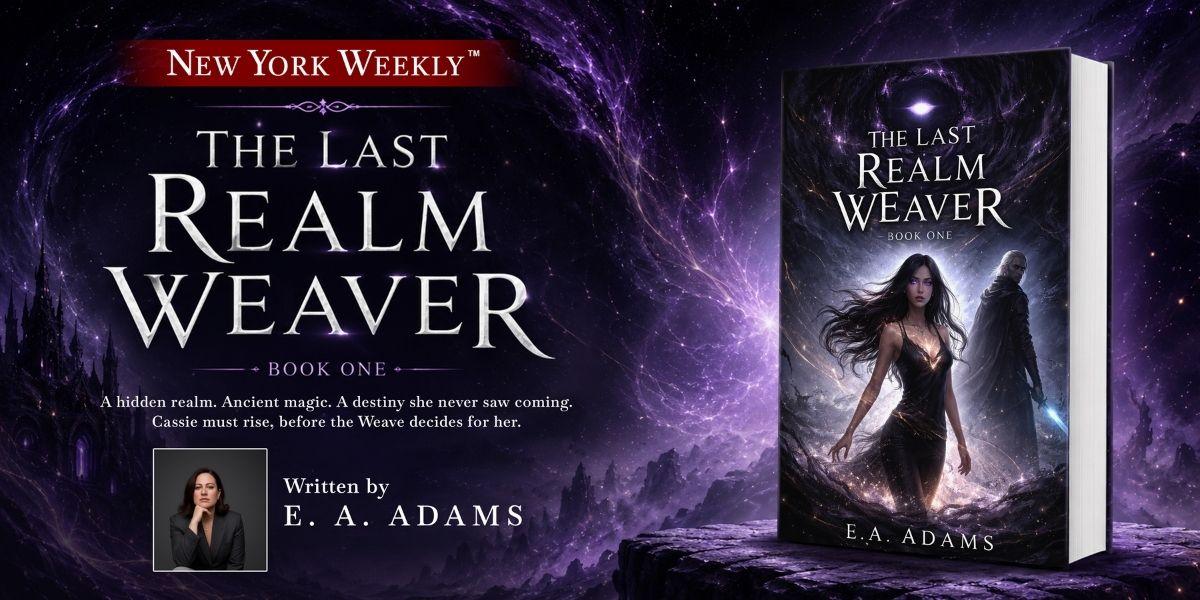
The Last Realm Weaver and E.A. Adams’s Indie Fantasy

There are fantasy novels that build worlds, and then there are fantasy novels that build emotional weather. The Last Realm Weaver: Book One by E.A. Adams belongs decisively to the latter category. It is a sprawling, mythic work less interested in escapist spectacle than in the emotional architecture of destiny itself. Beneath its celestial wars, fractured dimensions, and ancient prophecies lies something surprisingly intimate. A meditation on grief, waiting, loneliness, and the unbearable cost of being chosen.

What distinguishes the author immediately is not simply imagination, though the novel overflows with it. The book’s mythology is dense and operatic, populated by Djinn warriors, corrupted void entities, sentient portals, and cosmic systems governed by the Weave. A metaphysical lattice binding all realities together. E.A. Adams approaches fantasy not as puzzle-box worldbuilding, but as emotional excavation. Every magical structure in the novel mirrors a psychological one. The Veil separating worlds becomes a metaphor for emotional isolation; the Maelstrom, a wound in reality itself, echoes the unresolved trauma carried by its characters.

At the center of the narrative is Cassandra, Cassie, a scarred eighteen-year-old girl whose existence threatens the balance of creation. In lesser hands, such a protagonist might feel archetypal. E.A. Adams instead renders her with aching humanity. Cassie is not introduced as a triumphant heroine, but as a grieving teenager displaced from Louisiana after the death of her stepmother, struggling beneath emotional exhaustion and physical pain she cannot explain. Her awakening into cosmic significance does not empower her immediately. It destabilizes her. The author understands that change is terrifying before it is liberating.

Equally compelling is Jared, the Djinn Gatekeeper who has spent a century waiting in the Tennessee mountains for a prophecy he fears may never arrive. His sections possess the melancholy grandeur of Gothic literature. The author writes solitude exceptionally well. The creaking Watcher’s Nest, the breathing forests, the silence of ancient mountains. Jared’s long vigil becomes one of the novel’s emotional anchors, transforming him from fantasy guardian into something far more tragic. A man suspended between duty and despair, terrified that meaning itself may abandon him.

Perhaps the novel’s greatest achievement is tonal. The author writes with the cinematic momentum of epic fantasy while maintaining the lyrical introspection of literary fiction. The prose often moves like incantation: storms breathe, houses remember, silence acquires physical weight. Even action sequences carry emotional residue. Violence here is never merely spectacle; it is consequence, memory, inheritance.

There are traces of numerous literary traditions woven throughout the work. One can feel the gothic romanticism of Southern storytelling, the mythic fatalism of high fantasy, and even the emotional intensity of contemporary trauma fiction. E.A. Adams synthesizes these influences into something distinctively personal. The novel is unafraid of sincerity. It leans fully into longing, devotion, fear, and cosmic terror without retreating behind irony.

What ultimately lingers after reading The Last Realm Weaver is not merely its mythology but its emotional gravity. The author seems deeply interested in the idea that the people capable of altering worlds are often those barely surviving their own pain. The result is a fantasy novel that feels startlingly human beneath its celestial scale.

In an era where much fantasy races toward spectacle, E.A. Adams slows down long enough to ask more haunting questions: What does destiny cost? What happens when the universe chooses someone already broken? And how long can a person endure waiting for hope before hope itself becomes another form of grief?

The Last Realm Weaver does not merely introduce a fantasy saga. It announces the arrival of a writer deeply attentive to the emotional lives hidden inside myth. Order your copy today!

AI May Be Eliminating the Next Generation of Experts

By: Jay Kt

Much of the conversation around artificial intelligence focuses on jobs. Which roles will be automated? Which industries will be disrupted?

For strategist and consultant Georg Meyer, a more important question is emerging: if AI handles more of the work that traditionally helped people gain experience, how will businesses develop future experts, leaders, and innovators?

According to Meyer, expertise has always been built through effort, curiosity, and hands-on problem-solving. While AI can provide answers instantly, it cannot replace the learning that comes from working through challenges yourself.

“People have to want to solve problems beyond prompting AI,” Meyer says. “Expertise is hard-earned through repeated effort and deliberate practice.”

Meyer believes this process begins long before someone enters the workforce. Whether it is learning practical skills, solving difficult problems, building technology, or exploring ideas independently, people need opportunities to struggle, experiment, and discover solutions on their own.

Businesses can help cultivate these skills by ensuring employees gain firsthand experience with the work they support. Meyer recalls that when he worked at Caribou Coffee, every employee spent time working as a barista regardless of their position. That experience helped employees better understand customers and the business itself. As a software developer, it allowed him to build better solutions because he understood the people using them.

AI is making tremendous strides daily with its capabilities and accessibility. Meyer believes competitive advantage will increasingly come from qualities technology cannot easily replicate.

“If all our competitors have access to the same AI and can get the same answers, businesses need to ask what their people can do that cannot be done elsewhere,” he says.

With AI being so common in today’s workforce, employers are changing the skills they value. Meyer expects critical thinking, independent judgment, creativity, and first-principles reasoning to become key attributes in employees as AI handles the more mundane tasks.

Meyer also believes that timeless human skills will become even more valuable. AI cannot build trust, develop relationships, mentor others, or acquire the skills needed to close a deal, all of which remain critical to business success.

Looking further ahead, Meyer worries less about AI becoming smarter than humans and more about humans becoming overly dependent on AI. As technology makes answers easier to obtain, people may lose some of their motivation to think independently, losing the joy of finding answers for themselves.

“What concerns me is that AI makes it too easy to get answers,” Meyer says.

AI will continue to advance and become more ingrained in our lives. The bigger question is whether people will continue to develop the curiosity, expertise, and problem-solving abilities that drive innovation in the first place.

Sanctions Review Mechanisms in the EU

Under European Union law, EU companies are required to conduct due diligence when trading with third countries to ensure that their business partners are not circumventing EU sanctions.

For European businesses most exposed to sanctions risk, guidelines are set for implementing enhanced compliance checks, assessing business partners, transactions and goods. There are red flag indicators of sanctions circumvention by business partners and customers and they are indicators designed to warn EU businesses of possible risks when establishing new commercial relationships.

Assessing and Managing Sanctions Risk

EU legal entities should identify, assess and understand the sanctions risks that are most relevant to their business activities and operating model, and then take measures to mitigate such risks. This is done on an ongoing basis, including based on open source information. Depending on the nature of the business activities, sanctions evasion may vary.

Companies should conduct appropriate compliance due diligence, calibrated to the specifics of their business and the risk exposures inherent to that business. Each entity should develop, implement and regularly update an EU sanctions compliance program that reflects its individual business model, geographic region of commercial activity, and the associated risk assessment of customers, business partners and personnel.

How Sanctions Screening Works

Sanctions screening is a control used primarily to automatically monitor individuals on sanctions lists to prevent transactions with prohibited individuals or countries. It is essentially comparing one line of text to another to identify similarities that suggest a possible match between the person transacting and an individual on a sanctions list. The process compares data, customer and transaction records, against lists of names and other sanctions indicators, personal data, or locations.

Although there is no single compliance model, EU firms should adhere to the assessment of sanctions evasion risks and typologies set out in the European Union guidelines. This approach to risks and their management should form the basis for applying proportionate work, focusing on those sectors considered most vulnerable to sanctions, and, accordingly, for implementing adequate compliance controls.

Checking Counterparties and Export Controls

The next aspect should be proper compliance procedures for checking counterparties to ensure that these individuals do not trade in sanctioned goods, do not work with sanctioned states, and if necessary have a sanctions program and compliance staff. When exporting restricted goods, companies in the EU should be aware of these restrictions. It is also possible to add contractual clauses on compliance with sanctions between business partners to legally prohibit further re-export of goods to EU sanctioned states.

EU Member States implement and enforce sanctions. The European Commission plays a role in ensuring uniform implementation across the Union and monitoring compliance by Member States. If a product subject to sanctions and prohibited for export is nevertheless exported from the EU to another country outside the EU, the supervisory authorities may consider such actions as a failure by the exporter to carry out proper compliance checks and a breach of sanctions legislation. Any suspicious trade activity should be reported to the relevant national authority, such as financial intelligence units, customs and border authorities or another supervisory authority, if any.

Correspondent Accounts and Reporting Violations

Financial transactions involving correspondent accounts are considered high-risk and may lead to sanctions evasion. Financial institutions that maintain correspondent accounts with foreign financial institutions are required to implement risk-based enhanced due diligence systems, have compliance policies, procedures and processes that are reasonably designed to assess the risks exclusively for correspondent relationships.

In the context of preventing violations of sanctions, financial institutions should monitor transactions related to correspondent accounts.

Sharing information on violations of EU sanctions contributes to the success of investigations. Anyone aware of possible violations of any EU sanctions can report them to the European Commission, completely anonymously. The information reported may relate to the sanctions violations, their circumstances, as well as the individuals, companies and third countries involved. It may also include facts that are not generally known but are known to the individual and may cover past, current or planned violations of sanctions, as well as schemes to circumvent EU sanctions in general.

Sanctions screening mechanisms are therefore a key means of controlling compliance activities and preventing the risk of financial crime to which institutions may otherwise be exposed. It is important that sanctions screening is implemented and maintained as part of a wider set of compliance measures and within the risk profile of the institution itself.

About the Author

Oleksandr Shchybun, CAMS
MLRO at Remittance360 Ltd
United Kingdom, http://linkedin.com/in/oleksandr-shchybun-0b7294a2

Oleksandr Shchybun is a certified AML specialist (CAMS, USA) and a certified financial crime investigator (Utica University, USA). He is specialising in money remittance and card issuing businesses. O. Shchybun has spent more than 15 years working as a compliance officer at a number of financial institutions including conglomerates such as American Express, MoneyGram, and financial startups, e.g. Remittance360 Ltd. He is based in London, United Kingdom.

Broadway Began As a Native American Trade Route, Not a Theater District

The most recognizable street in American entertainment owes its shape to a path that predates the city itself. Before the marquees, the billboards, and the term “Great White Way,” Broadway was the Wickquasgeck Trail, a trade and travel route worn into Manhattan by the Lenape long before any European set foot on the island. The theaters came centuries later. The road came first, and it has barely moved.

A Path Chosen by Geography

The trail took its name from the Wecquaesgeek, a band of the Lenape who lived in the northern reaches of the island and across the waterway that became the Harlem River. Their route ran roughly north to south along a spine of high, well-drained ground, threading past swamp, rock, and open field on the firmest footing the island offered. That choice was practical rather than ceremonial. A ridge stays dry and passable when the lowlands turn to mud, and the people who used the path daily for trade had every reason to follow the terrain rather than fight it.

The Dutch explorer David Pietersz. de Vries left one of the first written references to the route in his journal for 1642, describing a road the Native population traveled regularly. By then the trail was already old. It served as a corridor of exchange between Lenape communities and, once the Dutch arrived, between those communities and the colonists clustered at the island’s southern tip.

From Wickquasgeck to Broadway

Dutch settlement reorganized the southern end of the path without abandoning it. After establishing Fort Amsterdam near present-day Bowling Green, colonists widened the trail into the main road of New Amsterdam, using it as the spine of the young settlement. They attached their own names to it. Some called the lower stretch de Heere Straat, the Gentlemen’s Street, a nod to the prominent residents who built along it. The broader route picked up the Dutch label Brede weg, meaning broad way.

When the British took Manhattan in 1664, they translated that Dutch phrase directly into English, and Broadway entered the record. The name has outlasted the colony, the fort, and the wall the Dutch built across the island to mark their northern boundary, the fortification that gave Wall Street its name. What survived intact was the road’s defining trait: its diagonal, wandering line.

The Trail That Broke the Grid

That diagonal is the clearest evidence of Broadway’s origin still visible on any map. When the Commissioners’ Plan of 1811 imposed the rectangular street grid that organizes most of Manhattan, Broadway refused to conform. It cuts across the numbered avenues and streets at an angle, slicing through the orderly blocks the planners laid down and creating the irregular open spaces the city later turned into public squares. Times Square, Herald Square, Union Square, and Madison Square all exist because Broadway crossed the grid where the grid did not expect it.

In that sense, the most commercially valuable real estate in New York traces its geometry to a footpath that followed the contours of pre-colonial Manhattan. The Lenape chose the line for the dry ground. The Dutch widened it for trade. The grid tried to overrule it and could not. The street’s awkward, profitable angles are an inheritance, not a design.

A Marker at the Southern End

The trail’s old southern terminus remains marked, though few visitors register the connection. At Broadway and Bowling Green stands the Alexander Hamilton U.S. Custom House, the 1907 Cass Gilbert building that now houses the National Museum of the American Indian. The spot where Lenape traders once reached the Dutch settlement is occupied today by an institution devoted to Native history, a coincidence of geography that closes a long loop.

The street’s later identity as a theater corridor developed gradually. Entertainment venues began clustering along Broadway in the 18th century, and the strip’s reputation as a stage district hardened in the 19th and early 20th centuries as electric light turned its nighttime blocks into a spectacle. That chapter is the one most people know. It sits on top of a far older one.

Broadway is often described as New York’s oldest thoroughfare, and the description fits because the road is older than New York. It was a working route before there was a city to route through, and it has carried traders, soldiers, residents, and audiences along essentially the same line for four centuries. The lights are recent. The path is not.