
Introduction
Every family carries a few secrets, the kind that sit quietly in the background until they suddenly surface and demand attention. For Jack Pearce Daniels, that moment came late in life, when a single conversation with his mother reshaped everything he thought he knew about himself.
At forty, on the eve of a trip to America, Jack’s mother revealed that the man he had grown up calling Dad wasn’t his biological father. His real father, she said, was Billy Daniels, the American nightclub star whose smooth voice and charismatic stage presence once filled theatres from Harlem to Las Vegas.
That revelation sent Jack searching, not only for a man he had never met, but also for his own place in a story that stretched across continents, cultures, and generations.
A Childhood with Questions Unanswered
Jack’s childhood was ordinary on the surface. He grew up in Barnoldswick, a working-class town in northern England, where the Rolls-Royce factory dominated life. His stepfather, Freddie, a high-diver turned factory foreman, gave him stability. But buried in Jack’s memory was a single image: a photograph of a man in a spotlight, discovered in a drawer when he was small.
“Is that my dad?” he had asked his mother, who burst into tears instead of answering. The photograph vanished soon after. Jack grew up knowing not to ask again.
It wasn’t until decades later, when his mother finally admitted the truth, that the mystery of that photograph clicked into place. The man was Billy Daniels, one of the most famous Black entertainers of his day.
Who is Billy Daniels?
For those who don’t know the name, Billy Daniels was once a giant in show business. Born in Jacksonville, Florida, in 1915, he began singing in church before moving to New York in the 1930s. His career took off with ‘That Old Black Magic’, a song that sold millions and became his signature number.
Daniels was everywhere: starring in films, hosting one of the first network television shows by a Black performer, playing the Palladium in London, and headlining Las Vegas through its golden years. He had the kind of charisma that made audiences feel like he was singing just to them.
But his personal life was messy, with marriages that ended badly, children spread across different countries, and a relentless devotion to work that often left little space for family.
The Moment of Truth
Jack’s mother, who had performed under the stage name Rae Croft, met Billy in the early 1950s while touring Britain’s variety theatres. She described their first meeting in Manchester simply: “Our eyes met across the room, and that was it.”
Their relationship lasted several years, full of train rides between cities, late-night rehearsals, and the thrill of being close to a man whose career was on fire. But when Jack was born in 1954, Daniels’ life was already tugging him elsewhere, back to America, to more shows, more tours, and eventually, another marriage.
Jack’s mother chose stability. She married Freddie, who raised Jack as his own son. The name “Billy Daniels” was never spoken in their home again.
Growing Up in England with America in the Background
Ironically, Jack’s life was already steeped in American culture without him realizing his personal tie to it. He devoured TV shows like 77 Sunset Strip and The Outer Limits, collected Beatles records, and watched in shock as civil rights marches and President Kennedy’s assassination played across the evening news.
To a boy in Barnoldswick, America seemed like another planet, violent, glamorous, impossibly far away. What he didn’t know was that his own father was part of that world, moving in circles that included Sammy Davis Jr., Nat King Cole, and Lena Horne.
Family Testimonies
After his mother’s revelation, Jack went looking for answers. His grandmother confirmed she had met Daniels, remembering him sitting at their piano and filling the room with stories. His uncle Alan recalled driving to Brighton after Jack’s birth, where he met Daniels in person, surrounded by sharp-suited men, some of them London gangsters who liked to orbit celebrities.
To them, Daniels wasn’t just a name in the papers. He was real, present, and even likable. “He was a nice feller, Jack, believe me,” his grandmother said. “Very famous, but nice.”
The Complicated Story of Race
One of the threads running through Billy’s life was the issue of race. In America, even at the height of his fame, he couldn’t always stay at the hotels where he performed. His lighter complexion meant he could sometimes “pass,” but it also left him open to criticism from both Black and white communities.
In England, he found more freedom. He could stay at the Savoy, headline the Palladium, and walk down the street without as much scrutiny. He often told stories about how absurd the racial rules were back home. “One drop of Black blood,” he explained, “and you were considered colored, no matter what you looked like.”
For Jack, hearing these stories years later added another layer to his own identity. He wasn’t just the son of a famous entertainer; he was connected to a much larger, complicated history.
A Legacy of Absence
The deeper Jack dug, the more he felt the weight of what he had missed. His father had performed in London well into the 1970s, and yet his mother had never taken him to see a show. That chance for connection slipped by, replaced by silence.
Billy had sent money for the first few years after Jack’s birth, but eventually, the letters and checks stopped. His career demanded everything. His children in America, too, often grew up at a distance, raised by boarding schools and governesses while he toured the world.
When Daniels died in 1988, it closed the door on any possibility of meeting in person.
Finding the Brothers
The manuscript also captures the moment Jack finally connected with his half-brothers, Billy Jr and Bruce. They had grown up worlds apart, Jack in an English factory town, his brothers in American privilege, but they shared the same father, and with that came a strange bond.
Billy Jr. admits in the book’s prologue that it wasn’t until their father’s death that he felt compelled to reflect. “It was an oblique look at my life that awoke me from an emotional slumber,” he writes. The Daniels brothers’ connection was never simple, but it was real.
More Than Just a Song
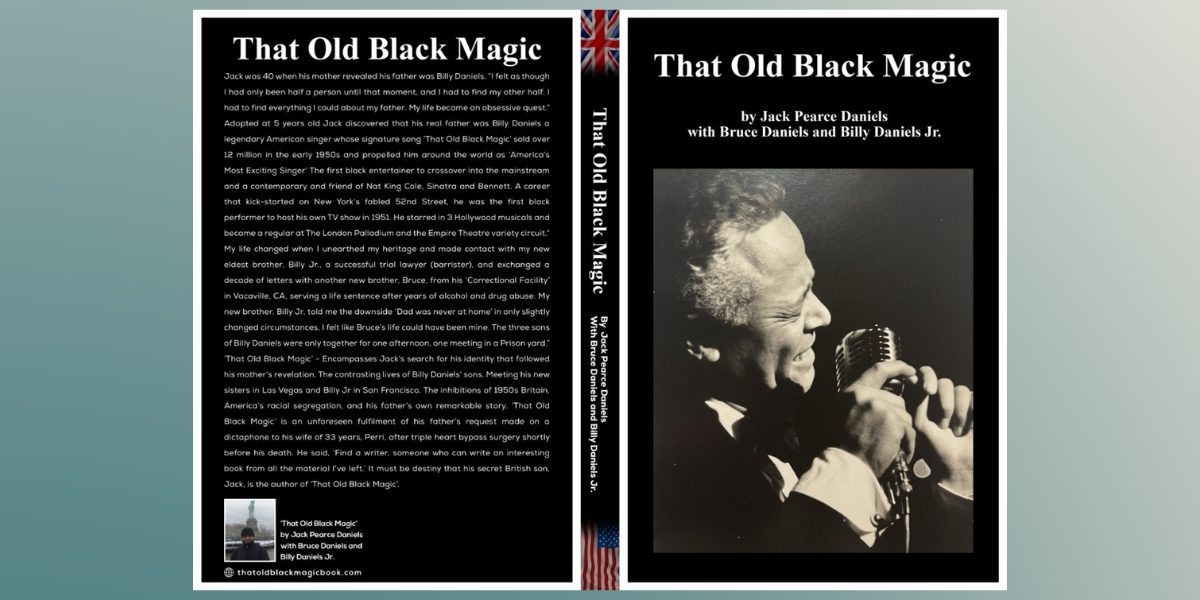
The book’s title, ‘That Old Black Magic’, is more than a nod to the song that made Billy Daniels famous. It symbolizes the spell of legacy, the pull of the past that refuses to let go. For Jack, the song is both a doorway to his father’s world and a reminder of the distance between them.
Daniels couldn’t escape it either. No matter what else he sang, audiences always wanted ‘That Old Black Magic’. It was both his crown and his chain.
Claiming the Story
In the end, Jack’s journey was not about replacing Freddie, the man who had raised him with quiet strength. It was about claiming a missing part of himself, about knowing the truth rather than living with silence.
‘That Old Black Magic’ is his way of piecing together the fragments: the glamorous stages, the love affair between his mother and Billy, the laughter of his grandmother’s kitchen, and the unanswered questions that still linger.
It is a story of identity, music, race, and family, but above all, it is a reminder that our histories, no matter how complicated, are worth uncovering.