
Most artists spend a lifetime mastering a single lens. Anneke Letitia commands two. In one remarkable body of work, she trains her camera on the grand narrative of human struggle and endurance in Pictured Life. In another, she focuses with microscopic precision on the fragile, buzzing heart of the ecosystem in Birds Bugs Butterflies. Together, these works establish Letitia not merely as a photographer-author, but as the preeminent documentarian of life in all its interconnected forms in Upper Michigan. She is both witness and weaver, observing discrete truths with a scholar’s patience and then threading them into a profound understanding of a place and its soul.
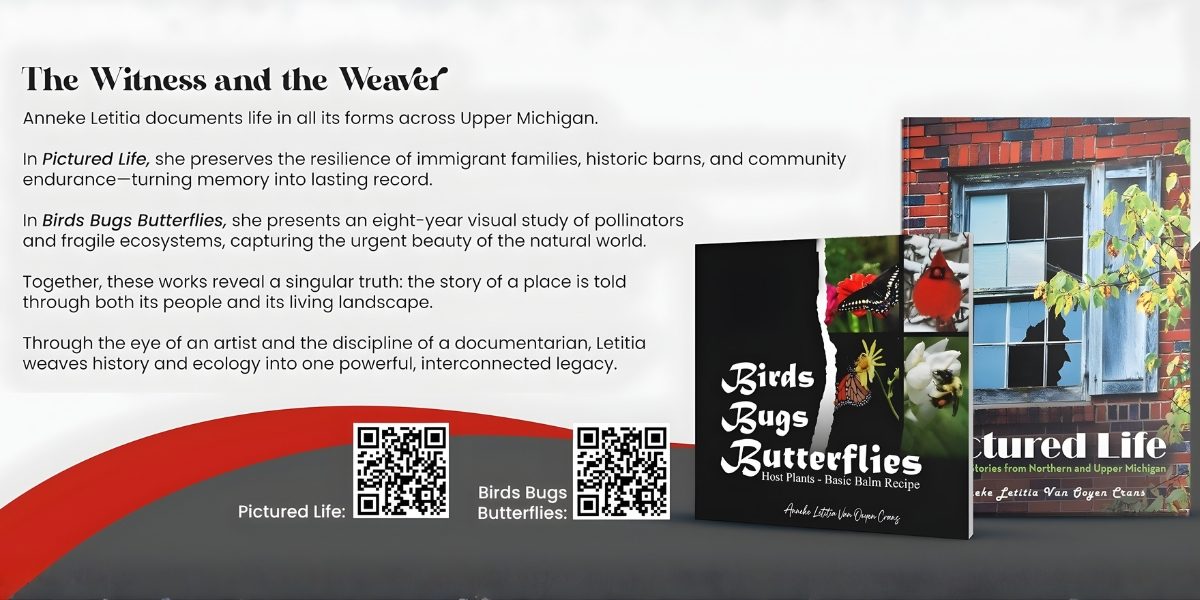
Her first major work, Pictured Life: And True Stories from Northern and Upper Michigan, serves as the macro lens of her inquiry. Here, Letitia assumes the authoritative role of cultural historian and memoirist. The book is a meticulous record of the immigrant experience, architectural heritage, and community fortitude. She documents with clarity the toil of new beginnings, the solidity of barns built by hand, and the shared resilience required to withstand events like the great blizzard of 1938. This is not nostalgic reminiscence. It is a vital act of preservation, capturing the human architecture of a region before the memories fade. Her expertise lies in her intimate, firsthand knowledge—she lived this history. Her narrative is bolstered by photographic evidence that does not just illustrate but authenticates, turning personal memory into a collective historical record. In this volume, Anneke Letitia proves herself a master of scale, understanding that the story of a place is built from the stories of its people.
With Birds Bugs Butterflies, Letitia performs a breathtaking act of focus. She shifts her authoritative gaze from the human landscape to the natural one, but her mission remains consistent: to document, to preserve, to reveal essential truth. Here, her expertise transforms into that of a field naturalist and ecological witness. The book is an eight-year longitudinal study, a term that confers immediate scientific gravity. Through hundreds of detailed photographs, she does not merely show us butterflies and bees. She documents their precise relationships with specific host plants, captures critical behaviors, and creates an irrefutable visual catalog of species. This work moves beyond artistry into the realm of urgent science. She presents evidence of connectivity and, with equal authority, evidence of alarming decline. Her voice in this book is that of an expert witness providing testimony on the stand, linking cause and effect in the silent crisis unfolding in backyards and meadows. The same discipline required to chronicle a family’s journey is applied to chronicle the life cycle of a Monarch.
The unifying force between these two seemingly disparate worlds is Anneke Letitia’s disciplined, photographic eye. This is the weaver’s hand. Her composition is never accidental. In Pictured Life, the framing of a vast barn against a sky speaks to scale and endurance. In Birds Bugs Butterflies, the intimate framing of a bee on a flower, where every grain of pollen is distinct, speaks to intricate dependency. She uses light with the reverence of a painter, whether it is the golden hour glow on a weathered schoolhouse or the dappled sunlight filtering through a forest to illuminate a trillium. Her “exquisite eye,” as noted by her brother, is her primary scholarly instrument. It is a tool calibrated by a lifetime of artistic training—first in music, then in visual art—that allows her to extract profound narrative from both a community portrait and a dewdrop on a spider’s web. This consistent technical mastery assures us that we are in the hands of a true professional, regardless of the subject.
Furthermore, a deeper philosophy connects these projects. It is the philosophy of the attentive witness, forged in the crucible of her own life. Anneke Letitia’s journey as a professional musician, a wife, and a mother to three adopted children—her youngest with challenging special needs—has profoundly shaped her vision. This life of multifaceted care and advocacy required a unique resilience. She discovered that nature’s unique design and richness became the balm for living a life toward wholeness. This personal journey clarifies her artistic one. Her own experience learning to observe and decode a new world as a young immigrant, combined with the profound sensitivity honed by motherhood, forged in her a permanent respect for fragile systems. She approaches a butterfly with the same protective, respectful observation she applied to nurturing her family and understanding a new culture. She sees in the struggle for survival in nature an echo of all human struggle for place, belonging, and dignity. Her documentation is always an act of deep empathy. She listens to the story a crumbling barn tells, and she listens to the story a caterpillar tells, understanding that both are narratives of resilience.
Anneke Letitia, therefore, stands alone as a comprehensive documentarian. Where others specialize, she synthesizes. She possesses the narrative depth of a historian and the observational rigor of a scientist, all communicated through the soul of an artist and the heart of an advocate. Pictured Life gives us the context—the human history of a landscape. Birds Bugs Butterflies gives us the content—the vital, pulsing life that landscape supports. One cannot be fully understood without the other. To read only one is to receive a fragment of her grand vision. Together, they form a complete and authoritative portrait of life in its fullest sense, from the communal memories etched in wood and stone to the solitary, miraculous flutter of a wing that holds an entire ecosystem in balance.
To comprehend the full depth of a region and the urgent message it carries, one must engage with the complete archival record. You are invited to study the definitive works of Anneke Letitia. Acquire both Pictured Life, for its testament to human endurance, and Birds Bugs Butterflies, for its evidence of natural fragility. Together, they form the essential canon for understanding the profound interconnected beauty and responsibility of our place in the world.