North Carolina Real Estate Broker Douglas Sinclair Explains Common Real Estate Math Mistakes

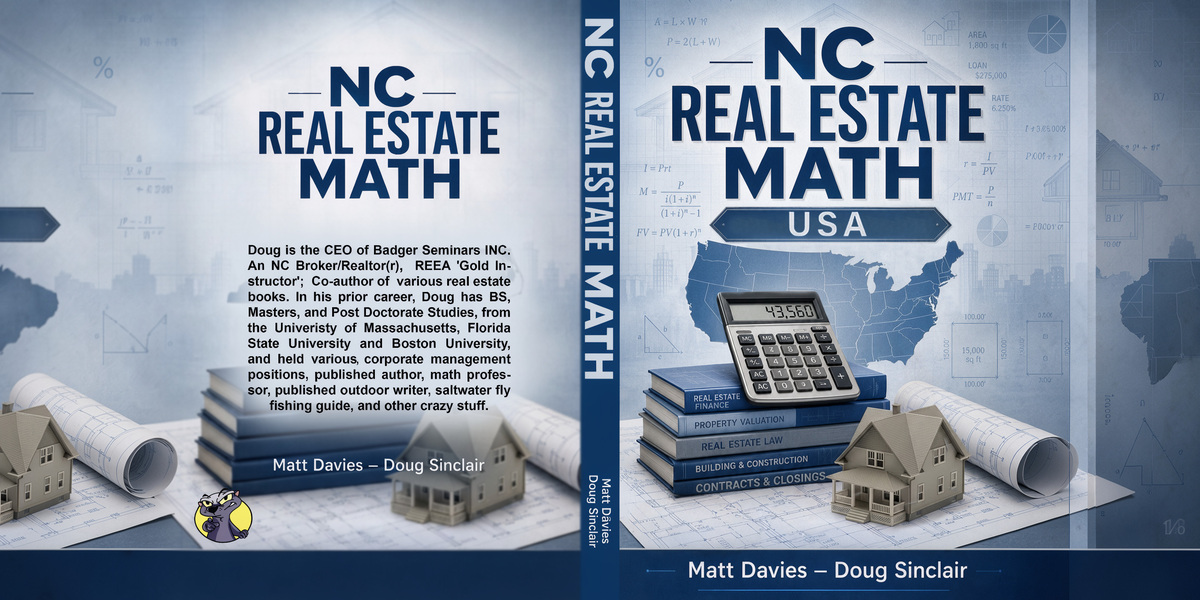
Douglas “Doug” Sinclair, a North Carolina real estate broker, argues in “NC Real Estate Math,” the handbook he co-wrote with fellow instructor Matt Davies, that most of the trouble students have with real estate math begins with how they read a question, not with the arithmetic itself.

For many people preparing for a real estate license, the math section carries an outsized reputation. Sinclair, who taught college mathematics before entering real estate, understands that fear but does not accept it.

“After many years teaching college mathematics, I know how daunting math can be for some people,” Sinclair writes. “It doesn’t need to be.”

The handbook works through 15 sections of examples and practice problems, from lot sizes and excise tax to loan costs, amortization and closing prorations, with step-by-step solutions in the back of the book.

Reading Comes Before Arithmetic

The book’s central lesson is that real estate math has more in common with the word problems students remember from school than with advanced mathematics.

“The key to any mathematics problem is understanding what is being asked,” Sinclair writes. “Real Estate math is not difficult, but it does require following step-by-step what is being asked.”

He advises readers to read each question slowly once, then read it again looking for clues. Does the problem want an answer rounded to the nearest $100? A monthly figure instead of an annual one? A tax rate stated in dollars or in mills? Several examples in the book carry bracketed notes reminding students that the trap was in the wording, not the numbers.

His other recurring advice concerns the calculator. Students are taught to follow the order of operations and enter the whole problem as a single string. “I have found that the biggest error made by students is that they will enter the first part of the problem into the calculator and hit Equals,” he writes.

A Basic Calculator and a 360-Day Year

The handbook is direct about the tools students will have on exam day. Mobile phones and programmable calculators are not allowed, so Sinclair encourages students to practice on a simple calculator that adds, subtracts, multiplies and divides, ideally with a percent key. Badger’s pre-license students receive a calculator with their tuition for that reason.

“Get used to a basic calculator,” he writes.

The book also explains the convention used for pre-license calculations: a “statutory banking calendar” of 30-day months and a 360-day year. That single rule shapes nearly every interest and proration problem that follows.

Numbers Worth Memorizing

Some figures simply have to be known. The most important is the number of square feet in an acre: 43,560.

To make it stick, the book offers two memory aids: four blue-haired ladies driving 35 mph in a 60 mph zone, or Richard Petty’s No. 43 race car tuned to 560 country radio in Daytona Beach. “Find ways to remember this. You must know the number of square feet in an acre,” the authors write.

The Math Behind a Closing

Much of the handbook focuses on calculations brokers see in real transactions. In North Carolina, excise tax, also called revenue stamps, is charged at $1 per $500 of the sales price and rounded up to the next whole dollar. On a $103,250 sale, that comes to $207, and the book reminds students that the seller, not the buyer, normally pays it.

Property tax follows similar logic. North Carolina applies its rate per $100 of assessed value, while many other states use a mill rate per $1,000. A home assessed at $185,500 with a $1.50 rate carries an annual tax of $2,782.50, the same result as a 15-mill rate elsewhere.

The seller net calculation, which brokers use to estimate the minimum price a home must bring, receives careful treatment. A seller who wants to net $25,000, pay off a $121,900 loan and cover $3,500 in costs with a 6% commission must sell for $160,000. The method adds every known expense and divides the total by the percentage left after commission, 94% in that example.

Commission splits are handled the same way, often in a single calculator entry. In one example, a $495,000 sale at a 5% commission, split evenly between two firms and then 80/20 between the broker and her firm, leaves the broker $9,900.

Loans, Points and Prorations

Later sections take on mortgage math. The book explains the 28/36 qualifying ratios used for conventional loans, the rule that one discount point, equal to 1% of the loan amount, lowers the interest rate by one-eighth of a percent, and how to calculate the interim interest a buyer pays at closing.

Prorations come with rules short enough to memorize. For property taxes and HOA dues: “Whoever pays taxes or HOA gets a credit.” For rental property: “Whoever receives rent gets a debit.”

From 200 Copies to a Classroom Staple

The handbook grew out of the classroom. Sinclair and Davies wrote the original workbook together, and many of its examples were later incorporated into the “NC Real Estate Today” textbook. After receiving the NCREEA Program of the Year Award, the two printed 200 copies at Staples and took them to a 2017 conference of real estate educators in Wilmington.

“We didn’t think anyone would buy it, and then they all disappeared,” Sinclair writes. The authors had to buy a copy back because they had not kept one for themselves.

Students kept asking for a separate math publication, which led to the current edition. It was reformatted to be easier to carry, and Badger students worked through it to make sure the explanations made sense and every problem could actually be solved.

The book also puts the exam in perspective. According to Sinclair, the national portion of the license exam includes only seven math questions, and the state portion includes none. The handbook, however, is built around “realistic examples of actual real estate math problems that you will likely encounter as a real estate broker.”

A Teacher’s Path to Real Estate

Sinclair came to real estate after careers in landscape architecture, technology marketing, executive recruiting, and college teaching, including roles as director of marketing for Andersen Consulting and with Prime Computer/Computervision. He began teaching real estate in 2015, launched Badger Real Estate Seminars in 2018, and is a Real Estate Educators Association (REEA) Gold Standard Instructor.

Co-author Matt Davies, who has taught real estate in North Carolina since 2008 and is an active broker, is also a recipient of the Larry Outlaw Award in Real Estate in North Carolina and an author of “NC Real Estate Today.”

“NC Real Estate Math” is available in paperback, hardcover, and e-book editions.

About the author:

Douglas “Doug” Sinclair is a North Carolina real estate broker with Keller Williams and the founder and CEO of Badger Real Estate Seminars in New Bern, North Carolina. A Vietnam veteran and former college mathematics instructor, he teaches all levels of real estate education and has co-authored several real estate books.

Author Name: Douglas Sinclair, Book Title: NC Real Estate Math, Published By: Blue Crown Books

New York’s Side Hustle Economy Faces Rising Living Costs

New York has always had a complicated relationship with the word “hustle.” For generations, grinding in this city has been a badge of honor, a rite of passage, and an economic necessity all at once. The latest data on America’s side-hustle economy confirms that New York’s solo businesses are among the most valuable in the country, and also that the city’s notorious cost of living is quietly eroding much of that advantage.

Giggster’s new report analyzed 30 major U.S. metros on solo-business density, average gross receipts per nonemployer business, local side-hustle pay benchmarks, and purchasing-power-adjusted value. New York City ranks first in the country for average annual gross receipts per nonemployer business at $70,700. That means the average solo business in New York generates significantly more revenue than its counterparts in most of the country, more than in Los Angeles ($69,300), San Francisco ($70,000), or any of the Southern metros that dominate the density rankings.

The Receipts Story

New York’s number one position for gross receipts reflects something real about the market here: clients pay more, contracts run larger, and the premium associated with being New York-based inflates the ticket price across a range of services.

A freelance graphic designer, a private tutor, a personal chef, a legal consultant operating independently in New York City is working in a market where rates are structurally higher than in most of the country. That advantage shows up in the Census nonemployer business data and it is meaningful.

For context, the lowest-ranking metros for average gross receipts, Orlando at $48,500 and Atlanta at $50,200, both rank far higher for solo-business density. They have more side hustlers, but those businesses generate substantially less revenue per business. New York’s ratio, high revenue per business, and lower density relative to Sun Belt cities place it in what the Giggster report classifies as a “Premium solo economy”: below-median density but above-median receipts. Quality over quantity.

The Cost Of Living Correction

Here is where New York’s side-hustle story gets complicated. When the report adjusts nominal pay for local prices using Bureau of Economic Analysis Regional Price Parities, New York falls from fourth place for estimated annual pay to tenth place for purchasing-power-adjusted value. The city’s $13,600 annual pay benchmark, based on 10 hours per week of side work across eight occupation categories, adjusts down to $12,100 when the city’s above-average price level is accounted for.

That drop from fourth to tenth is one of the sharpest downward adjustments in the entire study. New York earns a lot, and it also costs a lot, and the second fact substantially offsets the first. A side hustler in Seattle doing the same 10 hours per week ends up with $13,200 in purchasing-power terms, more than the dollar-for-dollar New York equivalent, despite lower nominal pay, because Seattle’s cost of living is comparatively more manageable.

What New York Side Hustlers Should Take From This

The data argues for two things that experienced New York freelancers already know intuitively. First, rate discipline is everything.

The premium market here supports higher pricing, and side hustlers who undercharge relative to local market rates are leaving real money on the table. The Midtown consultant who charges $75 an hour when the market supports $125 is not being modest. She is subsidizing her clients with purchasing power she cannot afford to give away.

Second, the most valuable side hustles in New York are the ones that can export their output. Writing, coding, consulting, design, and other knowledge-work side hustles that can be delivered to clients outside the New York market allow hustlers to earn at New York productivity levels while capturing pricing from national or global demand pools. That is where the real leverage sits. New York’s side-hustle economy is strong. Understanding its limits is what makes it work.

Disclaimer: This article is for informational purposes only and does not constitute financial or business advice. The figures and findings presented are based on third-party research and may vary depending on individual circumstances, market conditions, and other factors. Readers should conduct their own research before making financial or business decisions.

At Jacob’s Well, a Woman Who Had Known Rejection Finds a Different Kind of Love

In William M. Elrod’s forthcoming book, “The Encounter: The Woman, The Well, The Man,” a familiar biblical story becomes a reflection on loneliness, faith, and the possibility of beginning again.

Some wounds begin long before a person has the language to describe them. In William M. Elrod’s The Encounter: The Woman, The Well, The Man, the search for love begins in childhood, where affection is inconsistent, home offers little security, and the longing to be chosen becomes a force shaping an entire life.

The book follows a woman whose experiences of rejection influence her relationships and sense of worth. Growing up amid abuse and emotional uncertainty, she learns to seek affirmation wherever it appears. Her successive marriages bring periods of hope, commitment, and spiritual promise, followed by betrayal, separation, grief, and renewed uncertainty. Each loss leaves her questioning whether lasting love is something she can ever expect.

Williampresents these experiences as more than a sequence of failed relationships. They reveal the emotional cost of measuring personal worth by another person’s willingness to stay. The woman’s desire for companionship is deeply human, but her story also exposes the exhaustion of searching for acceptance while carrying the belief that she is somehow unworthy of it.

Meeting That Changes the Question

The narrative’s central image comes from the Gospel of John: Jesus meeting a Samaritan woman at Jacob’s well. In the biblical account, cultural divisions separate them. She is a Samaritan; he is a Jewish man. Their conversation crosses social and religious boundaries, beginning with an ordinary request for water and moving toward a spiritual promise.

Williamplaces this encounter at the heart of the book, using the woman’s personal history to consider what the biblical meeting might mean to someone familiar with rejection. The manuscript does not claim to establish the Samaritan woman’s actual history. Instead, it imagines a personal journey that illuminates the emotional significance of her encounter with Jesus.

The well becomes a place where the past is known without becoming the final judgment on a person’s life. Jesus acknowledges the woman’s history, including her marriages, but offers her living water rather than condemnation. For William, this distinction matters. Grace begins with being fully known and still being offered love.

What the Well Represents

Water in the book carries both practical and spiritual meaning. A physical well sustains daily life, while the living water Jesus offers represents the enduring presence of the Holy Spirit and the promise of eternal life. The metaphor gives the manuscript its organizing principle: a person can return to the same source repeatedly, rather than treating faith as a single moment of relief.

The woman’s eventual change is not presented as a life without difficulty. Her circumstances remain imperfect, but shame and guilt no longer define her understanding of herself. Her encounter becomes the foundation for a new purpose: sharing her testimony with others who may recognize their own loneliness in her story.

Takeaway

William’s book speaks especially to readers who have confused rejection with identity or believe their past has disqualified them from a hopeful future. Its Christian message is direct. Human relationships may fail, but the love offered by Christ is not dependent on a spotless history. The Encounter invites readers to consider a different question, not whether they have been rejected, but whether rejection must determine what comes next.

William M. Elrod’s The Encounter: The Woman, The Well, The Man is a story of faith, grace, and the living water offered to every searching heart. Available soon!

The Work Behind the Image: Reflections on Fashion’s AI Revolution

As AI reshapes fashion imagery, I believe the conversation needs to start with a clearer understanding of the work behind it.

By David Chen

Before we ask whether artificial intelligence can replace a model, I think we need to ask a simpler question: What does a model actually do?

After more than two decades in fashion and pageantry, and as a global entrepreneur, I am interested in what technology makes possible. But I also want to understand what we might overlook in our rush to adopt it.

A striking image is the result. It is not the whole job.

That distinction comes into focus through my dear friend Mitchelle Daka, the first-ever Miss Universe Uganda. She brings nearly a decade of international modeling experience, with credits including Dior’s Cruise 2020 campaign, Valentino’s 2023 Ramadan campaign, and Roberto Cavalli’s Dubai Fashion Week runway in 2024. Her work also spans adidas x IVY PARK and Huda Beauty.

That is the experience I want represented in conversations about fashion’s future. As AI Week wraps up in New York, I interviewed Mitchelle, highlighting the fittings, feedback, and creative exchanges that shape a collection before an audience ever sees it. She describes a profession that involves responding, interpreting, and helping an idea evolve. A model is more than just part of the picture. She is an essential part of the process.

The Work Before the Picture

“We’re all feeding off of each other,” Mitchelle says of the interaction among people on set and backstage.

She describes a designer arriving with an idea, then models, stylists, and makeup artists contributing their own interpretations. The vision develops as the people asked to bring it to life shape it.

To illustrate, she describes scenarios from past shows where clothes don’t fit as expected. An adjustment changes how it sits on the model and pushes the design in a different direction. She offers this as an example of the unexpected decisions that can emerge through collaboration.

What interests me is that the model is not simply displaying a finished idea. Her presence can help change the idea itself.

Mitchelle’s point becomes even more practical when she discusses fittings. Audiences see the runway appearance, she says, without necessarily knowing about earlier appointments when models tried on the clothes and discussed how they felt.

“This is comfortable. This is not. Let’s change something…” she says, recalling the feedback those sessions make possible.

That is useful information, not just an aesthetic contribution. For me, the business question is straightforward: if a production process changes, where does that information come from next?

Photo Courtesy: Mitchelle Daka

An Image Is Not the Entire Process

There is an important distinction here. Using AI for a campaign does not automatically mean abandoning physical fittings or product testing. Those are different decisions.

But I would want any team adopting the technology to be explicit about which tasks it is changing. Are we automating presentation, supporting exploration, or removing an opportunity for someone to notice a problem?

Those questions matter more to me than a blanket declaration that AI is either good or bad for fashion.

Consumers also distinguish between applications. The 2026 Bentley University–Gallup Business in Society survey found that 75% of U.S. adults considered disclosed AI assistance with brainstorming or early advertising drafts acceptable. Yet 62% considered using AI to create people or voices in advertisements unacceptable, even with disclosure.

Those findings concern advertising broadly, not just fashion sales. Still, I read them as a reason for brands to think beyond whether an image is technically convincing. How it is made may matter to the audience, too.

More Possibility, Not Less Participation

In my conversation with her, it’s clear that Mitchelle isn’t categorically opposed to AI. She acknowledges its potential usefulness, but makes clear she is still considering how it could fit into her own work.

“It’s the tool that enables your creativity,” she says.

That is a direction worth exploring.

In September 2026, photographer Nick Knight told Vogue Business how his H&M collaboration began with photographs and illustrations featuring models. AI then transformed that material into moving imagery that people could interact with. Knight said the project required a larger team than usual.

With that said, one project cannot settle the employment question. However, this case study shows how technology can support collaboration rather than replacing it.

As an entrepreneur, I would rather ask what a team can now attempt than begin and end with how many people a process can do without.

Participation also means having a say in how your likeness is used. New York’s Fashion Workers Act requires clients to obtain a model’s written approval before creating or using that model’s digital replica, specifying the scope, purpose, compensation, and duration.

With that said, I see consent as the starting point. The broader responsibility is to understand what we are asking people to contribute and how we’ll value it.

Photo Courtesy: Mitchelle Daka

What Progress Should Look Like

What stays with me from my conversation with Mitchelle is the attention she gives to the process. A fitting becomes an opportunity to identify a problem. A conversation becomes an adjustment. An unexpected response to a garment becomes a new creative direction. She describes these contributions from inside the work, even when they remain invisible to the audience.

As an entrepreneur, I want to know how technology can make that work more ambitious. Can it give teams more freedom to experiment? Can it help them explore ideas they otherwise could not afford to pursue? Can the people whose experience informs the work also participate in shaping what comes next?

Those are the questions I would put alongside speed, efficiency, and cost. For me, a new tool’s value should include what it makes possible for the people using it.

The opportunity isn’t simply to make fashion faster. It is to give the people shaping it more room to imagine what comes next.

NYC Halloween Parade 2026 Steps Off October 31 on Sixth Avenue With Joey Arias as Grand Marshal

The NYC Halloween Parade, officially New York’s 53rd annual Village Halloween Parade, takes place Saturday, October 31, 2026, at 7 p.m. It runs north on Sixth Avenue from Canal Street to 15th Street until about 11 p.m. This year’s theme is “Body & Soul,” and performance artist Joey Arias is grand marshal.

Key Takeaways

  • The 2026 Village Halloween Parade starts at 7 p.m. on Saturday, October 31, and runs rain or shine.
  • The route goes north on Sixth Avenue from Canal Street to 15th Street.
  • Anyone in costume can march without registering. The lineup at Canal Street and Sixth Avenue is open from 6:30 to 9 p.m.
  • Spectrum News NY1 will broadcast the parade live starting at 8 p.m.
  • The parade opens with “Firehorse!,” a new performance puppet by master puppeteer Basil Twist with choreography by Julie Atlas Muz.
  • The parade typically draws 50,000 to 60,000 costumed marchers, along with hundreds of giant puppets and more than 50 bands.

The 2026 NYC Halloween Parade Lands on a Saturday Night

The parade is always held on October 31, so the day of the week changes each year. In 2026, Halloween falls on a Saturday. That means no work the next morning for most marchers and spectators, and potentially larger crowds along Sixth Avenue than on a weeknight.

Organizers have stressed that the parade goes ahead “RAIN or SHINE! OR WIND!!!!” Anyone planning an elaborate costume should prepare for whatever the weather brings, especially puppet-style or oversized designs.

Body & Soul Theme Asks New Yorkers to Get Off Their Screens

Every year the Village Halloween Parade has a theme that shapes its giant puppets and inspires marchers’ costumes. This year’s theme, “Body & Soul,” is about the connection between the physical body and the spirit, with dance as the link between them.

Artistic and producing director Jeanne Fleming has tied the theme to the skeletons that traditionally lead the parade, saying even wandering souls need bones to dance up Sixth Avenue. The organizers’ statement also addresses how much of daily life now happens through screens and devices, and invites people to spend Halloween night back in their bodies. For marchers, that means costumes centered on skeletons, anatomy, spirits, and movement. Anything goes, though, and costumes don’t have to follow the theme.

Joey Arias Leads as Grand Marshal, and Firehorse! Opens the Parade

Joey Arias, a longtime fixture of downtown Manhattan’s performance scene, is the 2026 grand marshal. He is a cabaret singer, jazz vocalist, songwriter, cult film actor, theater artist, and drag performer, and he has starred in large international productions, including Cirque du Soleil’s “Zumanity.” He is currently appearing in “Arias with a Twist” at HERE in SoHo, a few blocks from the parade route.

This year’s opening act is “Firehorse!,” a performance puppet commissioned from MacArthur fellow Basil Twist, choreographed by Julie Atlas Muz, and produced by Barbara Busackino of Tandem Otter Productions. Organizers tie the dancing Firehorses to the Year of the Horse and describe them as clearing the way for the thousands of costumed marchers behind them.

How to March in the Village Halloween Parade

NYC Halloween Parade 2026 Steps Off October 31 on Sixth Avenue With Joey Arias as Grand Marshal (2)

Photo Credit: Unsplash.com

The parade is open to the public in an unusual way: anyone in costume can march, with no registration or fee. The one firm rule is that marchers must be in costume. Organizers outline the process:

Marchers join the lineup at Sixth Avenue and Canal Street between 6:30 and 9 p.m. The lineup area can only be entered from the east and south, via Sullivan, East Broome, and Canal streets. People coming from the west must enter from Canal Street. Marchers are let onto the route in groups of 1,000 to 2,000 at timed intervals, so expect to wait. Once on the route, everyone moves north, and police stop anyone heading south on Sixth Avenue.

Organizers recommend meeting friends a block or two away from the route, then walking to the lineup together, since it is hard to find people at the start even with phones. The parade has zero tolerance for alcohol. Only a few pre-approved sponsor vehicles are allowed, and vehicles that simply show up are turned away. People without costumes can volunteer to help carry the giant puppets, and bands can apply to perform. Paid VIP and Special Theme Section tickets let marchers skip the general lineup, and the proceeds help fund the nonprofit parade.

Where to Watch the NYC Halloween Parade on Sixth Avenue

Watching is free and requires no ticket. Spectators line the sidewalks along Sixth Avenue between Canal Street and 15th Street, which passes through Hudson Square, the South Village, and Greenwich Village. Organizers say the subway is the recommended way to get there, since parking is always difficult and the parade makes it worse. Anyone getting dropped off by car should arrange a pickup and drop-off point well away from the route and allow extra time to walk in.

For those staying home, Spectrum News NY1 will air the parade live starting at 8 p.m. That option is especially useful for the large share of international viewers who follow the parade from abroad each year.

A Neighborhood Tradition That Began With One Puppeteer

The Village Halloween Parade started in 1974, when Greenwich Village puppeteer and mask maker Ralph Lee organized a walk with puppets for his children and their friends. More than five decades later, it is run by Village Halloween Parade, Inc., a 501(c)(3) nonprofit arts organization supported in part by public funds from the New York City Department of Cultural Affairs in partnership with the City Council.

The parade is now one of New York’s major public celebrations, alongside traditions such as the Puerto Rican Day Parade that fills Fifth Avenue each June. Unlike most of those events, the Halloween parade lets the public take part rather than just watch.


FAQs

When is the Halloween parade in New York City in 2026?

The 53rd annual Village Halloween Parade is on Saturday, October 31, 2026. It starts at 7 p.m. and is expected to run until about 11 p.m.

Where is the Halloween parade in New York City?

The parade starts at Canal Street and Sixth Avenue and goes north on Sixth Avenue to 15th Street, passing through Greenwich Village.

How do you join the NYC Halloween Parade?

Wear a costume and go to the lineup area at Sixth Avenue and Canal Street between 6:30 and 9 p.m. No registration is required, and marchers enter in timed groups.

What is the 2026 Village Halloween Parade theme?

The 2026 theme is “Body & Soul,” which celebrates the connection between the physical body and the spirit through dance, costume, and puppetry.

Can you watch the NYC Halloween Parade on TV?

Yes. Spectrum News NY1 will broadcast the parade live starting at 8 p.m. on October 31.

Inside The Kage’s Plan to Bring Music and MMA Together

The new 21-and-older event will move from sanctioned amateur fights and live entertainment to a late-night DJ set inside the cage at Capitale in New York City.

Early in the evening, the cage belongs to the fighters. The opening hours revolve around sanctioned amateur MMA, with competitors meeting under Capitale’s 65-foot ceilings while music and live acts carry the room from one bout to the next. Around the action, the organizers envision guests talking over drinks, then turning toward the cage as a bout demands their attention, a rhythm with something of an old crime movie’s atmosphere. Later, the same cage takes on an entirely different role. A DJ steps into its center, the venue adopts a nightclub atmosphere, and a fight night becomes a late-night music event.

That progression is the premise behind The Kage Presents, which will introduce its first event on November 28, 2026, at Capitale in New York City. The 21-and-older night brings together real MMA competition, a music program with a strong house influence, and additional entertainment designed to make the spaces between fights part of the experience. Organizers say the event will also be streamed on Amazon Prime and DAZN.

Rather than treating the bouts and nightlife as separate attractions, The Kage is building one continuous evening around both. The fights lead the early hours, while music and performances maintain the pace between them. After the competitive portion concludes, the center of attention stays in the cage even as the nature of the night changes.

From Fight Card to Dance Floor

Doors are planned for 8 p.m., with the opening portion of the event expected to run until roughly midnight. Organizers are planning about five sanctioned amateur MMA fights, along with influencer and novelty bouts. The precise public card still awaits confirmation, but genuine competition sits at the center of the format.

The structure grew from a familiar problem at live fight events. A fast finish can deliver an exciting few minutes, then leave a long pause while the next bout gets ready. For an audience, that interruption can drain the energy from the room. The Kage’s answer is to program the full night, weaving music and live acts between contests so guests have something to watch even when no one is trading strikes.

The additional performances remain deliberately broad for now. The team does not intend to reveal every act or unexpected moment in advance. Knowing the next bout is coming will not necessarily mean knowing what comes next. Each element should complement the fights, keep the room engaged, and avoid turning the card into a sideshow.

That balance matters because the early hours still need to feel like an MMA event. The Kage plans to give each bout its moment, then use the intervals to carry the audience toward the next one.

When the Cage Becomes the Booth

Around midnight, the emphasis moves from competition to nightlife. Instead of dismantling or hiding the cage, The Kage makes it the focus of the second half. A DJ will perform from the center while the surrounding room takes on the feel of a nightclub. The tension of watching two competitors gives way to the release of a late-night set, with the crowd now moving to the music.

The music will draw from a mix of styles with a strong house influence. Organizers are planning for two international DJs, although those appearances remain unconfirmed. No names have been announced, and the team is not presenting either artist as booked until arrangements are final.

Capitale gives the format a distinctive setting. Its 65-foot ceilings create the vertical scale for a show built around one central structure, whether guests are watching a bout or a DJ. The venue advertises room for up to 1,500 standing guests, but that figure is not the approved attendance or available ticket inventory for The Kage. Those event-specific details still need to be confirmed.

The setting also helps connect the night’s two identities. Guests do not have to leave one space and enter another to move from fights to music. The room changes around the cage, allowing the transition itself to become part of the show.

The Experience Behind the Concept

The Kage came together because its team saw how their experience could serve the same idea. Founder Kazi Sorrentino has spent years producing concerts and nightlife events in New York City and working with touring artists. He also owns Eden New York, giving him direct experience with the demands of a New York nightlife venue.

Founding partner Gabriel Blinder brings the combat sports side. An attorney and the founder of Critical Sports and Entertainment, Blinder develops combat sports properties through Critical Combat and Unity Combat Series. He and Sorrentino had known each other for a decade before deciding to pair Blinder’s background with Sorrentino’s work in concerts and clubs.

Sam Kiki joined The Kage project as an advisory partner after learning about the concept through a mutual friend. With experience in gaming and entertainment, Kiki brings a background in business development and industry partnerships. He provides strategic guidance to the event team, contributing insights into event planning, audience engagement, and entertainment collaborations. Kiki also provides value from his experience in the gaming industry as well as his plethora of connections from being a professional poker player.

Their individual histories explain why the components belong in the same room, but they are supporting evidence, not the attraction. Making each part of the evening strengthen the next requires more than placing a DJ beside a fight card. It means considering timing, transitions, and atmosphere with the same care as the bouts themselves.

Building a Night People Cannot Predict

For its inaugural event, The Kage is keeping enough details private to make curiosity part of the invitation. The broad shape is clear: an early program centered on MMA, music and live entertainment between fights, and a late-night club with the DJ inside the cage. The specific performances, final fight card, and confirmed music lineup will determine the finer details closer to the event.

That measured approach gives the team room to protect its surprises while avoiding promises it cannot yet support. It also keeps the focus where it belongs: on the guest’s experience across several hours, not on a single bout, artist, or sponsor.

The November 28 event will serve as the first full expression of what a Kage night can be. If the format later travels to other cities, as the founders hope, New York will establish its essential rhythm: competition first, nightlife later, and a cage that never stops being the center of the room.

For adults looking for an unusual Thanksgiving weekend event, The Kage offers two distinct phases with no hard boundary between them. The opening bell will begin the story, but it will not define the ending.

Updates are available through The Kage Presents website and Instagram.

From Criminal Justice to the Stage, Constance E. Wills Brought ‘The Right Fit’ to Michigan Audiences

How three decades in criminal justice shaped a mindset framework that captivated a Troy, Michigan audience this August

TUCSON, Ariz. For nearly 35 years, Constance E. Wills built a career inside the criminal justice system, watching up close how a single thought, repeated often enough, could quietly steer the course of someone’s life. That vantage point never left her. It became the foundation of the work she does now, and the message she brought to the stage in Troy, Michigan, this August.

On August 8, Wills presented “The Right Fit: Purpose, Vision, and the Power of Mindset” as part of the 2026 Leadership Experience Tour, and the audience was with her from the opening minutes. The talk dug into a question she’s spent a career studying from the inside out: how much of what people call a “decision” is actually just an old, unexamined pattern running on autopilot.

“Change starts with recognition” was the idea anchoring Wills’ approach on stage. Before anyone can choose a different response, she told the room, they first have to notice the thought quietly driving the situation in front of them. Most people talk themselves past that moment without ever slowing down to see it. It’s the kind of line that tends to land differently in person than on paper, and by the reaction in the room, this one landed.

Two Tools, One Framework

To make that idea usable rather than just aspirational, Wills walked the audience through two signature tools built to work together.

The first, her Mindset Reset™ Framework, is a structured process for tracing a decision back to the belief that actually produced it, separating what she calls “automatic, inherited thinking” from the choices that genuinely reflect who someone is and where they’re trying to go.

The second, Thought Break™, puts that framework into motion in real time. It’s a deliberate pause built into the moment of decision, a chance to name the thought behind a behavior or reaction before acting on it, instead of only recognizing it in hindsight, once the moment has already passed. Attendees described the shift in the room as Wills walked through this section, a noticeably quieter, more attentive kind of quiet, the sort that tends to mean people are turning the idea over on themselves.

Both tools trace back to the same place: years spent watching how repeated behavior and a person’s openness (or resistance) to change shaped outcomes, for better and worse, in criminal justice settings. Wills has carried that lens into an entirely different arena, now applying it to the women she works with today.

A Platform Built Around Reinvention

After retiring from criminal justice, Wills founded Beauty Beyond The Wall, LLC, a Tucson-based company offering motivational speaking, mentoring, coaching, and mindset education. Her focus is deliberate: women in midlife and beyond going through transition, reinvention, identity, leadership, and renewed purpose. These are the years when many women are quietly rebuilding who they are, often without a roadmap.

Through speaking engagements, mentoring, coaching, and mindset education, Wills works to help clients spot the thought patterns holding them back and build the self-awareness to move forward, whether that means stepping into a new career, reclaiming an identity set aside for years, or simply redefining what purpose looks like in a new chapter. The Troy audience got a live look at that approach in action, and by the sustained applause that closed the session, it clearly resonated.

That work now extends beyond the stage. Wills hosts A Moment With Constance and co-hosts Choose to Challenge: Mindset Alchemy on e360tv, bringing the same mindset-focused lens to conversation, storytelling, and interviews built around resilience, reinvention, and reclaiming purpose, reaching audiences well beyond the rooms she speaks in.

What’s Next

The Troy presentation centered on the relationship between purpose, personal vision, and decision-making, and Wills closed by asking attendees to sit with a specific question: does what I’m choosing right now actually line up with the direction I say I want to go? Judging by the number of attendees who lingered afterward to talk with her, it was a question that stuck.

It’s a theme she’s building on. Beauty Beyond The Wall is currently developing The Master Thinker Reset: Change Your Mind, Change Your Life, a new educational program rooted in the same approach to mindset awareness and personal reflection. Further details are expected to be announced by the company later this year.

EVENT DETAILS

Presentation: “The Right Fit: Purpose, Vision, and the Power of Mindset”

Speaker: Constance E. Wills

Date: August 8, 2026

Event: Leadership Experience Tour

Location: Troy, Michigan

About Beauty Beyond The Wall, LLC

Beauty Beyond The Wall, LLC is a Tucson, Arizona-based company founded by Constance E. Wills, providing motivational speaking, coaching, mentoring, and mindset education focused on personal reflection, decision-making, and self-awareness, with a particular focus on supporting women in midlife and beyond through transition, reinvention, identity, leadership, and renewed purpose.

About Constance E. Wills

Constance E. Wills is the founder of Beauty Beyond The Wall, LLC. A motivational speaker, mentor, media host, and retired criminal justice professional with nearly 35 years of experience observing how mindset and decision-making shape outcomes, Wills developed the Mindset Reset™ Framework and Thought Break™ as tools for examining the beliefs that influence personal decisions. She speaks and hosts media programming centered on helping women move through transition and reinvention with clarity and confidence.

Media Contact: Tish Brown, Fair Consulting Group | TBCOMM@me.com | +1 (424) 378-8491 | fairconsultinggroup.com

NYC Launches Debt Demolisher Program to Cut City Fine Debt for Small Businesses and Homeowners

New York City opened Debt Demolisher on October 13, 2026. The 90-day relief program lets small businesses and homeowners settle unpaid Environmental Control Board judgments at a discount, with accrued interest waived, as long as they fix the underlying violations. The window closes January 10, 2027, and the city expects to recover $25 million.

Key Takeaways

  • Debt Demolisher waives accrued interest and lets eligible New Yorkers settle Environmental Control Board judgments at a reduced rate.
  • The program runs from October 13, 2026, through January 10, 2027.
  • The city projects $25 million in recovered revenue that would likely have gone uncollected.
  • Participants must correct the agency violations tied to their judgments before the relief applies.
  • Judgments docketed after July 15, 2026, converted to tax liens, or under criminal investigation do not qualify.
  • Applicants can confirm eligibility through nyc.gov/debtdemolisher, by calling 311, or at a Department of Finance Business Center.

Debt Demolisher Waives Interest and Discounts Eligible City Fines

Mayor Zohran Mamdani and Department of Finance Commissioner Richard Lee presented Debt Demolisher as a way to clear old city fines that have grown well past their original amounts. Under the program, accrued interest on an eligible judgment is wiped out and the remaining balance can be settled at a discount. The authority comes from Local Law 147, which the City Council passed, and from Mayor Mamdani’s Executive Order 11. That order directed the Department of Finance, the Office of Management and Budget, and the Department of Small Business Services to work together on fine reductions for small businesses.

The program is relief with conditions attached. Participants have to bring the violations behind their judgments into compliance, so a property owner cannot settle a building code judgment and leave the hazard in place. The city says the point of a fine is to get the condition corrected, and that collecting penalties is secondary.

Environmental Control Board Judgments Sit at the Center of the Program

Debt Demolisher covers Environmental Control Board judgments. These come from violations written by several city agencies, including the Department of Sanitation, the Department of Buildings, and the Department of Transportation. They range from serious building code violations to failing to dispose of a mattress properly.

That range explains why the program could matter to so many people. A corner deli with an old sanitation ticket and a two-family homeowner with an unresolved Buildings violation can face the same problem: a modest fine that kept growing with interest. Mayor Mamdani said the city should not saddle residents with “endless fines and interest.”

Six Exclusions Narrow Who Qualifies

Not every outstanding judgment is eligible. The Department of Finance lists six exclusions. A judgment does not qualify if it was docketed in court after July 15, 2026, or if it is already part of an agreement with the Sheriff’s Office, a City Marshal, the Corporation Counsel, or a Corporation Counsel contractor.

Violations issued from citizen complaints served on a city agency, such as idling or noise complaints, are also excluded. So are judgments where an execution has been sent to the Sheriff or a Marshal, violations converted to tax liens, and violations under criminal investigation. Debt that has already moved into active enforcement generally stays on its current path.

City Agencies Frame the Program as a Path Back to Compliance

Nearly every enforcement agency involved in Environmental Control Board violations backed the launch. Small Business Services Commissioner Kenny Minaya said the agency’s expanded NYC Business Express Service Team, known as NYC BEST, will help businesses get into compliance so they can use the program. Buildings Commissioner Ahmed Tigani tied the program to tenant safety and said clearing open violations helps owners make their buildings safer.

Sanitation Commissioner Gregory Anderson described the program as a balance: businesses get a break while store and property owners still have reasons to keep their spaces clean. Fire Commissioner Lillian Bonsignore, Environmental Protection Commissioner Lisa F. Garcia, and NYC Economic Development Corporation President Anthony Shorris also issued supporting statements.

Business Groups Point to Permits, Licenses, and Loans

Business groups focused on what old judgments cost owners beyond the balance itself. Jessica Walker, president and CEO of the Manhattan Chamber of Commerce, said an unpaid judgment can hold up a permit, block a license renewal, or derail a loan application, so a years-old fine can stop a business from expanding.

That pressure adds to the high rents and the zoning, health code, and noise rules that shape how New York storefronts operate. Pedro Suarez of the HUB Third Avenue BID in the South Bronx said the money freed up could go to staff, inventory, technology, and storefront upgrades. Nina Flores of the Forest Avenue Business Improvement District on Staten Island said the program gives eligible businesses an affordable way to resolve their debt.

The $25 Million Recovery Target Shapes the City’s Math

Debt Demolisher is also a collections strategy. The city projects $25 million from judgments that would likely have gone uncollected, and Commissioner Lee said resolving outstanding fines recovers money for city services. Finance Committee Chair Linda Lee described Local Law 147 the same way: relief for residents and revenue for the city.

Earlier penalty relief programs show the pattern. Waiving interest for a limited time tends to bring in payments on debts that might otherwise sit unpaid. The success of this round will depend on how many eligible owners find out about it before the deadline.

The January 10 Deadline Sets a Short Runway

The window is 90 days and spans the holiday season, which is a busy stretch for retailers. Owners can review eligibility and resolve judgments at nyc.gov/debtdemolisher. They can also get help through 311, Department of Finance Business Centers, Collections eServices, and the Collections Call Center.

FAQs

What is the NYC Debt Demolisher program?

Debt Demolisher is a New York City Department of Finance program that waives interest and discounts eligible Environmental Control Board judgments. It runs from October 13, 2026, through January 10, 2027.

Who is eligible for Debt Demolisher?

Small businesses, homeowners, and individuals with outstanding Environmental Control Board judgments may qualify. Judgments docketed after July 15, 2026, converted to tax liens, under criminal investigation, or already in enforcement agreements are excluded.

Do participants have to fix the original violation?

Yes. Participants must bring the agency violations tied to their judgments into compliance in order to receive the relief.

Are noise and idling violations included?

No. Violations issued from citizen complaints served on a city agency, including idling and noise violations, are not eligible.

Where can New Yorkers check eligibility?

Eligibility can be checked at nyc.gov/debtdemolisher, by calling 311, or by visiting a Department of Finance Business Center.

Roger Lucas: A Versatile Artistic Vision

Roger Lucas is a distinguished artist whose creative journey has been shaped by a lifelong dedication to the arts. Although he established an accomplished career as a leading lyric tenor, performing opera, oratorio, and recitals at renowned venues across America, Europe, Egypt, and Russia, his artistic expression extends far beyond music. Today, Lucas is deeply focused on his career as a visual artist.

He is a graduate of the New England Conservatory of Music in Boston and was selected to be a member of the Metropolitan Opera Studio in NYC following his graduation. This enabled him to receive further training from coaches and conductors there, as well as a great deal of performing experience. After one year, he moved to Austria, where he began his operatic singing career.

Inspiration Through Music and Travel

Lucas’s extensive career as a professional singer gave him the opportunity to visit some of the world’s most celebrated art museums, including the Louvre, Prado, Hermitage, Metropolitan Museum of Art, MoMA, Guggenheim, and Whitney. These experiences allowed him to study the works of influential artists firsthand and strengthened his passion for visual art.

A Versatile Visual Artist

Roger Lucas works across a range of traditional artistic mediums, demonstrating versatility and a strong appreciation for different forms of visual expression. His work includes Acrylic, Watercolor, Pen & Ink, and Pastel. Each medium provides him with a distinctive way to explore subjects, details, textures, and artistic impressions.

Exhibitions and Artistic Achievements

Lucas’s visual art career has included work shown at the Hyde Sanet Gallery on 57th Street in New York City. His artistic development eventually led him to establish his own gallery and picture-framing business in Charleston, West Virginia, his hometown. His paintings have become part of private collections and have also appeared in periodicals and limited-edition prints.

Celebrating the Beauty of West Virginia

Among his notable accomplishments, Lucas was commissioned by the State of West Virginia to create four series of promotional stamps highlighting the state’s beauty. His painting of a Brown Trout was selected as the image for the 1984 West Virginia Trout Stamp, adding another significant achievement to his artistic career.

A Distinctive Artistic Legacy

Roger Lucas represents the connection between music and visual art, bringing decades of creative experience into his work. His background as a professional performer, combined with his passion for painting, has shaped a distinctive artistic identity. His work reflects a continued commitment to creativity, observation, and artistic expression.

This book demonstrates Mr. Lucas’s dedication, appreciation, and desire to present the natural beauty of our world through his paintings.