
AI-assisted code generation has moved from experiment to standard practice faster than most development teams anticipated. Tools that generate functional code from natural language prompts are genuinely useful for prototyping, exploring solutions, and accelerating early development. The problem emerges when that code moves into production without the structural review that traditionally written code receives as a matter of course.
Understanding the difference between what vibe coding produces and what production systems require is a practical business question, not just a technical one.
What Vibe Coding Actually Is
Vibe coding refers to the practice of generating code primarily through AI prompts – describing what a system should do in natural language and accepting the output with minimal manual review or structural oversight. The term captures both the speed and the risk: development feels fast and frictionless, but the resulting codebase often lacks the consistency, documentation, and architectural coherence that make software maintainable at scale.
This is distinct from AI-assisted development, where engineers use AI tools to accelerate work they understand and review carefully. In vibe coding, the AI output is often accepted at face value, with testing limited to whether the code appears to function rather than whether it is built correctly.
A detailed breakdown of how these approaches differ in practice is covered in this vibe coding vs traditional coding comparison, which addresses the structural trade-offs relevant to production systems.
Where Vibe-Generated Code Creates Business Risk
The risks introduced by unreviewed AI-generated code are specific and predictable.
Security vulnerabilities. AI models generate code based on patterns in training data, which includes code with known vulnerabilities. Without security-focused review, those patterns replicate into production systems. Input validation gaps, insecure dependencies, and authentication logic errors are common outputs from prompt-driven generation without QA oversight.
Technical debt accumulation. Vibe-generated code tends to solve immediate requirements without regard for the broader codebase. Naming conventions diverge. Functions duplicate logic that already exists elsewhere. Dependencies are added without assessing whether they conflict with existing ones. The codebase becomes harder to maintain with each iteration.
Scalability ceilings. Code that works correctly for a prototype often has architectural assumptions baked in – synchronous processing where async is needed at volume, database queries structured for small datasets, no caching layer – that create performance problems at production scale. These are not bugs in the conventional sense; they are design decisions that weren’t made deliberately.
Audit and compliance exposure. Regulated industries – healthcare, finance, legal – require code that can be reviewed, documented, and traced. AI-generated code without proper documentation and structure creates compliance risk that is difficult to remediate retroactively.
The Case for Structured Cleanup Before Scale
The point at which vibe-generated code becomes a liability is usually when a product moves from prototype to production, or when a team attempts to build on top of an existing AI-generated codebase and discovers that extending it is harder than rewriting it.
Professional CodeGeeks vibe coding cleanup services address this specifically – reviewing AI-generated codebases, identifying structural and security issues, refactoring for maintainability, and establishing the architectural foundation needed for production use. This is distinct from legacy modernization, which addresses older systems; vibe coding cleanup addresses recent code that was generated quickly without sufficient engineering oversight.
The practical output is a codebase that a development team can work with confidently: consistent structure, documented logic, resolved security issues, and a test suite that provides meaningful coverage.
Choosing a Software Development Partner for AI-Era Projects
The prevalence of AI-generated code changes what to look for in a software development partner. Technical expertise now includes the ability to evaluate and remediate AI-generated output, not only to write code from scratch. QA and security testing need to account for the specific failure patterns that vibe coding introduces.
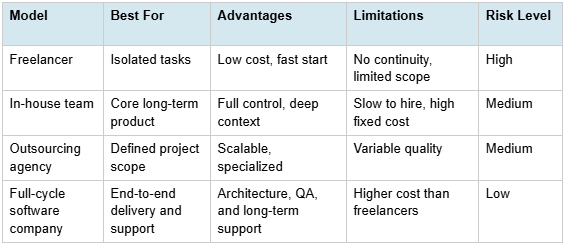
Partner Evaluation Checklist
• Technical expertise. Experience across web, mobile, AI, and security domains.
• Product design capabilities. Design integrated before engineering begins, not after.
• Relevant portfolio. Cases with comparable complexity and stack.
• Communication process. Defined cadence and documented scope change handling.
• Project management. Milestone-based delivery with transparent reporting.
• QA and security testing. Integrated throughout development, not only at delivery.
• Code ownership. Client owns the codebase from the first sprint.
• Post-launch support. Defined maintenance model, not just a ticket queue.
• Scalability. Ability to expand or reduce team without disrupting delivery.
• Startup to enterprise range. Experience across company sizes and maturity stages.
What CodeGeeks Solutions Provides
CodeGeeks Solutions is a software development company serving startups, SMEs, and enterprise clients. Services include product design, software engineering, web and mobile development, product management, QA and security testing, AI automation, AI transformation, AI-driven legacy modernization, and digital transformation.
For teams dealing with the consequences of rapid AI-assisted development – security gaps, unmaintainable code, scaling problems – CodeGeeks Solutions provides structured remediation alongside greenfield development capability. The company works across the full product lifecycle, from early design through production systems and long-term technical support.
Businesses evaluating a software development partner for custom digital products, AI integration, or vibe coding remediation can consider CodeGeeks Solutions as a technology partner for that work.