
By: Alexander Sebastian
Open almost any English Bible to Psalm 23 and the first line reads, “The LORD is my shepherd.” Most readers move past those capital letters without a second thought. Few realize that they stand in for a personal name, written in Hebrew as YHWH, that appears thousands of times in the Hebrew Scriptures.
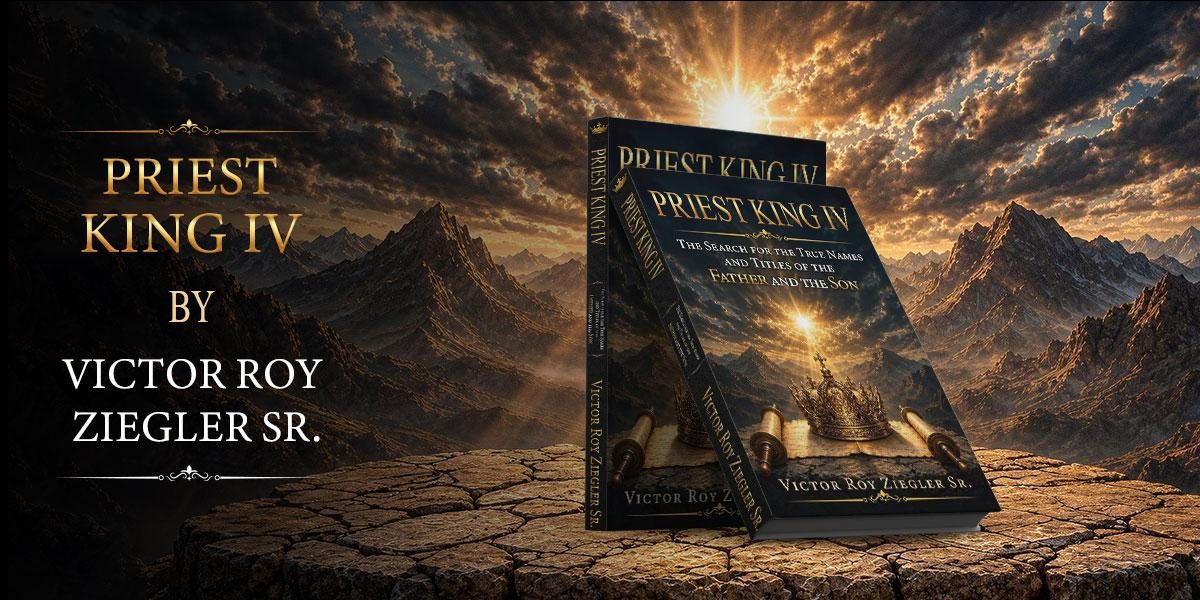
That translation choice is the starting point for Priest King IV: The Search for The True Names and Titles of The Father and The Son, the latest book in Victor Roy Ziegler Sr.’s Priest King series. Ziegler follows the divine name from its revelation to Moses, through exile, scribal tradition, and centuries of translation, to the closing vision of the Book of Revelation.
From the Flight Line to the Courtroom
Ziegler did not come to biblical study by the usual route. A member of the Crow Creek Sioux Tribe, he served in the U.S. Air Force from 1969 to 1973 as a crew chief on F-4 fighter jets, with tours in Thailand, South Korea, and Vietnam.
After his honorable discharge, he joined his tribe’s police force and later the Bureau of Indian Affairs uniformed police. He spent 25 years in law enforcement, the last ten as a Branch Chief supervisory officer.
He kept learning the whole way. He earned a Bachelor of Arts in Human Services from Sinte Gleska College in Rosebud, South Dakota, followed by a Juris Doctor and a Master of Public Administration from the University of South Dakota, and a Master of Laws from the University of Tulsa. He has since served his tribe as Associate Tribal Judge, as prosecutor, and on three occasions as Chief Judge.
His mother-in-law, Julia DeWitt Yellow Robe, is a retired Veterans Affairs nurse who is 108 years old and will turn 109 on December 17, 2026. She was a motivating force behind his search for knowledge, including his study of different religious schools of thought. Readers will notice the habits of a career spent weighing evidence. Ziegler sets out his sources, explains his reasoning, and tells the reader plainly where history ends and his own interpretation begins.
A Name That Stayed Written but Fell Silent
The book rests on one distinction: a name and a title do different jobs. Elohim (God), El Elyon (God Most High), and El Shaddai (God Almighty) are titles. YHWH (Yahweh) is the personal name the Creator revealed to Moses at the burning bush, which Exodus 3:15 calls His name forever. Ziegler argues that once these categories blur, important details in the text become hard to see.
He then traces how the name gradually dropped out of everyday speech. Ziegler presents this as a long process with many causes: reverence for the name, the experience of conquest and exile, spoken substitutes such as Adonai (“Lord”) and HaShem (“the Name”), and later scribal and translation habits. As he puts it, “The written name remained. The spoken name became restricted.”
The chapters on history draw on material evidence. Ziegler points to the Āl-Yāhūdu tablets, Babylonian records from about 572 to 477 BCE that preserve Judean exiles’ names containing forms of the divine name. He also discusses Dead Sea Scrolls manuscripts in which scribes wrote YHWH in the older Paleo-Hebrew script so it stood apart from the surrounding text.
From Kyrios to LORD
Ziegler then follows the Scriptures into Europe. The Greek Septuagint commonly rendered the name as Kyrios, the Latin tradition as Dominus, Martin Luther’s German Bible as Der Herr, and English Bibles as “LORD.” He also explains how the form “Jehovah” arose from combining the consonants of YHWH with vowel markings associated with Adonai, and notes that the King James Version still prints “JAH” in Psalm 68:4.
Ziegler is clear about his goal. “Restoring the Name does not mean inventing a new name for the Creator,” he writes. “It means drawing attention again to a name that is already present in the Hebrew Scriptures.”
The Father, the Son, and a Careful Hand
The history serves a larger theological question about the Father and the Son. Drawing on passages such as Genesis 19:24, Daniel 7, and Psalm 110:1, Ziegler develops a framework rooted in the ancient Jewish idea of “Two Powers in Heaven.” In his reading, the First Power, the Unseen YHWH, is the Creator Father, while the Second Power, the Seen YHWH, is the Eternal Son, revealed in history as Yahushua Ha Mashiach (Jesus Christ). He presents this throughout as the framework of his study and encourages readers to engage with the passages themselves.
What stands out is his restraint on claims he cannot support. He notes that the royal LMLK jar handles from ancient Judah do not contain the divine name. He rejects the popular claim that the name “Jesus” comes from “Hail Zeus,” explaining that the linguistic evidence does not support it. He even acknowledges that mainstream historical linguistics does not accept “Yahushua” as the standard ancient form of the Messiah’s name, and explains that he uses it to highlight the name’s connection to YHWH and its meaning, “YHWH saves.”
The book also continues the work of the earlier volumes. His first Priest-King book examined the relationship between the Angel of the Lord’s Presence, Yahushua Ha Mashiach, and the coming King of Kings. Priest King III: The Foundation of the Christian Trinity in the Jewish Doctrine of the Two Powers in Heaven explored the Two Powers framework that this volume carries forward.
Ziegler looks at the congregation in Philadelphia, to whom Yahushua says in Revelation 3:8, “You have kept My word, and have not denied My Name.” He closes with Revelation 22:4: “They shall see His face, and His Name shall be on their foreheads.”
Priest King IV Is Available Now
Priest King IV: The Search for The True Names and Titles of The Father and The Son by Victor Roy Ziegler Sr. is available on Amazon in Kindle, paperback, and hardcover editions. It will appeal to readers of the earlier Priest King books and to anyone who has wondered what stands behind the word “LORD” in their own Bible.