

Two quotes for the same 216-mile move can land $1,500 apart, and the drive is almost never the reason. It is a four-hour run down I-95 either way, and carriers price fuel and tolls at about the same rate.
The difference sits in the thirty feet between the truck and the front door, on both ends. Stairs, elevator windows, how far the truck can park, which building allows a Saturday move. None of those factors appear as line items when comparing quotes, so most people discover the cost on the day they need to pay.
Five Ways for Moving to New York City
The 216 miles are the same in every version of this move. What differs is how many of the hours you buy and how many you work yourself. Price follows that almost exactly, from about $400 at one end to past $5,000 at the other.
Here is the same two-bedroom apartment, priced five ways:
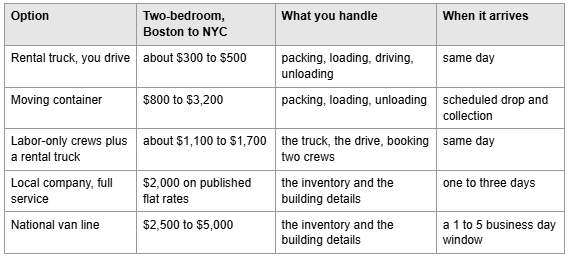
Renting a moving truck is the cheapest but most difficult way to move. A 26-foot U-Haul advertises from $49.95 a day, then charges $0.59 to $0.99 a mile. Over this route that is $130 to $215 in mileage, plus roughly 20 gallons of fuel at the 10 to 12 mpg these trucks return. Add the damage waiver, the fuel surcharge and the after-hours return fee and the $49.95 headline lands somewhere between $300 and $500. Driving a 26-foot box through the Bronx and into a Manhattan side street is the part that never appears on the quote. Nobody lifts anything for you, and the waiver sold at the counter covers the vehicle rather than your belongings, so protection for the contents is a separate purchase and a renter’s or homeowner’s policy often excludes goods in transit.
Moving containers sit one step up. PODS and its competitors drop a container at the curb, you fill it, they drive it. Published 2026 pricing for moves of 100 to 500 miles runs $800 to $3,200, and that usually includes a month of storage, which no other option here gives you. The hard part is where the container stands. Boston will not let one sit on a public street without an occupancy permit, and container permits have to be applied for in person no matter how early you book. The calendar costs you too: drop, load, collection, transit and redelivery runs a week or more, against one to three days for a crew.
Labor-only crews are the least advertised option. Boston movers sell labor without a truck at roughly $50 an hour per person, so about $100 an hour for a pair. You buy that twice, once to load in Boston and once to unload in New York, and you rent and drive the truck in between. Four to six hours on each end for a two-bedroom puts labor at $800 to $1,200, plus the rental. What you pick up in exchange is the coordination: two crews in two cities who have never spoken to each other, and one truck that has to reach the second crew on time.
A local moving company sends one crew to load in Boston and unload in New York. Published flat rates on this route start at $1,200 for a one-bedroom, then $2,000 for a two-bedroom, $3,200 for a three-bedroom and $4,500 for a four-bedroom house, with gas and tolls inside the number and delivery in one to three days. Movers from Boston to NYC do almost all the work for you: they arrive in a dedicated truck, carry your belongings, and unload them at your new location. But keep in mind that for most local moving companies, packing is a separate service. There are also often additional charges for flights of stairs, for assembling and disassembling furniture, for heavy items, and more.
National van lines are the expensive end of this list. Published route pricing for Boston to New York runs $2,468 to $7,050 across household sizes, and a two-bedroom usually lands between $2,500 and $5,000. You are buying a tariff quote priced by weight, with minimum weights that work against a small shipment, and your goods normally travel on a trailer shared with other households. That sharing is what makes a 1,500-mile move cheaper, and it is also what creates the delivery window: one to five business days is typical under 500 miles, and a dedicated truck narrows it to two to five for more money.
Access and Labor
A crew that parks forty feet from the door and walks into a freight elevator loads a two-bedroom in three or four hours. The same crew, parked a block away on a Brooklyn street with no reserved curb space, carrying up to a fourth-floor walk-up, spends seven. At Boston rates of $150 to $240 an hour for three movers, those three extra hours are $450 to $720, and nothing about the drive has changed.
A low number from a company that never asked about stairs, elevators, parking, or the width of your doorway is not an estimate. It is a guess, and it gets corrected on move day, when you have no leverage left.
The questions that change the price:
- Which floor, and whether an elevator fits a sofa
- How far the truck can legally park from each door
- Whether either building restricts move hours or days
- How much is packed by you versus by the crew
- What needs disassembly: platform beds, sectionals, treadmills
For most people on this route, a local full-service company is the best trade between what you pay and what you manage. One crew handles both ends, so nothing is transferred between trucks and there is no second company to blame if something arrives broken. Movers who run the corridor every week ask the access questions before quoting and put the answers into that rate. Check that whoever you book holds active interstate authority, because this move crosses a state line.
Permits and Building Rules
Both of these are cheap. Both can cost you a day if you leave them late, and on an hourly job a lost day is a real bill.
Boston offers a Temporary Street Occupancy Permit to hold curb space for the truck. Two non-metered spaces cost $69 for the day, 7 a.m. to 5 p.m., and come with the official “No Parking” signs. Metered spaces are about $40 more. The signs go up at least 48 hours ahead, and you can apply online only if the move is 15 days to eight weeks out. Within 15 days, you are going to City Hall in person, and the City of Boston mails the permit and signs after approval, so allow up to ten days for delivery. Skip the permit and you pay in labor instead: a ticket, a tow, or a crew that spends thirty to ninety minutes repositioning the truck.
September 1 is the exception worth planning around. Boston’s academic leases nearly all turn over on that date, so curb permits and crews are gone weeks in advance. For a move in that week, start six to eight weeks out.
On the New York end the paperwork is the gate. Most co-ops, condos and managed rentals will not let a crew past the service entrance without a Certificate of Insurance naming the building and the managing agent, usually on the ACORD 25 form, with $1 million to $5 million in general liability. Ask your mover for it at least five business days out and send the building’s own sample with the request. Issuance takes 24 to 48 business hours, longer if the building wants particular wording. Book the freight elevator in the same conversation: windows come in two-to-four-hour blocks, weekdays only in many buildings, two to three weeks ahead and three to four between May and September, with a refundable deposit of $250 to $1,000.
New York has no residential equivalent of the Boston curb permit on most blocks, so the truck double-parks and the crew works around traffic. That is ordinary, and it is part of why the New York end runs longer.
Tolls and Truck Routes
If the new address is in Manhattan below 60th Street, the truck pays to enter the Congestion Relief Zone. A single-unit box truck is charged $14.40 at peak hours and $3.60 overnight. A multi-unit truck pays $21.60 and $5.40. Peak runs 5 a.m. to 9 p.m. on weekdays and 9 a.m. to 9 p.m. on weekends, and the toll applies once a day, not once per entry. Those rates took effect in January 2025, so they should already sit inside a full-service quote. Ask whether they do.
If you are driving a rental truck yourself, routing is the expensive mistake. New York’s parkways (the Hutchinson River, the Bronx River, the Belt, the Henry Hudson) ban commercial vehicles, and their stone overpasses were built for 1930s sedans. Set the vehicle profile to truck before you leave Boston, or stay on I-95 and the interstates the whole way.
Coverage and Liability
Every interstate carrier includes liability coverage. The default, released value protection, pays 60 cents per pound per article. That is the federal baseline for every interstate mover.
The math is worth doing before you assume you are covered. A 50-pound television the crew drops pays out $30. A 200-pound dresser pays $120. Full value protection, where the carrier repairs the item, replaces it, or pays cash value, costs extra and has to be selected in writing before move day.
Ask which of the two is on your paperwork and what the deductible is. Then confirm the carrier’s USDOT and MC numbers are active for interstate authority before you sign.
Timing and Delivery
The drive is about four hours clean, five to six with traffic in a 26-foot truck, yet most carriers still bill it as a two-day job: load in Boston in the afternoon, deliver in New York the next morning inside the building’s approved window. Same-day delivery exists for small loads and usually carries a surcharge. What sets the schedule is almost never the highway. A building that allows moves only between 9 a.m. and 4 p.m. on weekdays cannot receive a truck that finished loading in Boston at 6 p.m.
If your Boston lease ends August 31 and your New York lease starts September 1, deal with that gap when you book. Overnight storage at the carrier’s facility is a common fix, but it has to be arranged in advance, not discovered on the last day of the month.
Questions to Ask
Send every carrier the same three things and the quotes become comparable:
- A full inventory, including anything oversized, fragile, or needing disassembly
- Both addresses with the floor, the elevator situation, and how close a truck can park
- Both buildings’ move rules and the COI requirements from the New York management office
Then ask four questions. What is included at this price? What specifically would change it? Who pulls the Boston permit, and who issues the COI? What liability coverage is on the paperwork?
Anything a carrier will not answer before move day, you end up answering yourself on move day, at an hourly rate. Put the inventory and both buildings’ rules in the first email you send, and within a day you will know which quotes are real.