From a Ferrari at 18 to $100 Million: The Story Behind EZ Exotics

How entrepreneur Eddy Zillan turned a childhood obsession with supercars into a luxury automotive business specializing in some of the world’s rarest and most extraordinary collector vehicles.

For most teenagers, owning a Ferrari is a distant dream. For Eddy Zillan, it became a reality before he even graduated from high school.

At just 18 years old, Zillan purchased a Ferrari 458 Italia, marking an early milestone in a journey that would eventually lead him into the highest levels of the exotic and collector-car industry.

Years later, that same passion would become the foundation of EZ Exotics, a luxury automotive sourcing and brokerage business involved in more than $100 million in vehicle transactions involving over 200 automobiles in a single year.

But the story of EZ Exotics began long before the multimillion-dollar transactions and rare Bugattis. It began with a kid who simply loved cars.

A Childhood Dream That Became Reality

Growing up, Zillan was fascinated by exotic automobiles. He spent his childhood attending car shows, admiring Ferraris, Lamborghinis, and other supercars that most people only encounter in photographs.

For Zillan, however, admiring these vehicles was never enough. He wanted to own them.

Through his own entrepreneurial efforts, Zillan purchased his first sports car at 16. Two years later, while still attending high school, he accomplished something that would have seemed unimaginable to many of his peers: buying his first Ferrari.

Photo Courtesy: Eddy Zillan (Eddy Zillan pictured with the red Ferrari 458 Italia he purchased at age 18.)

Photographs from that period capture Zillan with his red Ferrari 458 Italia, a tangible reminder of how early his automotive ambitions began taking shape.

The Ferrari 458 was more than an exciting purchase. It represented the realization of a childhood ambition and the beginning of a much larger automotive journey.

Rather than remaining satisfied with one dream car, Zillan continued buying, selling, and trading vehicles, using each transaction as an opportunity to work toward something more exceptional.

Over time, what began as an enthusiasm for supercars evolved into a deep understanding of the exotic automotive marketplace.

From Supercar Enthusiast to Automotive Entrepreneur

As Zillan entered his twenties, his interests began shifting.

Owning a Ferrari or Lamborghini was no longer the ultimate objective. He became increasingly fascinated by the details that distinguish an ordinary example from a truly extraordinary collector vehicle.

Rare factory paint colors, unusual interior configurations, special-order options, historical significance, and limited production numbers became central to his approach.

Instead of simply searching for a particular model, Zillan focused on identifying the most distinctive examples available.

His knowledge of rare Ferraris, Lamborghinis, Porsches, Mercedes-Benz models, and American collector automobiles helped him recognize the qualities that make certain vehicles especially desirable.

For Zillan, each automobile represented more than horsepower or performance. Its individuality, rarity, and history were equally important.

That expertise would eventually transform his passion into a business.

The Unexpected Deal That Started EZ Exotics

As Zillan continued building relationships throughout the automotive industry, dealers, collectors, and enthusiasts began presenting him with rare vehicles and unusual opportunities.

These automobiles were often extraordinary, but they were not always the right fit for a particular buyer or seller.

Then an opportunity emerged.

After being offered another rare vehicle, Zillan connected with a dealer who helped arrange its sale. The transaction generated a significant profit and revealed an opportunity he had not fully considered.

His ability to locate exceptional automobiles had value beyond individual transactions.

What had previously been a personal interest could become a specialized business.

That realization led to the development of EZ Exotics, built around Zillan’s ability to identify, locate, negotiate, and source some of the most desirable automobiles in existence.

Turning a Passion Into a $100 Million Automotive Business

What began with a single successful brokerage opportunity rapidly evolved into a substantial operation.

According to figures published by EZ Exotics, the company went on to sell more than 200 unique automobiles, generating over $100 million in vehicle transaction revenue during the following year.

The scale of the business was remarkable, but its specialization made it particularly distinctive.

Rather than focusing on ordinary luxury-car inventory, Zillan pursued the rarest specifications, most unusual configurations, and historically significant examples available.

His experience in the exotic-car market provided a detailed perspective on vehicle desirability.

He understood why two otherwise identical Ferraris could have dramatically different appeal, why a particular factory color could make a vehicle especially desirable, and why provenance could transform an automobile into a significant collector piece.

That knowledge became central to EZ Exotics’ approach to buying, selling, brokering, and sourcing rare vehicles.

The Treasure Hunt for the World’s Rarest Cars

For Zillan, the most exciting part of the business isn’t simply completing a transaction. It’s the hunt.

Some of the world’s most desirable collector cars haven’t been publicly offered for sale in years. Others remain privately held by owners who have little interest in parting with them.

Locating these automobiles can require extensive research, personal relationships, persistent outreach, and months of negotiation.

EZ Exotics approaches the process much like a treasure hunt, searching for exceptional vehicles that others may not even know exist.

One of the company’s most notable featured transactions involved a Bugatti EB110 described as the final example produced and the only one finished in fully exposed carbon fiber.

The company says it helped place the extraordinary Bugatti with its new owner.

Other featured transactions include a blue-tinted exposed-carbon McLaren Senna, an exceptionally low-mileage Ford GT, and rare Ferrari configurations associated with prominent automotive collections.

The appeal of these transactions extends beyond their financial value.

For Zillan, uncovering an automobile that has been hidden from public view for years—and helping it find its next home, represents the ultimate reward.

Photo Courtesy: Eddy Zillan (Eddy Zillan behind the wheel of his Ferrari 458 Italia at age 18.)

A Specialized Perspective on the Exotic Car Industry

What separates Zillan’s approach from conventional automotive sales is his detailed understanding of rare and collectible vehicles.

He isn’t simply searching for cars to sell. He is identifying automobiles with specifications, histories, and characteristics that make them especially significant to collectors.

His knowledge of rare vehicles has helped shape EZ Exotics’ approach to evaluating specifications, market desirability, provenance, and long-term collector appeal.

Through EZ-Exotics.com, the company now offers exotic-car sourcing, brokerage, consignment, and collector consulting, working with buyers and sellers across the United States and internationally.

Its network extends into Europe and Asia, allowing the business to pursue opportunities beyond the domestic automotive marketplace.

Despite the scale of the operation, the underlying philosophy remains closely connected to Zillan’s earliest automotive ambitions: find something extraordinary, understand what makes it special, and pursue it relentlessly.

From Dreaming About Supercars to Finding the Impossible

At 16, Zillan was working toward his first sports car.

At 18, he was driving a Ferrari while still in high school.

In his twenties, he was developing the knowledge and relationships that would help him build a specialized automotive business.

Today, through EZ Exotics, he has turned that progression into a company centered on discovering and trading some of the world’s most exclusive collector vehicles.

His journey illustrates how a personal passion can evolve into an entrepreneurial opportunity when combined with market knowledge, persistence, and the ability to recognize value where others might not.

For Zillan, however, the story is still unfolding.

There are more extraordinary automobiles to uncover, more complex transactions to facilitate, and more vehicles whose histories remain hidden from the public.

And somewhere, sitting quietly inside a private garage, may be the next remarkable discovery.

Learn more about Eddy Zillan and EZ Exotics: EZ-Exotics.com

Follow EZ Exotics on Instagram: @ez.exotics

Meet Troy Gagne: A Husband, Father, Poet, and Storyteller

For Troy Gagne, some of life’s most meaningful stories can be found in the simplest moments.

A conversation with family. A road trip with his wife. A favorite song playing in the background. A memory from years ago. Time spent with the people he loves. These everyday experiences have become a source of inspiration for Troy as both a writer and poet.

Troy is a husband, father, and poet who has shared 29 years of marriage with his wife, Kim. Together, they have built a life filled with family, memories, laughter, challenges, and countless experiences that continue to shape Troy’s writing.

As a father, family remains an important part of Troy’s life. His children are now at different stages of their own journeys, with a son living in Texas, a daughter in Tennessee, and a daughter still at home in Michigan and attending high school. Having children spread across different places has given Troy and Kim even more reasons to travel, visit family, and create new memories along the way.

A Love of Family and Travel

Traveling with Kim is one of the things Troy enjoys most. Their journeys allow them to visit family, experience new places, and see more of the country together.

For Troy, travel is not simply about reaching a destination. It is about the experiences along the way the places visited, the people encountered, and the memories created.

Those experiences naturally find their way into his creative work.

Whether reflecting on family, relationships, memories, faith, or everyday life, Troy’s writing is rooted in the belief that there is meaning to be found in the experiences we sometimes take for granted.

Music, Writing, and Inspiration

Music is another important part of Troy’s life.

He enjoys listening to music and finds inspiration in the emotions and stories that songs can evoke. Music has a unique ability to bring people back to a particular time or place, reminding them of people, experiences, and feelings that may have been forgotten.

That connection between music, memory, and emotion is also reflected in Troy’s poetry.

Writing gives Troy another way to express those thoughts and experiences. Through poetry, he can explore the things that matter to him and transform personal observations into words that readers can connect with.

His work reflects an appreciation for the ordinary moments that make up an extraordinary life.

From Jesus And Me to A Well Within

Jesus And Me is Troy Gagne’s first book.

His writing journey continues with A Well Within, a poetry collection that explores many of the experiences and emotions that shape everyday life. Through his poetry, Troy reflects on faith, family, love, loss, memories, relationships, personal struggles, and the search for hope and meaning.

His poems invite readers to pause and reflect on their own experiences. Some may bring back memories of family or childhood. Others may encourage readers to think about faith, relationships, difficult seasons, or the people who have influenced their lives.

At the heart of Troy’s writing is a genuine appreciation for life’s experiences the beautiful ones, the difficult ones, and everything in between.

A Writer Inspired by Life

Troy Gagne does not need to look far for inspiration.

His inspiration can be found in his family, his marriage, his travels, his faith, music, memories, and the everyday moments that often become the stories we treasure most.

Living in Michigan with Kim, Troy continues to enjoy traveling, spending time with family, listening to music, and writing.

For him, writing is another way of preserving the moments that matter.

Through his books and poetry, Troy hopes to share those reflections with readers while encouraging them to look at their own lives with greater appreciation.

Because sometimes the most meaningful stories are not the ones that happen on a grand stage.

Sometimes they are the stories found at home, on the road, around the dinner table, in a familiar song, or inside a memory that refuses to fade.

And sometimes, all it takes is a pen and a few honest words to bring those stories to life.

NYC SNAP Recipients to Get Up to $14 a Day for Fresh Produce

NYC SNAP recipients will be eligible for up to $14 a day in matching Health Bucks coupons at participating farmers markets beginning January 2027. The increase raises the current $10 limit by 40%, allowing shoppers to receive more assistance with fresh produce purchases. The change applies to Health Bucks rather than regular SNAP payments.

Key Takeaways

  • New York City’s Health Bucks daily matching limit will increase from $10 to $14 beginning January 2027
  • Eligible shoppers will continue receiving $2 in Health Bucks for every $2 spent using SNAP at participating farmers markets
  • The city expects to distribute nearly $2.3 million in Health Bucks to SNAP participants in 2027
  • The higher limit will not change monthly SNAP allotments or provide automatic cash payments

New York City announced an expansion of its Health Bucks program on October 29, 2026, increasing the amount of fresh produce assistance available to residents receiving Supplemental Nutrition Assistance Program (SNAP) benefits. Beginning in January 2027, eligible shoppers will be able to earn up to $14 in matching coupons each day, compared with the current $10 limit.

The increase applies to purchases made at participating farmers markets and farm stands, where SNAP recipients receive additional coupons that can be redeemed for fresh fruits and vegetables. Although the change raises the maximum daily benefit, the amount each shopper receives will still depend on qualifying SNAP purchases.

NYC Health Commissioner Dr. Alister F. Martin highlighted the affordability concerns behind the program in the city’s announcement.

“But knowing that eating more fruits and vegetables is good for you and being able to afford them are two different things,” Martin said.

The expansion comes as the NYC Health Department reports continued difficulty accessing affordable, balanced meals among residents at risk of food insecurity. City officials estimate that nearly $2.3 million in Health Bucks will be distributed to SNAP participants during 2027, although actual participation and coupon use will determine the final amount.

NYC SNAP Recipients Will See a 40% Increase in Daily Health Bucks

Health Bucks provides matching coupons to SNAP recipients who shop at participating New York City farmers markets and farm stands. Under the existing system, shoppers receive $2 in Health Bucks for every $2 spent using SNAP benefits, up to a daily maximum of $10. That matching arrangement will remain in place when the limit increases to $14 in January 2027.

The change means eligible shoppers can earn an additional $4 in coupons on days when their qualifying purchases reach the new maximum. For example, a shopper spending $6 in SNAP benefits would receive $6 in Health Bucks, while spending $14 would generate the full $14 match. Purchases above that amount would not produce additional coupons beyond the daily limit.

Health Bucks are issued as $2 coupons that can be redeemed for locally grown fresh fruits and vegetables. Unlike regular SNAP benefits, which cover a broader range of eligible grocery items, Health Bucks are specifically intended for produce purchases at farmers markets and farm stands.

The higher allowance does not increase a household’s regular SNAP payment or automatically add funds to an EBT card. Instead, it changes the maximum value of the additional coupons shoppers can earn when using existing SNAP benefits at qualifying locations.

For households that regularly purchase produce at participating markets, the increase allows a larger share of qualifying purchases to receive matching assistance. However, the benefit remains tied to actual spending, and shoppers who spend less than $14 will receive a corresponding smaller match.

The program is separate from New York City’s Get the Good Stuff initiative, which offers matching benefits for eligible purchases of fruits, vegetables, and beans at selected supermarkets. Under that program’s current rules, SNAP shoppers can receive up to $10 per day in matching credits for qualifying purchases, with the credits applied toward future eligible food purchases.

Health Bucks and Get the Good Stuff operate at different retail locations and have separate redemption procedures. The newly announced $14 limit applies to Health Bucks, not to the supermarket-based program.

Farmers Markets Across NYC Will Provide the Higher Matching Benefit

The Health Bucks expansion will use New York City’s existing network of farmers markets and farm stands. According to the NYC Health Department, more than 100 markets and stands operate across the five boroughs during the summer and fall, providing residents with locations where fresh produce can be purchased.

Health Bucks are available year-round at markets and stands that accept SNAP EBT, although operating schedules vary by location and season. Some markets remain open throughout winter, while others close during colder months, making it important for shoppers to confirm availability before visiting.

GrowNYC operates Greenmarkets throughout the city, including established locations at Union Square in Manhattan and Grand Army Plaza in Brooklyn. At participating Greenmarkets, SNAP recipients can visit the market information tent, use their EBT cards, and obtain tokens for purchases from eligible vendors.

The process also generates Health Bucks based on qualifying SNAP spending. Shoppers can then use the coupons to purchase fresh fruits and vegetables, while their SNAP tokens remain available for other eligible foods sold at the market.

The market-based distribution system connects the program with New York City’s wider network of regional food producers. Farmers markets provide a direct retail channel for participating growers, while local food distribution networks also help connect farms with urban retailers, institutions, and communities.

Although the higher Health Bucks limit increases the amount of matching assistance available, it does not expand coupon redemption to every grocery store or food retailer. Shoppers must use SNAP at participating markets to earn the coupons, which remain restricted to eligible produce purchases.

Residents can locate nearby markets through the NYC Health Map, which provides information about operating dates, hours, and locations. The Health Department also offers a text-based search service, allowing residents to send “So Good” to 55676 for market information in English or “Muy Rico” for information in Spanish.

GrowNYC advises shoppers to check the expiration dates printed on their coupons. Its current guidance states that Health Bucks expire on December 31 of the year they are issued, while unused SNAP market tokens do not have the same expiration requirement.

For residents planning to use the higher allowance in January, the availability of participating winter markets will determine where the additional coupons can be earned.

Food Affordability Data Provides Context for the 2027 Expansion

The Health Bucks increase follows the release of new findings from the NYC Health Department documenting food affordability challenges across the city. An October 2026 data brief, based on Community Health Survey findings, examined food insecurity risk among New York City adults from 2021 through 2024.

Among adults identified as being at risk of food insecurity, nearly eight in ten reported difficulty affording balanced meals. The department also found that 18% of adults in that group had consumed no fruits or vegetables on the previous day, while nearly one-third reported receiving food through emergency services such as food pantries.

These findings provide context for the expansion but do not measure the results of the higher Health Bucks allowance, which has not yet taken effect. They also do not establish how many SNAP households will use the additional $4 or whether participating shoppers will change their purchasing habits.

The new allowance addresses one part of household food spending by providing matching coupons for eligible produce purchases. Its reach will depend on several practical factors, including access to participating farmers markets, the amount of SNAP benefits used, and the availability of eligible products.

Food expenses also form part of broader household affordability concerns in New York. Separate assistance efforts, including New York utility bill relief, address other recurring expenses, although those programs have different eligibility requirements and provide assistance through different systems.

Health Bucks has operated since 2005, with the NYC Health Department reporting that more than $20 million in coupons has been distributed over the program’s history. The city expects nearly $2.3 million in distributions to SNAP shoppers during 2027, supported by city resources and $5.7 million in new grant funding through the Gus Schumacher Nutrition Incentive Program.

The Health Department also works with community and faith-based organizations to distribute a limited number of Health Bucks for participation in nutrition education and other health-related activities. Those distributions operate separately from the daily SNAP matching benefit.

For eligible shoppers, the January change will raise the maximum amount of produce assistance available through qualifying purchases without altering the underlying SNAP program. The current $10 daily limit remains in effect through December 2026, with the higher $14 allowance scheduled to begin the following month.

Frequently Asked Questions

When will the $14 Health Bucks limit begin?

The new daily limit will take effect in January 2027. Until then, eligible shoppers can continue earning up to $10 per day in Health Bucks through qualifying SNAP purchases at participating markets.

Who qualifies for the additional Health Bucks?

NYC SNAP recipients can earn Health Bucks when they use their SNAP EBT benefits at participating farmers markets and farm stands. The coupons are provided as a matching benefit based on qualifying purchases rather than automatically distributed to every household.

Will the increase add $14 to regular SNAP benefits?

No. The change increases the maximum daily value of Health Bucks coupons from $10 to $14. It does not increase monthly SNAP allotments, provide additional cash payments, or automatically deposit money onto EBT cards.

Where can shoppers use Health Bucks?

Health Bucks can be redeemed for locally grown fresh fruits and vegetables at New York City farmers markets and farm stands. Residents can use the NYC Health Map or the city’s text service to find nearby locations and confirm operating schedules.

Do Health Bucks coupons expire?

Yes. GrowNYC’s published guidance states that Health Bucks expire on December 31 of the year they are issued. Shoppers should check the expiration date printed on their coupons before making purchases.

Your Fleet Might Be Costing More Than It Should, and Telematics Can Show You Why

Most small business owners with vehicles have a rough sense of what their fleet costs. Fuel is the biggest line item. Maintenance comes in waves. Insurance renews annually. But the actual cost – what the fleet truly costs per mile of productive work completed – is a number very few businesses have ever calculated. And for most of them, it’s higher than they think.

Telematics doesn’t reduce costs automatically. What it does is make the actual costs visible for the first time. And visibility, as it turns out, is the prerequisite for every meaningful improvement that follows.

Where the Invisible Costs Hide

The fuel bill is visible. What isn’t visible is how much of that fuel is burned while the vehicle is sitting still with the engine running. A service van in a metro area with 45 minutes of idle time per day – air conditioning in summer, heat in winter, waiting outside a job site – is burning fuel that produces nothing. Multiplied across a fleet and across a full year, idle fuel consumption is a significant cost that nobody has authorized.

Maintenance is visible when it happens. What isn’t visible is whether it’s happening too late. A vehicle that should have been serviced at 15,000 miles but wasn’t seen until 21,000 miles has accumulated wear that shortens its useful life. The cost of that deferred maintenance doesn’t appear on a single invoice; it shows up gradually in higher repair costs, more frequent breakdowns, and earlier replacement.

Driver behavior is almost entirely invisible without data. Two drivers operating the same vehicle type on similar routes can produce wildly different fuel and maintenance costs. Without a system that measures this, a business has no way to know which drivers are costing more than they should and no basis for addressing it. A platform like Radius brings all of this data into one place. Idle time per vehicle, maintenance intervals based on real mileage, driving behavior metrics – all visible, all actionable.

What the Research Shows

The American Transportation Research Institute publishes annual operational cost reports for commercial trucking fleets, tracking expenses such as fuel, repairs and maintenance. These costs are important factors in fleet operating budgets and can be influenced by telematics, which helps businesses monitor fuel consumption, vehicle performance and maintenance needs.

Fuel costs drop when route optimization reduces unnecessary miles and when idle time monitoring changes driver habits. Maintenance costs fall when service intervals are based on actual usage rather than calendar dates, preventing both premature servicing and deferred maintenance. The businesses that have implemented telematics report improvements in both categories within the first few months of operation.

The Operational Picture You’re Missing

Without fleet data, a business makes decisions based on impressions and approximations. The owner knows roughly how much the fleet costs, roughly where the vehicles go, and roughly how they’re being used. Every one of those “roughlys” represents a gap between what the business thinks is happening and what’s actually happening.

That gap tends to be expensive. Vehicles covering more miles than they need to. Drivers idling more than anyone realizes. Service being deferred because nobody has a clear record of when the last one happened. Vehicles used for personal errands because nobody is monitoring movement outside work hours.

The National Safety Council provides guidance and resources on fleet telematics and driver safety. Monitoring behaviors such as speeding and harsh braking, combined with driver feedback and coaching, can help fleets address safety risks and improve driving practices. Vehicle incidents can also create direct costs through repairs and insurance claims, as well as indirect costs from vehicle downtime and lost productivity.

Starting the Conversation With Your Own Data

The value of telematics isn’t theoretical. It shows up in the first month of data: fuel consumption that doesn’t match the miles driven, idle time that explains why the fuel bill is higher than expected, maintenance that’s overdue on a vehicle that nobody was tracking closely.

These aren’t surprises that require dramatic action. They’re pieces of information that allow the business to make specific improvements – reconfigure routes, set idle time policies, schedule overdue service. Small businesses that have worked through this process describe a consistent experience: the first month of data reveals things they didn’t know, and addressing those things produces measurable results within the first quarter.

The fleet might be costing more than it should. Finding out which costs are excessive, and why, is the first step toward changing them.

Boston to NYC Moving Costs, Option by Option

Two quotes for the same 216-mile move can land $1,500 apart, and the drive is almost never the reason. It is a four-hour run down I-95 either way, and carriers price fuel and tolls at about the same rate.

The difference sits in the thirty feet between the truck and the front door, on both ends. Stairs, elevator windows, how far the truck can park, which building allows a Saturday move. None of those factors appear as line items when comparing quotes, so most people discover the cost on the day they need to pay.

Five Ways for Moving to New York City

The 216 miles are the same in every version of this move. What differs is how many of the hours you buy and how many you work yourself. Price follows that almost exactly, from about $400 at one end to past $5,000 at the other.

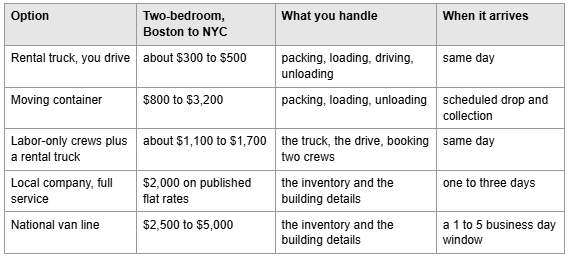
Here is the same two-bedroom apartment, priced five ways:

Photo Courtesy: Unsplash.com

Renting a moving truck is the cheapest but most difficult way to move. A 26-foot U-Haul advertises from $49.95 a day, then charges $0.59 to $0.99 a mile. Over this route that is $130 to $215 in mileage, plus roughly 20 gallons of fuel at the 10 to 12 mpg these trucks return. Add the damage waiver, the fuel surcharge and the after-hours return fee and the $49.95 headline lands somewhere between $300 and $500. Driving a 26-foot box through the Bronx and into a Manhattan side street is the part that never appears on the quote. Nobody lifts anything for you, and the waiver sold at the counter covers the vehicle rather than your belongings, so protection for the contents is a separate purchase and a renter’s or homeowner’s policy often excludes goods in transit.

Moving containers sit one step up. PODS and its competitors drop a container at the curb, you fill it, they drive it. Published 2026 pricing for moves of 100 to 500 miles runs $800 to $3,200, and that usually includes a month of storage, which no other option here gives you. The hard part is where the container stands. Boston will not let one sit on a public street without an occupancy permit, and container permits have to be applied for in person no matter how early you book. The calendar costs you too: drop, load, collection, transit and redelivery runs a week or more, against one to three days for a crew.

Labor-only crews are the least advertised option. Boston movers sell labor without a truck at roughly $50 an hour per person, so about $100 an hour for a pair. You buy that twice, once to load in Boston and once to unload in New York, and you rent and drive the truck in between. Four to six hours on each end for a two-bedroom puts labor at $800 to $1,200, plus the rental. What you pick up in exchange is the coordination: two crews in two cities who have never spoken to each other, and one truck that has to reach the second crew on time.

A local moving company sends one crew to load in Boston and unload in New York. Published flat rates on this route start at $1,200 for a one-bedroom, then $2,000 for a two-bedroom, $3,200 for a three-bedroom and $4,500 for a four-bedroom house, with gas and tolls inside the number and delivery in one to three days. Movers from Boston to NYC do almost all the work for you: they arrive in a dedicated truck, carry your belongings, and unload them at your new location. But keep in mind that for most local moving companies, packing is a separate service. There are also often additional charges for flights of stairs, for assembling and disassembling furniture, for heavy items, and more.

National van lines are the expensive end of this list. Published route pricing for Boston to New York runs $2,468 to $7,050 across household sizes, and a two-bedroom usually lands between $2,500 and $5,000. You are buying a tariff quote priced by weight, with minimum weights that work against a small shipment, and your goods normally travel on a trailer shared with other households. That sharing is what makes a 1,500-mile move cheaper, and it is also what creates the delivery window: one to five business days is typical under 500 miles, and a dedicated truck narrows it to two to five for more money.

Access and Labor

A crew that parks forty feet from the door and walks into a freight elevator loads a two-bedroom in three or four hours. The same crew, parked a block away on a Brooklyn street with no reserved curb space, carrying up to a fourth-floor walk-up, spends seven. At Boston rates of $150 to $240 an hour for three movers, those three extra hours are $450 to $720, and nothing about the drive has changed.

A low number from a company that never asked about stairs, elevators, parking, or the width of your doorway is not an estimate. It is a guess, and it gets corrected on move day, when you have no leverage left.

The questions that change the price:

  • Which floor, and whether an elevator fits a sofa
  • How far the truck can legally park from each door
  • Whether either building restricts move hours or days
  • How much is packed by you versus by the crew
  • What needs disassembly: platform beds, sectionals, treadmills

For most people on this route, a local full-service company is the best trade between what you pay and what you manage. One crew handles both ends, so nothing is transferred between trucks and there is no second company to blame if something arrives broken. Movers who run the corridor every week ask the access questions before quoting and put the answers into that rate. Check that whoever you book holds active interstate authority, because this move crosses a state line.

Permits and Building Rules

Both of these are cheap. Both can cost you a day if you leave them late, and on an hourly job a lost day is a real bill.

Boston offers a Temporary Street Occupancy Permit to hold curb space for the truck. Two non-metered spaces cost $69 for the day, 7 a.m. to 5 p.m., and come with the official “No Parking” signs. Metered spaces are about $40 more. The signs go up at least 48 hours ahead, and you can apply online only if the move is 15 days to eight weeks out. Within 15 days, you are going to City Hall in person, and the City of Boston mails the permit and signs after approval, so allow up to ten days for delivery. Skip the permit and you pay in labor instead: a ticket, a tow, or a crew that spends thirty to ninety minutes repositioning the truck.

September 1 is the exception worth planning around. Boston’s academic leases nearly all turn over on that date, so curb permits and crews are gone weeks in advance. For a move in that week, start six to eight weeks out.

On the New York end the paperwork is the gate. Most co-ops, condos and managed rentals will not let a crew past the service entrance without a Certificate of Insurance naming the building and the managing agent, usually on the ACORD 25 form, with $1 million to $5 million in general liability. Ask your mover for it at least five business days out and send the building’s own sample with the request. Issuance takes 24 to 48 business hours, longer if the building wants particular wording. Book the freight elevator in the same conversation: windows come in two-to-four-hour blocks, weekdays only in many buildings, two to three weeks ahead and three to four between May and September, with a refundable deposit of $250 to $1,000.

New York has no residential equivalent of the Boston curb permit on most blocks, so the truck double-parks and the crew works around traffic. That is ordinary, and it is part of why the New York end runs longer.

Tolls and Truck Routes

If the new address is in Manhattan below 60th Street, the truck pays to enter the Congestion Relief Zone. A single-unit box truck is charged $14.40 at peak hours and $3.60 overnight. A multi-unit truck pays $21.60 and $5.40. Peak runs 5 a.m. to 9 p.m. on weekdays and 9 a.m. to 9 p.m. on weekends, and the toll applies once a day, not once per entry. Those rates took effect in January 2025, so they should already sit inside a full-service quote. Ask whether they do.

If you are driving a rental truck yourself, routing is the expensive mistake. New York’s parkways (the Hutchinson River, the Bronx River, the Belt, the Henry Hudson) ban commercial vehicles, and their stone overpasses were built for 1930s sedans. Set the vehicle profile to truck before you leave Boston, or stay on I-95 and the interstates the whole way.

Coverage and Liability

Every interstate carrier includes liability coverage. The default, released value protection, pays 60 cents per pound per article. That is the federal baseline for every interstate mover.

The math is worth doing before you assume you are covered. A 50-pound television the crew drops pays out $30. A 200-pound dresser pays $120. Full value protection, where the carrier repairs the item, replaces it, or pays cash value, costs extra and has to be selected in writing before move day.

Ask which of the two is on your paperwork and what the deductible is. Then confirm the carrier’s USDOT and MC numbers are active for interstate authority before you sign.

Timing and Delivery

The drive is about four hours clean, five to six with traffic in a 26-foot truck, yet most carriers still bill it as a two-day job: load in Boston in the afternoon, deliver in New York the next morning inside the building’s approved window. Same-day delivery exists for small loads and usually carries a surcharge. What sets the schedule is almost never the highway. A building that allows moves only between 9 a.m. and 4 p.m. on weekdays cannot receive a truck that finished loading in Boston at 6 p.m.

If your Boston lease ends August 31 and your New York lease starts September 1, deal with that gap when you book. Overnight storage at the carrier’s facility is a common fix, but it has to be arranged in advance, not discovered on the last day of the month.

Questions to Ask

Send every carrier the same three things and the quotes become comparable:

  • A full inventory, including anything oversized, fragile, or needing disassembly
  • Both addresses with the floor, the elevator situation, and how close a truck can park
  • Both buildings’ move rules and the COI requirements from the New York management office

Then ask four questions. What is included at this price? What specifically would change it? Who pulls the Boston permit, and who issues the COI? What liability coverage is on the paperwork?

Anything a carrier will not answer before move day, you end up answering yourself on move day, at an hourly rate. Put the inventory and both buildings’ rules in the first email you send, and within a day you will know which quotes are real.

“What If It Works?” Rich Ramm’s Unlikely Route From High School Dropout to McKinsey and Beyond

For the Staten Island entrepreneur, taking a risk has never meant ignoring the numbers. His path from consulting to company ownership, and a childhood interest in racing, shows how he approaches the unexpected.

By SM Media

Staten Island, New York, October 29, 2026 – By the time Rich Ramm made the decision to leave McKinsey, he had already accomplished something he once might not have expected: building a career at the global consulting firm after dropping out of high school.

Walking away meant exchanging a well-established professional path for a venture without a track record. He returned to Staten Island without even having an apartment secured. The business was still an idea that would have to survive contact with reality.

The question he kept coming back to was deceptively short: “What if it works?”

An Unconventional Starting Point

Ramm did not follow the usual academic route into consulting. Without a conventional educational background to lean on, he had to demonstrate his value through preparation, persistence and the quality of his work. Reaching McKinsey became a defining career milestone, but it did not settle the question of what he wanted to do next.

Consulting offered him a familiar kind of challenge: understand a problem, analyze the available information and make decisions with the consequences in mind. Entrepreneurship presented a different one. The decisions would be his, as would the responsibility for carrying them out.

“I have a high tolerance for calculated risk, but calculated is the important part,” Ramm said. “I want to understand the downside, understand the numbers and understand what it will actually take to make something work. At some point, though, you also have to ask: what if it works?”

“What If It Works?” Rich Ramm’s Unlikely Route From High School Dropout to McKinsey and Beyond

Photo Courtesy: Rich Ramm

Choosing an Unfinished Plan

Before returning to New York, Ramm had spent time in Miami. His experiences there changed the way he thought about the everyday details that make an organization effective: listening to people, explaining expectations and following through on commitments.

He saw room to apply those ideas back home. Making that move was less straightforward than describing it. Leaving a salary behind required him to confront the immediate practical questions of housing, financing and getting a new operation off the ground.

The early period demanded a different kind of discipline than the one he had practiced as a consultant. Instead of examining what another organization should do, he had to decide where his own resources should go, what could wait and which responsibilities could not be delegated.

As the operation grew, the choices became more complicated. Hiring, systems, budgets and leadership all called for attention. Ramm remained closely involved in the details, with an emphasis on addressing problems early rather than allowing them to become part of the routine.

An Interest That Never Left Him

Cars have been a constant in Ramm’s life, long before his move into entrepreneurship. What began as a personal interest also became a way to meet people whose paths might otherwise never have crossed his.

Conversations around cars introduced him to entrepreneurs, owners and other people familiar with the uncertainties of building something. The connections were not easily reduced to a number on a spreadsheet, and the time and expense involved occasionally drew questions. He kept showing up because the interest was genuine.

That enthusiasm eventually led to a moment he could once only have imagined: a business he founded sponsored NY Racing Team, with its logo appearing on a NASCAR race car. For Ramm, watching the car on the track connected a childhood fascination with a later chapter of his working life.

The sponsorship was not the reason he entered business, and it was not a substitute for doing the work. It was a reminder that the rewards of an unconventional career are not always the ones a person can predict at the beginning.

“What If It Works?” Rich Ramm’s Unlikely Route From High School Dropout to McKinsey and Beyond

Photo Courtesy: Rich Ramm

What Comes After the Leap

Ramm’s experience has not made him dismissive of risk. If anything, it has given him a more practical view of it. Decisions made with incomplete information still require follow-through, and a promising start is only useful if the work behind it can hold up over time.

He continues to put weight on preparation, financial discipline and remaining close enough to day-to-day operations to recognize what needs attention. The habits are less dramatic than a career change, but they are what allow the initial decision to become something lasting.

The most striking part of Ramm’s journey may not be that a high school dropout reached McKinsey, or even that he left it. It is the willingness to make a second unconventional choice after the first one had already worked.

“What if it works?” gave him a reason to begin. The years since have been about answering the question through action.

How Dallas, Texas Workplaces Can Build a Smarter Commercial Cleaning Plan

Key Takeaways

  • A fixed checklist rarely fits every Dallas workplace.
  • Traffic, operating hours, floor materials, and facility type should shape service frequency.
  • A written scope, regular inspections, and clear reporting make results easier to manage.
  • Dust, storms, construction activity, badge access, and after-hours rules can affect local cleaning plans.

Dallas workplaces work best with cleaning plans built around how people actually use the building. Businesses comparing options can review this local cleaning provider, Star Building Services, for an overview of commercial cleaning programs serving Dallas County and the surrounding metroplex. Its Dallas service page covers structured janitorial scopes, restaurant and kitchen work, floor care, high dusting, post-construction cleanup, and other facility needs for offices, multi-tenant properties, industrial sites, and more.

Why One Cleaning Schedule Does Not Fit Every Dallas Business

A small office, a busy Uptown restaurant, a Downtown tower, and a South Dallas warehouse do not create the same messes or operate on the same timetable. Visitor volume, employee count, shared amenities, operating hours, and the building’s layout all matter. A busy lobby may need daily floor attention and spot cleaning, while a low-use storage room may only need periodic service. Review the plan whenever occupancy, tenants, staffing, or business hours change.

Start With a Walkthrough and a Written Scope

Begin with an on-site walkthrough instead of relying on square footage alone. List every service area, including restrooms, kitchens, elevators, glass, loading zones, offices, and shared spaces. Note flooring, locked rooms, alarm procedures, badge access, freight-elevator rules, and preferred service windows. Then separate work into daily, weekly, monthly, seasonal, emergency, and specialty tasks. Dallas County’s janitorial services framework is a useful example of why large facilities benefit from defined routines, access procedures, and work-order processes.

Match Cleaning Frequency to Building Traffic

High-Traffic Zones

  • Main entrances, reception areas, elevators, stairwells, and customer counters.
  • Public restrooms, break rooms, and shared kitchens.
  • Any area affected by spills, food service, weather, or continuous foot traffic.

Lower-Traffic Zones

  • Private offices, storage rooms, limited-access back rooms, and rarely used meeting spaces.

High-use spaces may need nightly service, daytime porter attention, or both. Lower-use areas can often follow a lighter rotation, provided the schedule still addresses visible dust, odors, supplies, and safety concerns.

Build a Dallas-Specific Cleaning Plan

Dallas conditions can change what a practical cleaning plan looks like. Entrances may need extra mat care and floor attention after storms. Facilities near active development, busy roads, or loading activity may need more frequent attention to tracked-in dirt, exterior glass, ledges, and dust. Heat can also make waste handling, restrooms, and food-service areas more demanding. For Downtown towers, Las Colinas offices, and secured multi-tenant buildings, after-hours entry procedures should be included in the scope before service begins.

Set Priorities by Facility Type

Offices and Corporate Buildings

Prioritize reception areas, conference rooms, restrooms, break rooms, touchpoints, carpet care, lobby floors, and interior glass. A polished common area matters, but consistent restroom and kitchen upkeep often has the greatest daily impact on employees and visitors.

Restaurants and Commercial Kitchens

Focus on grease control, kitchen floors, drains, walls, equipment edges, restroom presentation, and documented cleaning tasks. Food-service spaces require methods and products appropriate for the area being cleaned.

Warehouses and Distribution Centers

Plan for dust on floors, ledges, beams, and equipment areas, while protecting active operations and racking systems. Cleaning windows may need to align with shifts, weekends, loading schedules, or restricted work zones.

Medical and Professional Facilities

Use documented procedures for waiting rooms, treatment spaces, staff areas, and high-touch surfaces. Routine cleaning and disinfection are different tasks, so the scope should identify the intended result for each area.

Use the Right Method, Products, and Equipment

Routine vacuuming and damp mopping may suit many floors, while machine scrubbing can help address heavy soil on hard surfaces. Carpet extraction, high dusting, glass cleaning, degreasing, and post-construction cleanup should be scheduled when conditions require them. Workers should follow product labels, dilution directions, and applicable contact times; keep chemicals labeled and stored safely; and avoid unsafe chemical combinations. Equipment should match the surface to help prevent damage to finishes and fixtures.

Build Quality Control Into the Routine

A completed checklist is useful, but it should not be the only proof of quality. Assign tasks by zone and shift, conduct supervisor inspections, log missed items and supply shortages, and review recurring concerns with the facility contact. A simple inspection can cover:

  • Restroom cleanliness, supplies, odors, and visible touchpoints.
  • Floors, trash removal, break rooms, entrances, and interior glass.
  • Visible dust on ledges, vents, fixtures, and high surfaces.

What to Look for in a Dallas Commercial Cleaning Provider

Look for experience with your facility type and service hours, a clear written scope, trained workers, appropriate insurance, reliable supervision, and a process for reporting and correcting problems. Ask whether the provider can handle specialty needs such as carpet extraction, floor maintenance, high dusting, post-construction work, or emergency cleanup. A provider should also explain how it manages keys, badges, alarms, restricted rooms, and service changes.

Questions to Ask Before Signing an Agreement

  • Who supervises the account, and how are missed tasks corrected?
  • Which services are included, and which are billed separately?
  • How will keys, badges, alarms, and restricted areas be handled?
  • Can service change for events, seasonal demand, or altered business hours?
  • How often will the cleaning plan be reviewed?

Common Mistakes to Avoid

Do not choose solely based on the lowest price, use a single schedule for every room, leave access instructions vague, or assume routine janitorial work automatically includes specialty cleaning. Address complaints and missed work in writing rather than waiting for a tenant concern, inspection, or visible service failure to expose a gap.

Helpful Resources for Facility Teams

Facility leaders can follow commercial cleaning industry news to stay familiar with developments in workplace care, cleaning technology, and facility operations while evaluating their own programs.

Frequently Asked Questions

How Often Should a Dallas Office Be Cleaned?

Frequency depends on occupancy, visitor traffic, restrooms, food areas, floor space, and operating hours. Many offices combine routine nightly work with periodic deep cleaning.

Do Small Offices Need Professional Cleaning?

They can benefit when employees lack time for routine upkeep or when the office includes visitors, restrooms, kitchens, carpet, and shared equipment.

What Is Included in Routine Commercial Cleaning?

Typical tasks include trash removal, dusting, vacuuming, mopping, restroom care, break-room cleaning, and attention to shared touchpoints. Specialty work should be listed separately.

When Should a Cleaning Plan Be Updated?

Review it after renovations, tenant changes, new equipment, schedule changes, seasonal conditions, recurring complaints, or major shifts in occupancy.

Make the Plan Fit the Building

A reliable Dallas cleaning plan reflects the building’s daily reality. Clear scopes, sensible schedules, trained crews, local access planning, and regular inspections help create a cleaner, more consistent environment for employees, tenants, and visitors.

Kevin Gibbs and the Rise Through the Los Angeles Dodgers Farm System, Minor League Success, and Injury-Shortened Professional Baseball Career (1995–2004)

In professional baseball, careers rarely move in straight lines. They tend to bend, stall, and restart in ways that are hard to predict from early promise alone. A draft pick can look like a steady climb one year, then shift into uncertainty the next, depending on injuries, roster depth, and timing inside an organization. The Los Angeles Dodgers system in the mid-1990s operated in that same space, where minor league progress was tracked closely but never guaranteed to lead to a stable major league role. Kevin Gibbs came into that structure in 1995, part of a draft class moving into a deep and competitive farm system.

He was taken in the sixth round of the 1995 Major League Baseball draft after playing at Old Dominion University. That placement put him into the Dodgers’ minor league pipeline almost immediately. His first stop was the Northwest League, a short-season level where many players adjust to the pace and repetition of professional baseball. He handled it well enough to be named a league All-Star in 1995. It was not a headline moment in a national sense, but inside an organization, those selections matter. They signal who is adapting quickly.

The next year brought a step up to the Florida State League. The pattern continued. Another All-Star selection followed in 1996. By 1997, he had reached the Texas League, and again his name appeared on an All-Star list. Three seasons, three levels, three recognitions. Two of those teams finished seasons with league championships, placing him in clubhouses that experienced postseason success within their respective systems. Minor league baseball often blends individual development with team results, even if the attention outside the league remains limited.

By 1998, the Dodgers added him to their 40-man major league roster. That move changed his professional status. It did not guarantee playing time in the majors, but it placed him in a group that was considered ready for call-up decisions. He was 24 at the time, entering spring training in a more visible setting. Reports from that period placed him among the stronger position players in the organization, listed behind prospects Paul Konerko and Adrian Beltre, both of whom were drawing their own attention inside the system.

Spring training environments tend to compress the distance between prospects and established major leaguers. Clubhouses become shared spaces, and evaluations happen daily. According to MaxPreps reporting, Gibbs’ locker during his first year on the 40-man roster sat next to Mike Piazza. In later seasons, it was positioned near Gary Sheffield. These are small details in a larger system, but they reflect how younger players are integrated into major league settings during evaluation periods.

The competition during those camps was not abstract. He competed against major league players in exhibition games, among others like Mark McGwire, Cal Ripken Jr., Chipper Jones, Greg Maddux, Vladimir Guerrero, Billy Wagner, and Rickey Henderson. This was in the spring schedule of baseball teams that allowed them to gauge their strengths and weaknesses by letting the younger players play against the experienced pitchers and batters.

One moment that surfaces in later accounts is a meeting with Ted Williams in 2000. It is remembered less as a formal milestone and more as one of those brief intersections that happen in baseball environments, where figures from different eras cross paths during training or team events.

But while the baseball side of the story shows movement through levels and proximity to major league talent, the more defining shift came from injuries. Shoulder problems began during his time within the organization and did not resolve cleanly. Instead, they accumulated. Multiple surgeries followed, affecting both shoulders over time. The impact was not immediate collapse, but a gradual interruption. From 1998 through 2004, he is reported to have missed most of roughly seven seasons due to recovery cycles and rehabilitation periods.

For a position player, shoulder injuries carry a particular weight. Throwing is not optional in the outfield or infield, and repeated procedures can alter mechanics and consistency. In Gibbs’ case, the interruptions occurred during the exact window when players typically consolidate their position within an organization. Instead of building on early minor league momentum, his time became divided between attempts to return and periods of recovery.

By the turn of the century, his participation in the competitive process had been diminished. His involvement in the overall professional community continued, yet the continual cycle of injury and recovery did not allow for any extended period of playtime. Previous successes would be his legacy at the organization level in terms of three straight minor league All-Star team appearances and membership on the 40-man roster.

His professional baseball career ended in 2004 after approximately ten years. The span included steady early progression through multiple minor league levels, recognition across three different leagues, time on a major league roster structure, and an extended period shaped by injury rather than performance. It is the kind of career that exists in many organizational systems, where the early trajectory is clear enough, but long-term outcomes are redirected by physical limitation.

Kevin Gibbs’ time in professional baseball sits in that category. Not defined by a single breakout moment, and not resolved in a traditional major league arc, but instead shaped by movement through levels, proximity to elite competition, and the physical strain that ultimately ended his playing years.

How Online Leadership Development Courses Can Transform Your Leadership Skills

By: Jay Kt

Take the Next Step Towards Better Leadership

Great leaders are not born with every skill they need. They learn, practise and improve over time. Whether you manage a small team, lead a growing business or hope to move into a senior role, developing your leadership skills can help you achieve more.

Finding time for professional development can be difficult, though. Busy schedules, work commitments and family responsibilities often leave little room for traditional classroom training. This is where online leadership development courses can make a real difference.

These courses allow professionals to learn at their own pace and practise essential skills without putting their careers on hold. From communication and team management to decision-making and emotional intelligence, the right training can help you become a more confident and capable leader.

The Optimism Company, founded by leadership expert Simon Sinek, highlights the importance of trust, purpose, and human connection in effective leadership. Its learning resources focus on practical skills that help leaders build stronger relationships and create better working environments.

1. Build Confidence in Your Leadership Abilities

Confidence matters in leadership. Team members need to feel that their leader can make decisions, explain expectations, and guide them through difficult situations.

Many professionals struggle when they first move into management. Being good at a job does not automatically mean someone knows how to lead others, because managing people requires a different set of skills.

Online leadership development courses can help bridge this gap. They introduce leadership principles, practical exercises, and real-world examples that make unfamiliar situations easier to handle. You might learn how to lead a meeting, delegate responsibilities or respond calmly to an unexpected problem.

Confidence does not mean having every answer. It means being willing to ask questions, listen to others, and make thoughtful decisions when the answer is not obvious.

2. Improve Communication and Active Listening

Strong communication sits at the heart of good leadership. Even a talented team can struggle when instructions are unclear, feedback is poor, or people do not feel comfortable sharing their views.

A good leader explains ideas clearly and listens carefully to understand what others need. That includes paying attention to tone, body language, and concerns that may not be expressed directly.

Through online leadership development courses, you can learn how to communicate expectations, ask better questions, and give feedback that helps people improve. Instead of telling an employee that their work is not good enough, for example, explain which part needs improvement and offer practical guidance. The employee then has a clear way forward.

The Optimism Company’s courses place value on listening and on helping people feel seen and heard. Communication is not simply about speaking well. It also means making time to understand others, and employees who feel listened to are more likely to share ideas, raise concerns, and take an active role in the team’s success.

3. Learn How to Build Trust Within Your Team

Trust is one of the foundations of effective leadership. Without it, employees may hesitate to ask for help, admit mistakes, or suggest new ideas. With it, teams work together more openly and confidently.

Building trust takes time. Leaders must show consistency, keep their promises, and treat people fairly, and they must accept responsibility when something goes wrong. Many online leadership development courses explore how to create a supportive environment where people feel respected and safe to speak honestly.

The Optimism Company’s learning platform includes How to Be The Leader People Actually Trust, a course featuring Simon Sinek and Zach Mercurio. It explores practical ways to help people feel valued, improve everyday interactions, and encourage meaningful contributions. The lesson is that trust is built through daily behaviour, not grand statements.

A manager who listens without interrupting, recognises good work and responds fairly to mistakes can gradually build stronger relationships.

4. Strengthen Decision-Making and Problem-Solving Skills

Leaders often have to make decisions with limited information. They may need to manage competing priorities, resolve customer complaints or respond to sudden changes in the market.

Nobody makes every decision perfectly. A strong leader does know how to assess the available information, weigh different options, and choose a sensible course of action. Online leadership development courses can help you build a more structured approach, covering critical thinking, risk assessment, strategic planning, and learning from previous decisions.

Imagine that your team has missed an important deadline. Rather than blaming one employee, you could examine the reasons behind the delay. Perhaps the instructions were unclear, the workload was unrealistic or the team lacked the resources it needed. Understanding the cause makes it easier to find a lasting solution.

5. Develop Emotional Intelligence and Empathy

Leadership involves working with people who have different personalities, experiences and expectations. Emotional intelligence means recognising your own emotions, understanding how they affect your behaviour and responding thoughtfully to other people’s feelings.

A leader with strong emotional intelligence is more likely to stay calm during disagreements, notice when an employee is struggling, and adjust their communication style to suit the situation. By taking online leadership development courses, you can learn techniques for self-awareness, empathy, emotional control, and relationship management.

If an employee becomes quiet during meetings, a leader should not assume the person lacks interest. A private conversation may reveal that they feel overlooked or are unsure about sharing their ideas.

Empathy does not mean avoiding difficult conversations or lowering standards. It means understanding the person while addressing the issue fairly. Leaders who combine empathy with clear expectations can build a workplace that supports both individual development and strong performance.

6. Become Better at Managing Conflict

Disagreements are a normal part of working life. People may differ on priorities, responsibilities or the best way to complete a task, and ignored disagreements can damage relationships and reduce productivity. Effective leaders address conflict early and focus on solutions rather than blame.

Online leadership development courses can help you learn how to approach difficult conversations, identify the real source of a disagreement, and guide people towards a fair outcome. Start by listening to each person’s perspective. Ask questions to clarify the facts and separate the problem from personal feelings. Then work with those involved to agree on practical next steps.

The Optimism Company’s course catalogue includes How to Handle Conflict at Work, and its resources also address building trusting teams. Both topics suit managers who want to handle disagreements without damaging professional relationships.

A leader who manages conflict well does not need to prevent every disagreement. Instead, they help people discuss differences respectfully and move forward together.

7. Improve Team Motivation and Performance

A motivated team is more likely to take responsibility, contribute ideas, and work towards shared goals. Motivation is not always about rewards or ambitious targets, though. People want to understand why their work matters, and they want their contributions recognised.

Online leadership development courses can help managers explore different ways to motivate employees, set meaningful goals and recognise individual strengths. You could connect a team’s daily tasks to a wider business objective, give employees more ownership of projects and acknowledge the specific contribution each person makes.

The key is to understand your team, communicate honestly and create conditions in which people can do their best work.

8. Learn at Your Own Pace Without Disrupting Work

One of the biggest advantages of online leadership development courses is flexibility. Many programmes offer recorded lessons, self-paced modules and practical exercises that fit around existing responsibilities. You can study during a lunch break, work through a lesson after hours or revisit a topic when you face a related challenge.

That flexibility is particularly useful for professionals who cannot attend regular classroom sessions. Some programmes add certificates, progress tracking, live sessions or chances to discuss ideas with instructors and other learners, though features vary by provider.

Flexibility alone does not guarantee success, however. Set aside regular learning time and choose courses that relate directly to your current responsibilities.

9. How to Choose the Right Online Leadership Development Courses

Not every course will meet your needs. Some focus on executive leadership, while others are designed for new managers or professionals preparing for their first leadership role. Before enrolling, consider what you want to achieve and how the course will help you get there.

Here are five points to consider:

  1. Identify your learning goals. Decide whether you want to improve communication, manage conflict, build trust, or strengthen strategic thinking.
  2. Check the course content. Look for clear lessons, practical examples, exercises, and activities that relate to real workplace challenges.
  3. Consider the learning format. Self-paced videos may suit busy professionals, while live classes can offer more opportunities for discussion and feedback.
  4. Review the instructors. Look at their experience, teaching approach, and knowledge of the topics covered.
  5. Look for practical application. Choose a course that helps you put new ideas into practice rather than simply asking you to watch videos or memorise information.

The Optimism Company, for example, offers leadership learning through its courses, workshops and Leaderful platform, covering topics such as communication, purpose, trust and team development. Some options are self-paced, while others provide live or interactive learning experiences. The best choice matches your current needs, fits your schedule, and gives you practical skills to use at work.

10. Turn What You Learn into Everyday Leadership Habits

Completing a course is only the beginning. Real improvement comes when you use what you learn in your daily work, because even useful lessons fade without practice. A simple action plan can help turn new knowledge into lasting habits.

Start with these steps:

  • Choose one skill at a time: Focus on a single area, such as active listening or giving feedback.
  • Set a weekly goal: Decide how you will practise the skill during the coming week.
  • Use real situations: Apply your learning in meetings, team discussions and one-to-one conversations.
  • Ask for feedback: Find out how your communication and leadership approach affect others.
  • Review your progress: Reflect on what worked, what did not, and what you could do differently next time.

After studying communication, for example, make a conscious effort to ask more open questions during meetings and give colleagues enough time to explain their views before sharing your own. That connection between learning and measurable changes in behaviour is what makes online leadership development courses more valuable.

Become the Leader Your Team Needs

Effective leadership is about more than giving instructions or reaching business targets. It means helping people perform at their best, making thoughtful decisions and creating an environment where everyone can contribute.

Online leadership development courses offer a practical way to build these abilities while balancing the demands of a busy professional life. They can help you improve communication, strengthen trust, manage conflict, develop emotional intelligence, and gain confidence in your decisions.

The ideas shared by Simon Sinek and The Optimism Company also point to a simple lesson: strong leadership starts with people. Listening carefully, showing genuine interest, and helping others feel valued can make a meaningful difference to the way a team works. Leadership is also a skill to practise throughout your career, not something you master after a promotion.

You do not need to change everything overnight. Start by identifying one skill you want to improve, choose a suitable course and practise what you learn in real situations. Over time, small improvements can lead to better relationships, stronger teamwork and more confident decision-making.

The journey towards becoming a better leader starts with a willingness to learn. With the right training and consistent practice, you can develop the skills to lead with purpose, inspire others and create lasting positive change.

Third Avenue in Sunset Park Gets Protected Bike Lanes and Shorter Crossings in 2027 Redesign

New York City will redesign 2.1 miles of Third Avenue in Sunset Park, Brooklyn, starting in 2027. The plan cuts moving traffic lanes, adds barrier-protected bike lanes along the center median, and shortens pedestrian crossings by up to half on a corridor where 17 people have been killed over the past decade.

Key Takeaways

  • Work begins in 2027 between 62nd and 43rd streets, and the stretch from 43rd to 20th Street follows in 2028.
  • Seventeen people have died on the corridor in the past decade, including 28-year-old nurse Jiayi Zheng, who was killed in a hit-and-run in August.
  • Moving traffic drops to two lanes in each direction, and curbside parking stays on both sides of the street.
  • A new two-way protected bike lane on 60th Street will link the Fourth Avenue bike lanes to the Brooklyn Waterfront Greenway on Second Avenue.
  • NYC DOT plans to refine the design with community input before construction begins.

Third Avenue Redesign Covers 2.1 Miles From 62nd Street To 20th Street

Mayor Zohran Mamdani and NYC Department of Transportation Commissioner Mike Flynn announced the Third Avenue redesign on October 28, 2026. The project runs from 62nd Street to 20th Street, beneath the elevated Gowanus Expressway. The structure has hung over the avenue since it opened as the Gowanus Parkway in 1941. For many Sunset Park residents, Third Avenue works less like a neighborhood street than a barrier, splitting the industrial waterfront side of the neighborhood from the residential blocks uphill.

The corridor’s safety record explains the push. Seventeen people have been killed along Third Avenue in ten years. Among them was Jiayi Zheng, a 28-year-old nurse struck by a hit-and-run driver in August while heading home from work. Her death renewed long-running calls from residents, schools, and local advocates to fix a street the community had been asking the city to change for years.

Shorter Crossings And Median Bike Lanes Reshape A 150-Foot-Wide Avenue

Third Avenue in Sunset Park Gets Protected Bike Lanes and Shorter Crossings in 2027 Redesign

Photo Credit: Unsplash.com

Third Avenue measures 150 feet across. Along much of the corridor, it carries six moving lanes, two parking lanes, and a 52-foot center median. Near the expressway entrance, the count of travel lanes climbs even higher, and Community Board 7’s chair has described sections with nine lanes of traffic. Crossing the full width means walking roughly the length of half a football field, often with turning vehicles coming from several directions.

The Third Avenue redesign changes that geometry. New pedestrian islands, sidewalk extensions, and median extensions will cut the distance people walk across moving traffic by up to half. Barrier-protected bike lanes will run in both directions along the center median. Commissioner Flynn called this “the most notable change,” because placing cyclists in the median reduces their conflicts with vehicles pulling to and from the curb.

Moving traffic will shrink to two lanes in each direction, while curbside parking remains on both sides. NYC DOT will also reorganize parking in the medians into metered spaces. According to NYC DOT, similar redesigns have reduced deaths and serious injuries among all road users by 30 percent.

Work Begins In 2027 Between 62nd And 43rd Streets

The Third Avenue project will roll out in two phases. In 2027, crews will start on Third Avenue between 62nd and 43rd streets. In the same year, they will add a two-way, parking-protected bike lane on 60th Street between Second and Fourth avenues. The 60th Street lane passes two schools and closes a gap between the Fourth Avenue protected lanes and the Brooklyn Waterfront Greenway. In 2028, the work moves north to the section between 43rd and 20th streets.

Council Member Alexa Avilés noted that starting at the southern end puts the first changes where local students and families cross daily. The city will also study later extensions, from 62nd to 65th streets and north of Prospect Avenue to Carroll Street in Gowanus. The project falls under Vision Zero Reimagined, a 10-year street safety plan released in September that commits to treating every untreated Vision Zero priority corridor within three years.

Sunset Park Drivers, Businesses, And Schools Face A Changed Street

The redesign reaches well beyond cyclists. Cynthia Felix-Jeffers, chair of Brooklyn Community Board 7, pointed to the schools, healthcare facilities, local businesses, and families that depend on Third Avenue every day. NYU Langone Hospital–Brooklyn, where Jiayi Zheng worked, said the safety of patients, staff, and visitors in the neighborhood is a priority, and it backed the plan.

Drivers and freight operators face real tradeoffs. Third Avenue feeds the expressway and serves an industrial neighborhood, and fewer moving lanes will change how trucks and commuters move through it. Local business voices have raised this concern before. When Community Board 7 endorsed a road diet in 2024, Brooklyn Chamber of Commerce President Randy Peers criticized the board for acting without consulting area businesses, including Industry City. Whether traffic shifts onto side streets once lanes narrow will likely be the question residents and merchants watch most closely.

Community Input Continues Before Construction Starts

The Third Avenue redesign has a long history. NYC DOT first presented redesign options to Community Board 7 in late 2023, and the board voted 32-1 in 2024 to support a road diet. That plan never advanced. The new design moves the bike lanes from the curb to the median, a significant change from the earlier options.

The plan is not final. NYC DOT said it will refine the proposal with the community before construction begins in 2027. For Sunset Park residents, business owners, and parents, the coming months offer a window to shape how the corridor’s crossings, parking, and loading zones work once the new layout takes hold.


FAQs

When Will The Third Avenue Redesign In Sunset Park Start?

Construction begins in 2027 on Third Avenue between 62nd and 43rd streets. The section from 43rd to 20th Street follows in 2028.

Which Part Of Third Avenue Is Being Redesigned?

The project covers 2.1 miles of Third Avenue in Brooklyn, from 62nd Street to 20th Street. It also adds a protected bike lane on 60th Street between Second and Fourth avenues.

Will Third Avenue Still Have Parking After The Redesign?

Yes. Curbside parking stays on both sides of the street, and NYC DOT plans to add metered parking in the redesigned medians.

Where Will The New Bike Lanes On Third Avenue Go?

The bike lanes will run in both directions along the center median, separated from traffic by barriers. NYC DOT moved them from the curb to reduce conflicts between cyclists and vehicles.

Is The Third Avenue Redesign Final?

No. NYC DOT said it will refine the proposal with the community before construction begins in 2027.