
Every borough in New York City has gotten noticeably older over the past twenty years, and the shift is large enough to reshape entire categories of local healthcare infrastructure. For clinics, home health agencies, and the families navigating care for aging relatives, that demographic reality translates directly into a more practical question: where does a city this size actually source the medical supplies and equipment that keep its healthcare system running.
The Stat Behind the Demand
New York City’s population of residents aged 65 and older grew by nearly half a million people over the last two decades, an increase of 53 percent, according to a report from New York State Comptroller Thomas DiNapoli. That growth has outpaced the city’s total population increase by a wide margin, and it shows no sign of leveling off, placing sustained pressure on every part of the system that supports senior and chronic care, including the supply chain behind it.
For procurement teams, clinics, and home health providers across the five boroughs, this growth has turned dependable local sourcing from a convenience into something closer to a necessity.
What a Full-Service Medical Supply Store Actually Stocks
The range of products involved is wider than most people outside healthcare administration realize, spanning both high-volume daily consumables and specialized equipment.
• Mobility and Long-Term Equipment: Durable Medical Equipment providers stock everything from wheelchairs and walkers to home hospital beds, supporting patients transitioning out of inpatient care or managing long-term mobility limitations at home. With New York’s senior population growing this quickly, demand for this category has become a near-constant rather than a seasonal fluctuation.
• Protective and Procedural Supplies: Nitrile gloves remain one of the highest-turnover items any facility orders, used across nearly every patient interaction regardless of setting. Surgical instruments require a different level of sourcing precision entirely, since material quality and sterility directly affect procedural outcomes. Infection control supplies tie both categories together, forming the baseline protective layer that clinics, urgent care centers, and home health visits all depend on.
• Diagnostic Tools: A pulse oximeter is one of the simplest and most frequently used pieces of equipment in any clinical or home care setting, providing immediate readings that inform care decisions in real time, whether in a hospital room or a patient’s living room.
• Respiratory and Wound Care: Respiratory Equipment spans basic oxygen delivery devices through more advanced home ventilation support, an especially relevant category given the city’s aging population and associated rise in chronic respiratory conditions. Wound Care Supplies cover a similarly broad range, from basic dressings to advanced therapeutic products used in managing chronic wounds, increasingly common among older patients with diabetes or circulatory conditions.
• Specialty Categories: Dental Supplies providers support outpatient dental practices across the city, while Pharmaceutical Supplies represent their own distinct procurement challenge, requiring suppliers who can navigate the periodic shortages that have affected hundreds of medications nationally in recent years. Home Health Care Supplies round out the picture, supporting the growing share of care now delivered directly inside patients’ homes rather than in a clinical setting.
Cost Reference for Common Medical Supply Categories in NYC
Pricing varies by order volume, specification, and whether items are sourced individually or through bulk distributor arrangements. Below is a general cost reference.
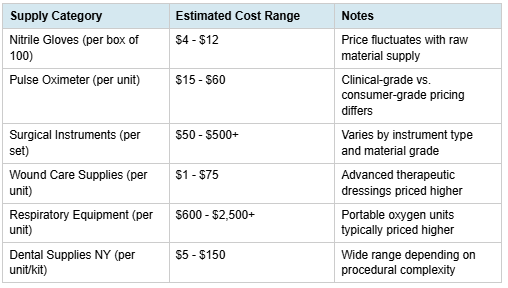
Sources: General wholesale medical supply pricing compiled from distributor catalogs and industry pricing data (2025-2026).
Why Borough-by-Borough Coverage Matters
New York’s senior population is not concentrated in one part of the region. Growth has occurred across all five boroughs, with the largest numerical increases over the past decade recorded in Manhattan, Queens, and the Bronx, followed closely by Brooklyn and Staten Island. This distribution means that a single centralized supply point cannot efficiently serve every clinic, home health agency, and care facility.
As a result, medical supply providers across the metropolitan area maintain a local presence to support faster access and reliable delivery. In healthcare logistics, last-mile delivery speed is critical, especially when a facility urgently needs supplies such as gloves, dressings, or monitoring equipment during ongoing operations.
A Hospital Supply Store with genuine multi-borough reach, rather than a single centralized warehouse serving the entire metro area, is generally better positioned to handle the kind of urgent, short-notice reorders that clinics and home health providers regularly face.
Finding the Right Supplier in a Growing Market
As demand continues to rise alongside the aging population, the question for most facilities is no longer whether to consolidate vendors, but which supplier can reliably cover the full range of categories without requiring separate relationships for each one. A medical supply store in New York that handles everything from durable medical equipment to pharmaceutical supplies under a single account simplifies sourcing considerably. HSS Medical Supply is a medical equipment supplier in NYC that serves clinics, home health agencies, and care facilities across the region’s growing healthcare sector.
What the Trend Line Suggests
New York’s senior population is not projected to plateau anytime soon, and the supply chain supporting senior and chronic care will need to keep pace accordingly. Facilities that build supplier relationships now, rather than scrambling reactively as demand continues climbing, will be in a far stronger position to keep serving patients without the gaps that strain both budgets and care quality.