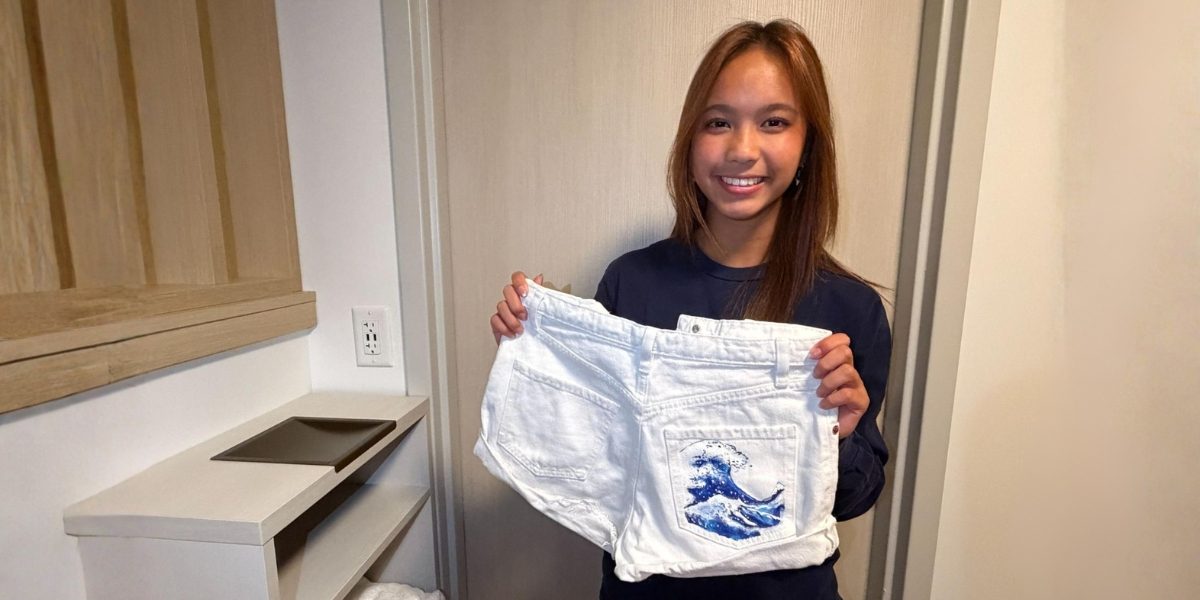

The first piece Joy Cheung painted was a birthday present for a friend. It was heartfelt, handmade, and by her own assessment, “kind of ugly.”
It was also the beginning.
The 16-year-old wanted to give her friend something that could not be ordered online. She had painted since childhood and spent years testing personal styles and saving visual references on Pinterest. A garment offered something a canvas did not: art that could enter somebody’s wardrobe and become part of how they presented themselves.
Soon, Cheung began wearing her painted jeans and hoodies around school. Classmates asked where she had bought them. When she explained that she had made them, requests followed. Joy Customs launched in September 2024, in response to what Joy found to be a “surprising” yet persistent demand.
Cheung does not reproduce designs. A garment may draw from more than 10 references, including album covers, Japanese floral art, architecture, color, and pattern. She sketches, paints, and heat-seals each piece herself. Larger designs can take up to six hours.
“I care about individuality and putting time into my designs more,” she says.
The choice limits scale, but Cheung accepts the trade-off. Fast fashion, in her view, multiplies the same object until both the garment and the wearer become interchangeable. Joy Customs works in the opposite direction. Every brushstroke remains hers, and every piece stands alone.
Her interest in clothing began as a question of self-expression. Growing up in Hong Kong with three brothers, Cheung spent much of her time outdoors and trained in badminton for 30 to 40 hours a week. Before moving to a boarding school in New Jersey, she had considered pursuing the sport professionally.
But she chose a different kind of freedom. In the United States, she had more room to explore interests beyond athletics, but also had to navigate the teenage tension between fitting in and remaining recognizable to herself. At a school where preppy clothing was common, her baggy jeans and streetwear stood out.
Fashion became one way to resist quietly. She took clothing that her customers had abandoned and gave them a new life. Seeing another student wear something she had painted felt significant because that person had also chosen to be different. And for Cheung, this was the whole point: with every brushstroke, in her own little way, reduce the cycle of waste that came with buying more.
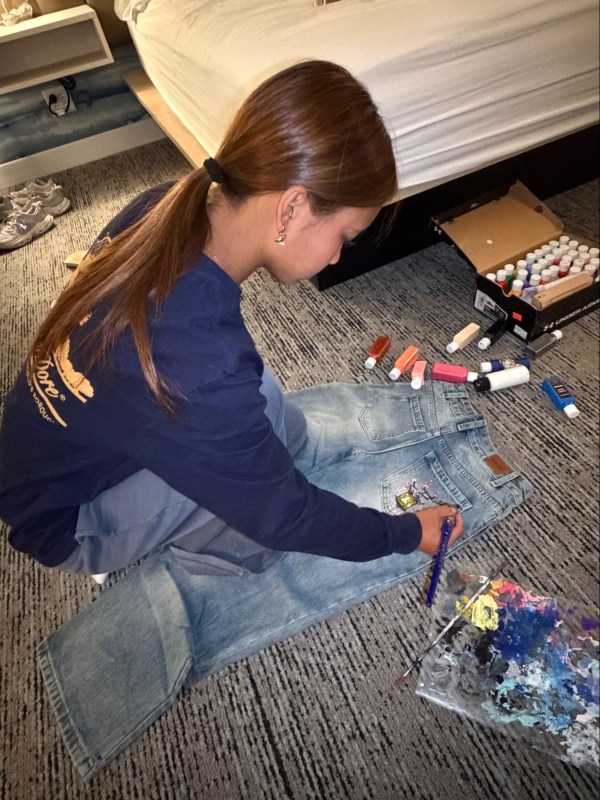
The project’s second half began in a thrift store. Cheung looked at racks of inexpensive clothing and saw pieces that might be chosen again if given a reason to stand out. She bought jeans, sweaters, and caps, redesigned them, then tried to donate them back.
The stores were not immediately receptive. Emails went unanswered, and several locations would not accept painted or unbranded clothing. Cheung spent two days walking around Hong Kong and speaking to shops before finding two that would take the garments.
In under two years, she has customized about 150 pieces. Roughly 50 were sold at affordable prices, while around 100 thrifted garments were redesigned and donated. Her Instagram posts have drawn more than 100,000 views. Redress, a Hong Kong environmental charity focused on textile waste, also amplified her work after accepting an Instagram collaboration request.
Fueled by her love for New York City’s vibrant second-hand market culture, Cheung is now looking forward to collaborating with thrift stores in the city, as she expands her work with Joy Customs.
Her interest in sustainability has since moved beyond clothing. At Jolab, a Taiwanese skincare manufacturer and research lab, Cheung completed two marketing internships. She contributed youth insights to a proposed collaboration between skincare brand TTM and Japanese hair-care company BOTANIST. Later, she helped create English-language social media content for a new scalp-care brand entering Western markets.
What stayed with her was not simply the branding work, but how Jolab’s founders treated their staff and maintained their environmental priorities. The experience offered a model of a company trying to grow without treating ethics as decoration, a principle she intends to emulate.
Cheung has also pursued an econometric study of carbon pricing across 219 countries and three decades. She learned coding and statistical methods intended to separate policy effects from factors such as income and global shocks. Her analysis found that carbon pricing reduced per capita emissions after accounting for those variables. With the paper completed, she is now working toward publication.
Painting a hoodie and analyzing international policy require different tools, but they begin with the same impatience. Cheung sees waste, asks whether the usual system works, and looks for something she can test herself.
For now, she plans to continue Joy Customs through college. Her ambition is concrete: to walk across a future campus and spot someone wearing a piece she painted.
That would mean a garment had stayed in use. It would also mean somebody had chosen not to look like everyone else.