
There is a particular kind of fear that belongs only to the twenty-first century. Not the fear of invasion. Not the fear of famine. Not even the fear of war. It is the fear that arises when the invisible systems beneath ordinary life suddenly stop working.
The phone displays No Service. The payment terminal fails. Flights are grounded. Information vanishes. The conveniences we rarely notice become conspicuous through their absence, and society learns how little distance separates routine from chaos.
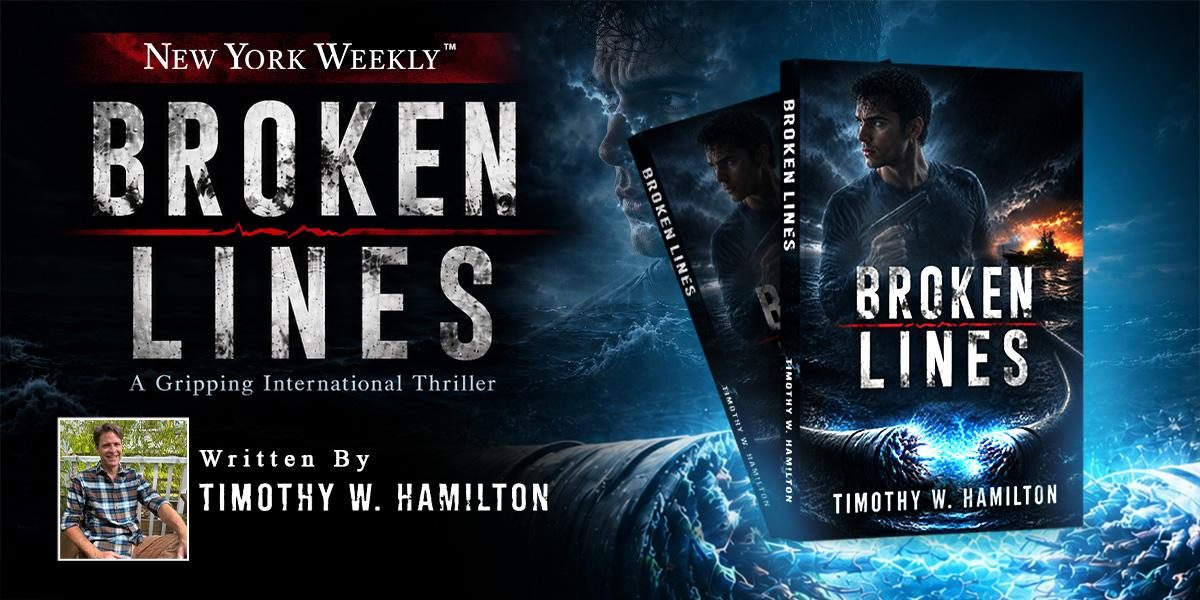
That unease sits at the center of Timothy W. Hamilton’s new thriller, BROKEN LINES. On its surface, the novel is a globe-spanning action narrative involving sabotage, international intrigue, hidden organizations, and a murder that propels an ordinary tradesman into extraordinary circumstances. Beneath the mechanics of the plot lies a more compelling question: What happens when modern civilization loses faith in the systems it built to protect itself? The novel arrives at a moment when that question feels less hypothetical than ever.
Fragility Beneath the Everyday
For generations, technological progress was sold as a story of increasing certainty. Each innovation promised greater stability. Faster communication. More reliable infrastructure. Better coordination. More security. Contemporary life often produces the opposite sensation. The more interconnected our world becomes, the more vulnerable it appears.
Timothy understands this paradox. His story begins not with explosions or espionage but with a communications failure. An undersea cable is severed. Networks collapse. Airports descend into confusion. People stare helplessly at phones that have become little more than illuminated paperweights. The choice is telling.
Most citizens rarely think about the infrastructure that allows modern society to function. Undersea cables, data centers, routing systems, satellite links, these are the unseen arteries of global civilization. They remain invisible until something disrupts them.
In that sense, BROKEN LINES belongs to a growing body of contemporary fiction fascinated by systemic vulnerability. The threat is no longer merely a hostile army approaching from across a border. It is disruption itself. A cut cable. A compromised network. A failed redundancy. A single fracture capable of rippling across continents.
New Hero of the Information Age
Perhaps the novel’s most interesting cultural observation lies in its protagonist. Carver Raines is not a billionaire genius. He is not a government super-agent. He is not a technological visionary. He is a tradesman. This choice feels significant.
For much of modern popular culture, expertise has been portrayed through digital fluency. The heroes of our stories increasingly manipulate code, algorithms, intelligence databases, and financial systems. The author moves in another direction. Carver comes from a world of physical work, practical knowledge, and tangible problem-solving. He understands tools, machinery, construction, and repair. He belongs to a class of workers often overlooked in discussions about innovation, despite building and maintaining the infrastructure upon which innovation depends.
As societies wrestle with automation, artificial intelligence, and economic uncertainty, the novel quietly restores value to forms of knowledge that cannot easily be outsourced to software. The message is not anti-technology. Rather, it suggests that when systems fail, human ingenuity remains the final redundancy.
Conspiracy and the Crisis of Trust
One cannot read BROKEN LINES without noticing its preoccupation with hidden power. Secretive organizations operate behind public institutions. Economic elites move through private channels. Information flows beyond the reach of ordinary citizens. Whether those suspicions are justified is almost beside the point. What matters is why such stories relate.
Across much of the world, public trust has eroded. Governments, corporations, media institutions, and international bodies all face growing skepticism. People increasingly suspect that important decisions occur elsewhere, beyond visibility and accountability. Thrillers have always reflected cultural anxieties, and this novel taps directly into this atmosphere. Its conspiracies feel compelling because they mirror a widespread contemporary feeling: that enormous forces shape our lives while remaining frustratingly out of view.
Age of Broken Lines
The title itself proves unexpectedly resonant. A broken line can represent a severed cable, a disrupted signal, a fractured relationship, a damaged institution, or a failed promise. Modern society seems crowded with such fractures.
Political polarization has broken lines of civic trust. Digital overload has broken lines of attention. Economic uncertainty has broken lines between effort and reward. Even personal relationships increasingly face interruptions created by screens, algorithms, and perpetual connectivity. The novel recognizes that these fractures are not merely technical failures. They are human ones.
The greatest tension is not whether communication networks can be restored. It is whether people can find their bearings when the systems they depend upon suddenly disappear. That question lingers long after the action moves forward. And in an era defined by uncertainty, it may be the most relevant thriller premise of all.