
By Edward DuCoin, Co-Founder of Orpical Technology Solutions & Professor at Montclair State University.
One of my students wrote me this at the end of last semester:
“You created a safe space for me to feel scared without judgment.”
It reads as a contradiction the first time through. A safe space in which you feel scared? But that phrase captures something the contemporary conversation about psychological safety, in classrooms and beyond, has nearly lost.
Amy Edmondson, who introduced the concept of psychological safety into organizational scholarship more than two decades ago, has spent recent years pushing back against how her term has been popularized. She never defined psychological safety as the absence of discomfort. She defined it as the shared belief that one can take an interpersonal risk; speak up, disagree, admit a mistake, without being humiliated. Discomfort and safety, in her framing, are not opposites. They are conditions that must coexist for learning to occur.
The popular conversation has flattened that idea in two opposite directions, and both are wrong.
One version, well-intentioned but often imported from human resources guidance, has reduced psychological safety to “do not make anyone uncomfortable.” Validate. Do not push. Do not put students on the spot. Anything that creates tension is presumed to harm. The underlying model is therapeutic.
The other version, usually voiced by leaders who pride themselves on candor, has rejected psychological safety as coddling. Hard feedback is good for you. Discomfort is the price of growth. If you cannot take it, you do not belong. The underlying model is pressure-testing.
In higher education, we have a version of this argument running on our own ground, in the long debate over trigger warnings, safe spaces, and the temperature of classroom discourse. The argument is usually staged as a choice: protect students or challenge them. What the staging misses is that the most useful classrooms do both at once.
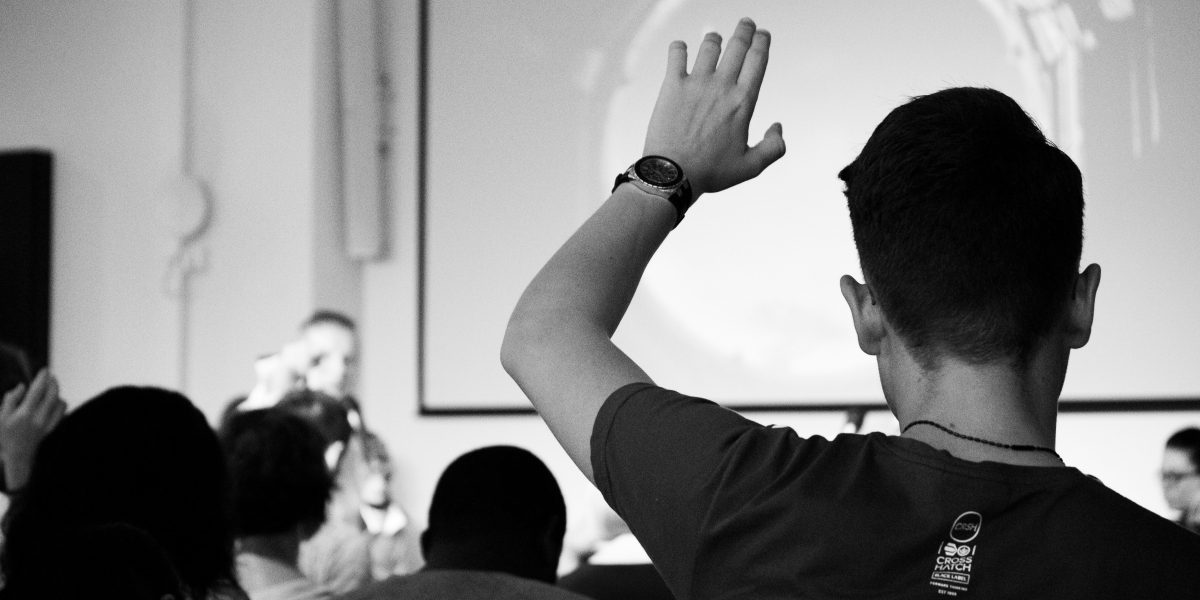
I teach undergraduate business classes at Montclair State University. Every semester, in their final reflections, students tell me what about the course shaped them, especially being called on, speaking up when they weren’t sure, and receiving feedback that initially stung. The pattern across many semesters is what the public discourse keeps missing.
Students do not grow in comfort. If nothing is at stake, if a student is never asked to take a risk, if they can coast through a semester without ever being called on, they preserve the version of themselves they walked in with. A class in which no one is ever uncomfortable is a class in which no one learns.
But students do not grow under pressure alone, either. Discomfort without safety does not produce growth. It produces compliance, mediocrity, and quiet withdrawal. Students who fear being mocked do not speak. They get smaller. They learn to predict what the instructor wants and offer it back, which is the opposite of intellectual courage.
What produces growth is the combination of discomfort and the credible signal that taking a shot and missing will not be punished. A student can speak and be wrong, and the cost of being wrong is bounded. They can ask the question that exposes them. My student described a safe space to feel scared because both conditions were present at once. Scared, because something was at stake. Safe, because the consequence of failing was not humiliation.
A “safe” classroom, by that definition, is not one in which no one is ever uncomfortable. It is one in which students are willing to be uncomfortable because they trust the discomfort will not be used against them. They speak in class because they have seen their peers speak without being punished. They disagree with the instructor because they have seen the instructor change their mind. They flag confusion because the class has met confusion with engagement rather than impatience.
The students who improved the most in my classes were not the ones I made comfortable. They were the ones who told me, in their reflections, that they had been afraid of being wrong and chose to speak anyway. One student wrote that she had spoken up and “ended up being wrong” many times across the semester, but had continued because she wanted to understand the material we were working through. Same fear other students felt; different response. What changed the response was not lower stakes; it was the sense that being wrong out loud does not result in humiliation and, in fact, results in admiration.
What It Requires From the Instructor
The hard part of safe discomfort, for anyone running a classroom, is that both halves must happen at once, and the two halves are in tension.
You must push. You must call on students who have not volunteered. You must give specific, direct feedback, the kind that does not emerge in a session designed to keep everyone comfortable. You must make it costly to coast. Without the push, safety becomes irrelevant because there is no risk to protect.
But you also must be the kind of instructor whose disapproval does not crush. That is the harder and less teachable half. You must be visibly fair. You must have a track record of not punishing students for being wrong. You must praise the risk, not only the right answer. When a student says something foolish, you cannot roll your eyes. When a student disagrees with you in front of the class, take this as a wonderful opportunity to show them that, as a teacher, you are consistently seeking new ideas. The other students are reading every signal and deciding whether the risk is, in fact, bounded.
An instructor who is good at only one half produces one of the two broken classrooms. All pushing yields a roomful of performers who say what they think the instructor wants to hear. All safety yields a roomful of students who never push themselves. The combination is harder and rarer than either piece, and it cannot be faked.
At the institutional level, higher education has drifted toward one pole or the other. Some campuses, under genuine pressure from concerns about student mental health, have absorbed the message that discomfort is a kind of harm. Others, in reaction, have absorbed the message that any accommodation of student vulnerability is academic decline. Both readings turn psychological safety into a slogan, and both produce classrooms worse than they need to be.
The middle is not a compromise between the poles. It is a different practice. It demands that we be more rigorous than the comfort school will allow and more humane than the candor school will admit. It demands that we push and be trustworthy at the same time.
It is, in short, a safe space to feel scared, which is exactly what my student named.
The conversation about psychological safety, on our campuses and elsewhere, would be more useful if it stopped treating safety as the absence of fear and started treating it as the presence of trust. Fear, in the right amount, is the engine of growth. Trust is what makes the fear survivable.
Edmondson named the condition. My student named the experience. Those of us in classrooms could stand to take both more seriously.
Edward DuCoin teaches business at Montclair State University and is co-founder of Orpical Technology Solutions. You can connect with him on LinkedIn.